How to Choose a Pickleball Paddle in 2026: Weight, Core, Shape & Grip
Table of Contents
I’m all too familiar with that overwhelming sense of jargon when you first open a shopping website or browse professional Pickleball gear websites (like Pickleball Central).
Polymer honeycomb core, Raw T700 carbon fiber, thermoformed, 16mm vs 13mm, swing weight, torque…
Admit it, it’s really a headache.
You might just want to buy a good pair of pickleball paddles to enjoy hitting the ball on a Sunday morning at your community court, work up a sweat, and make some friends, not to get a degree in materials physics. (However, if you do want to geek out on the science, check out our Pickleball Paddles Technology Comprehensive Analysis.)Looking at your $30 Pickleball paddle in your hand, and then at the $200 “miracle weapon” in the hands of your fellow players, you can’t help but wonder:
“Is there really a difference? Or is it just a waste of money?”
As a seasoned veteran in this industry and a professional enthusiast with an almost obsessive passion for equipment, I can confidently tell you: the differences are huge, but price doesn’t necessarily represent everything.
In the seemingly simple sport of pickleball, the racket in your hand is the only point of connection between you and the ball. It’s more than just a paddle; it’s an extension of your arm.
- A good pair of pickleball paddles can help you gently place the ball over the net as if you were holding it in your hand during intense dinking battles; they can also help you absorb powerful smashes from your opponent and protect your vulnerable elbows.
- A bad pair of pickleball paddles might cause the ball to inexplicably fly out of bounds when you intend to hit it straight; it could even cause annoying “pickleball elbow” due to excessive vibration.
Many beginners take the following detours: first, they buy a cheap fiberglass racket, play for two months and then feel it’s not good enough; then they follow the trend and buy a top brand racket, only to find it’s too stiff and uncontrollable; in the end, they have four or five rackets piled up at home, spending a lot of money but not improving their skills.
To help you avoid these pitfalls, we’ve compiled this “2026 Pickleball Paddle Ultimate Buying Guide.” This isn’t just a short buying guide ; it’s an in-depth white paper. We’ll strip away the fancy marketing jargon and guide you through six key dimensions, from microscopic material structure to macroscopic playing style, to help you find your perfect “sweetheart racket.”
1. Core Material: The “engine” of Pickleball Paddles
Although you can’t see the inside of the Pickleball Paddles , as they are completely encased in edge guards, the “core material” determines the feel, sound feedback, and energy transfer efficiency when hitting the ball. If you compare the Pickleball Paddles to a car, the surface is the tires, and the core material is the engine and chassis.
Polymer honeycomb core
Over 95% of mainstream pickleball paddles on the market (including major brands like Selkirk, Joola, and CRBN).
- what is it? It is made of polypropylene (PP) plastic. If you cut open a Pickleball Paddle , you will see that it is filled with a dense grid of hexagonal squares, just like a bee’s nest.
- Why is it hexagonal? Physics tells us that the hexagon is the most stable structure in nature. This structure can provide extremely high compressive strength while maintaining extremely light weight.
- What are its advantages?
- Shock Absorption: When a ball impacts the racket face at 60 km/h, the honeycomb structure undergoes minute deformations to absorb energy. This means less vibration is transmitted to your wrist.
- Quietness: Compared to earlier Nomex (a rigid material similar to Kevlar) or aluminum honeycomb, PP honeycomb produces a lower thud rather than a piercing ping. This is crucial in many noise-regulated community courts.
- Durability: Plastic honeycomb has excellent memory properties and is not easily collapsed even after long-term impact.
Avoid pitfalls: On the market, you can occasionally see Nomex Core (too hard and too noisy, like hitting a rock) or Aluminum Core (aluminum core, which is easy to control but can flatten the ball and cause dents).
My advice is simple: Unless you’re collecting antiques, go for “Polypropylene Honeycomb Core”. This is the absolute truth in 2026.To understand the physics behind why this material dominates, read our deep dive on the impact of Polymer Core on ball control.
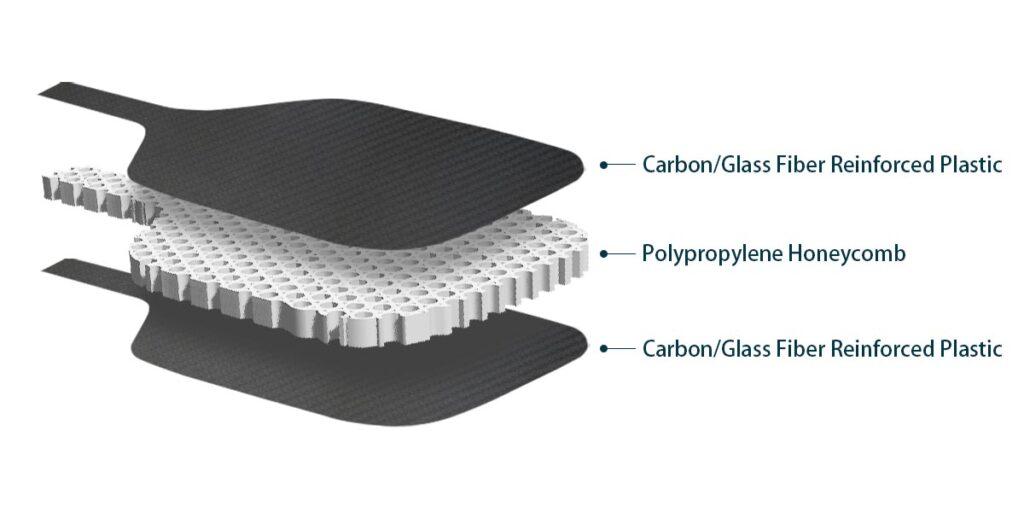
2. Surface Material: Determines rotation and force.
This is the part your hand can touch, and it’s where the racket and ball directly “bat.” The surface material directly determines two core parameters: spin and pop .
The market is currently divided into three main camps, but in the high-end sector, the winner has already been decided.
A. Carbon Fiber (Raw Carbon) – The Market Dominator in 2026
If you see a black Pickleball Paddle with a matte finish that feels like high-quality sandpaper, it’s most likely made of carbon fiber. The T700 Raw Carbon, in particular, is currently the standard equipment. Ever wondered why professional pickleball players favor carbon fiber paddles? It’s not just hype; it’s about performance advantages.
- Physical properties: Carbon fiber has extremely high stiffness.
- Real-world performance:
- Insane Spin: “Raw Carbon” means the carbon fiber weave is directly exposed on the surface, not covered by a thick layer of paint. This natural texture grips the smooth surface of the plastic ball like teeth. If you like to serve a shot that curves sharply after landing, or if you want to hit a topspin drop shot close to the net, carbon fiber is a must.
- Extra-large sweet spot: The rigidity of carbon fiber allows for more even power distribution, so even if you hit it off-target, the ball won’t fly around wildly.
- Precise control: It’s not like a spring, but more like a scalpel. It flies as far as you want it to go, with extremely high linearity.
B. Fiberglass (Composite) – A double-edged sword for “launch control”
This was the mainstream before carbon fiber became widespread. Now it’s commonly found on mid-range or entry-level pickleball paddles .
- Physical properties: The material is softer than carbon fiber and has flexibility.
- Real-world performance:
- Trampoline Effect: When a ball hits the racket face, the racket face slightly dents, propelling the ball forward. This provides tremendous explosive power (Pop).
- Disadvantages: This “bounce” is uncontrollable. For beginners, you might just want to gently block it, but the ball bounces directly off the baseline. Furthermore, the surface of fiberglass is usually quite smooth, making it far less capable of generating spin than carbon fiber.
- Lifespan issue: Over time, the glass fibers soften, causing “dead spots” to appear in the pickleball paddles .Still unsure between the two? Read our Carbon fiber vs. fiberglass Pickleball Paddle Beginner’s Guide to see which suits your court style.
C. Graphite
This was the king of the early days (think tennis rackets), but it was too thin for pickleball. Now it’s mainly used in some ultra-lightweight rackets. The feel is somewhere in between, but due to its mediocre durability, it’s gradually fading from the scene.
In-depth comparison and summary:
- Want the best control and spin? Choose Raw T700 carbon fiber. It’s the pinnacle of current technology.
- Want a cheaper price and faster ball speed (but not for control)? Choose fiberglass.
Expert Insider Tip: Many vendors will disguise “spray-grit” pickleball paddles as “carbon fiber texture.” Spray-grit paddles are initially stiff, but after a couple of months, the sanding wears off, leaving them smooth. Genuine T700 Raw Carbon paddles, however, have the texture woven into the fabric, making them virtually indestructible. When purchasing, always check for “Raw Carbon” or “T700” markings.
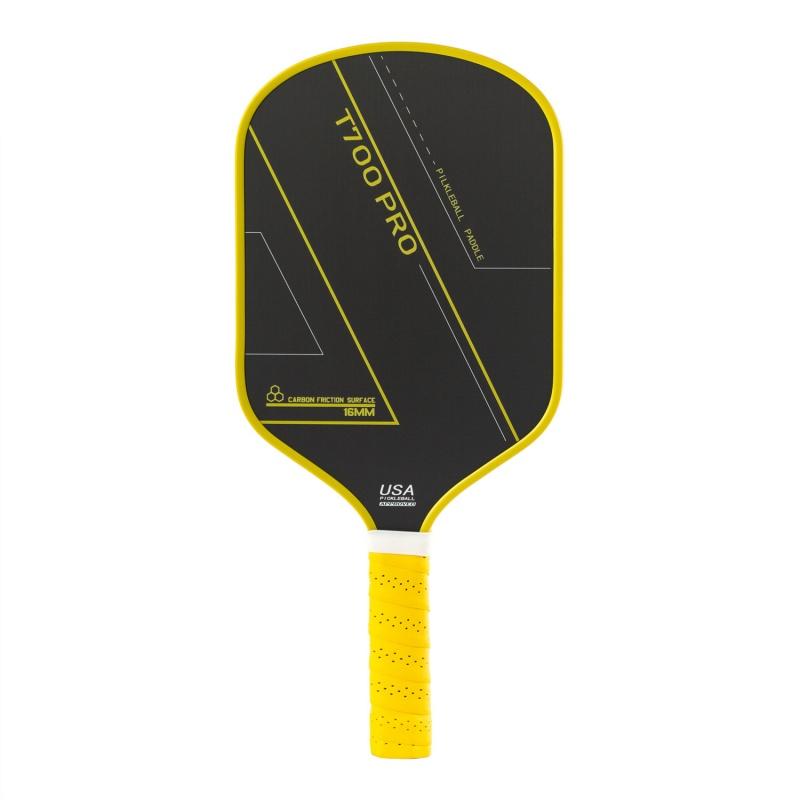
3. Thickness: 13mm or 16mm?
When you look at the detailed parameter table, you will find that most Pickleball Paddles come in two thicknesses: 13mm (or 14mm) and 16mm. Don’t underestimate this 3-millimeter difference; it has a revolutionary impact on the feel of the ball. This is often the biggest dividing line when making a purchase.
16mm (and above): The Control King
This is currently the most widely used specification in professional tournaments (PPA Tour), and it’s also the specification I most recommend to general players.
- Principle: The thicker the core, the stronger the shock absorption capacity, and the more energy is dispersed during the transmission process.
- Feel description: It feels like there’s a thin pillow on the racket face. The shot feels soft and solid.
- Practical advantages:
- Elbow protector: Vibration is a killer for your elbows. 16mm in diameter significantly filters out harmful vibrations, protecting your joints.
- Net Dominance: When dinking near the Kitchen line, you need “force absorption,” not “bounce.” 16mm helps you firmly “absorb” the ball and then precisely place it at your opponent’s feet.
- Forgiveness: Thicker cores provide better stability.
13mm (and below): The Power Hitter
- Principle: The thinner the core and the harder the racket face, the less energy is lost.
- Feel description: The shot is crisp, direct, and even a little jarring.
- Practical advantages: Fast ball speed! If you like to drive hard from the baseline, or if you are an offensive player who came from table tennis/tennis, you will love this crisp feedback.
- Cost: Smaller sweet spot, prone to mistakes when blocking, and requires high physical fitness.
Pitfall Avoidance Guide: If you are a beginner or unsure of your style, just go for 16mm. Why? Because in this sport, “avoiding mistakes” is far more important than “hitting hard.” 16mm allows you to return more balls, increasing the number of rallies, which is the key to improving your skills.
4. Weight and Swing Weight
Many people buy pickleball paddles based solely on their “static weight” (e.g., 8.0 oz), without fully understanding how the weight of the paddle affects power and ball control. However, “swing weight” is actually the real culprit in determining the feel.
The physics here is very simple:
Take a hammer. Swinging it by the handle versus swinging it by the head feels completely different, even though the weight is the same. The further out your center of gravity is, the more effort it takes to swing it, and the greater the inertia.
- Lightweight (7.3 – 7.6 oz):
- Suitable for: Female players with weak wrists, or elderly players with extremely slow reaction times.
- Disadvantages: When encountering a heavy ball, the racket will be “pushed” along by the ball, making it easy to flip the racket. You need to exert a lot of strength to grip it, which can easily lead to hand fatigue.
- Middleweight (7.7 – 8.2 oz) — Golden Range:
- This is the best choice for 90% of players. It achieves a perfect balance between flexibility (net play) and consistency (baseline drives).
- Heavyweight (8.3 oz+):
- Like Thor’s hammer. Once swung, it generates tremendous kinetic energy, sending the ball flying far with just a light touch. Singles players love it, but in doubles net play where you’re racing against time, you might find the racket feels like it’s made of lead.
This is professional test data, and the unit is $kg \cdot cm^2$.
- Below 110: Extremely fast and nimble, with unparalleled hand speed, but weak strength.
- 110 – 115: Perfect balance.
- Above 120: Power type, slow swing.
pickleball paddles with a static weight between 7.8 and 8.1 oz is the safest option.
5. Shape & Handle
Now that we have the material (T700) and thickness (16mm), the final step is to choose the “fit”. It’s like buying a suit; once you’ve chosen the fabric, you need to choose the cut.
Shape: Standard vs. Elongated
Standard/Wide Body: The aspect ratio is moderate (approximately 16″ x 8″.
- Advantages: Wide racket face with the largest sweet spot in both directions. It’s like holding a shield; it’s very difficult to miss a shot. Ideal for beginners to build confidence and for defensive players.
Elongated: The racket face is long and narrow (usually over 16.5″ in length).
- Advantages:
- Longer lever arm: The hitting point is farther from the hand, and the lever principle results in a more powerful smash.
- Coverage range: You can catch balls that are a little further away from your body.
- The trade-off: the racket face is narrower, and so is the sweet spot. You’ll need better ball control.
Handle length: an overlooked key factor
Long handle (5.5″ and above): Important note: If you are a tennis player accustomed to a two-handed backhand, this is essential. A short handle will force your second hand to grip only the throat of the racket, which is very uncomfortable.
Short handle (5.0″ – 5.25″): Suitable for table tennis grip, or for one-handed backhand players. It allows your fingers to be closer to the racket face, providing a more direct feel for the ball.
6. Real player feedback: Why did they replace their old rackets?
To verify the above theory, we interviewed several players at different stages to hear their real feelings.
Sarah (Level 3.5 player, formerly used fiberglass Pickleball Paddles ) : “I used to feel like my ball was flying everywhere, especially when receiving serves. Then my coach had me switch to a 16mm T700 carbon fiber racket. Wow, it feels like I had a braking system on the racket! Now I can confidently drop the ball at the net, and the ‘biting’ feeling is amazing.”
Mike (tennis switcher, 4.5 level player) : “I started with Pickleball Paddles with short handles , and I always felt constrained when using them for backhand power. After switching to Elongated with a 5.5-inch handle, I was finally able to generate power with my two-handed backhand. Moreover, the rigidity of the carbon fiber made my baseline shots deeper and with more spin.”
Linda (60+, recreational player) : “I have mild arthritis. The thin racket I used before made my hand hurt from the vibration. I took the advice and switched to a 16mm honeycomb core wide-body racket, and the vibration has really decreased a lot. Also, the sweet spot is much larger, so even if I don’t hit the center, the ball can still go over the net.”
Now, let’s look at you. Whether you are moving from Beginner to Tournament, our Pickleball Paddle Selection Guide will help you find your perfect partner.
7. Final Decision: Which type of player are you?
Don’t get overwhelmed by the parameters, just find the right one for you:
| Your portrait | Recommended configuration | Why? |
| Complete beginner/casual player | Widebody + 16mm + T700 | Since the T700 is already reasonably priced, why not go all in? The wide body and 16mm thickness will minimize mistakes and build confidence. |
| Advanced users/Tech enthusiasts | Standard + 16mm + T700 Raw Carbon | A versatile setup. Requires a rough texture for spin control and a 16mm lift for front-end control. |
| Offensive/Two-handed backhand | Elongated + 5.5″ handle | Unleash the power of your two-handed backhand and increase the lever arm to boost smash speed. |
Top rated Pickleball Paddles
-
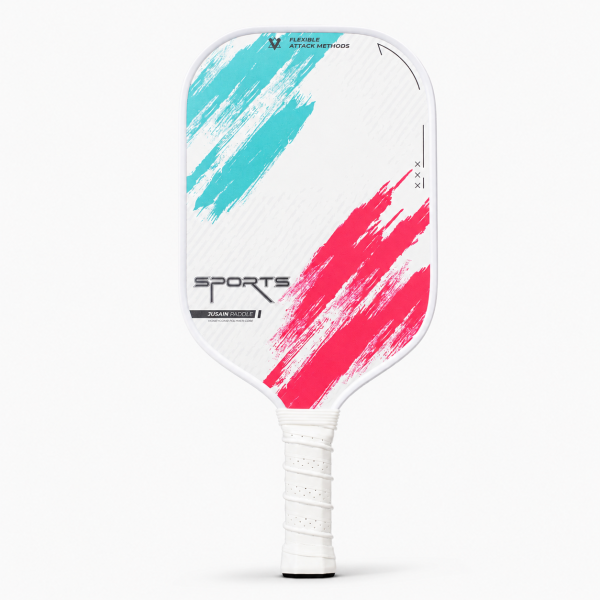
Fiberglass Pickleball Paddle – 16mm Attack, SPORTS Brushstroke Teal Pink Design
$17.99 -
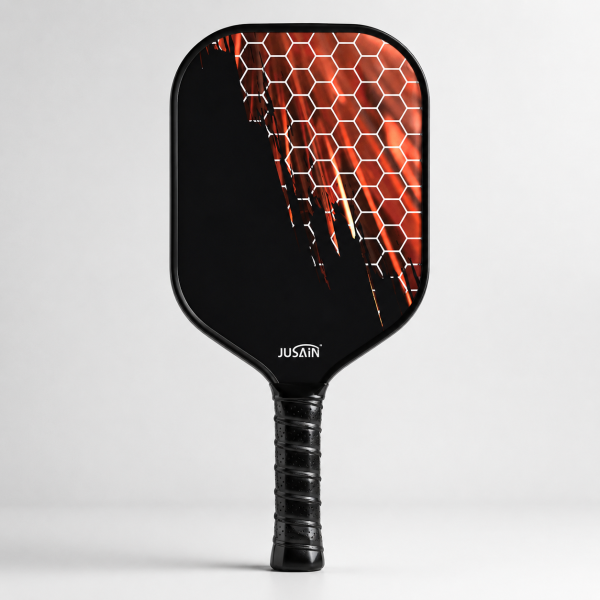
Fiberglass Pickleball Paddle – 13mm Defensive, Orange Honeycomb Fast-Swing JUSAIN
$17.99 -
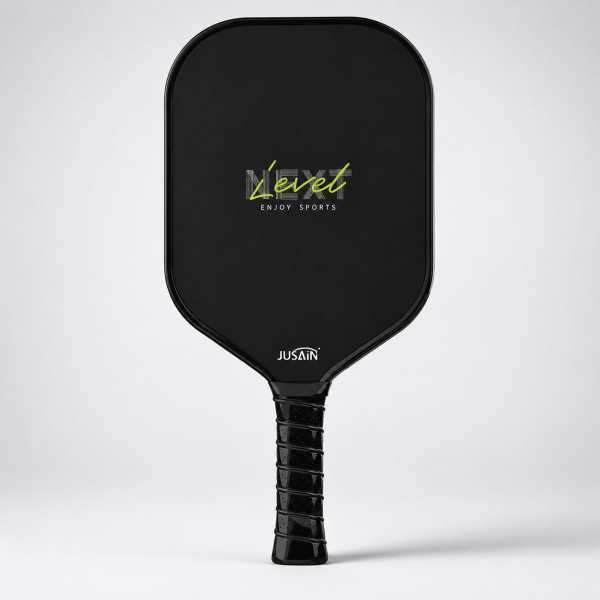
Fiberglass Pickleball Paddle – 16mm Defensive, NEXT Level All-Black Minimal Design
$17.99 -
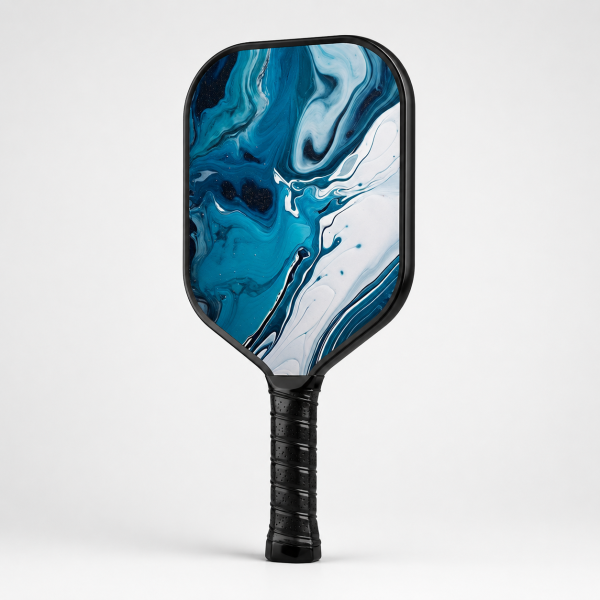
Fiberglass Pickleball Paddle – 16mm Defensive, Blue White Marble Fluid Art Design
$17.99 -
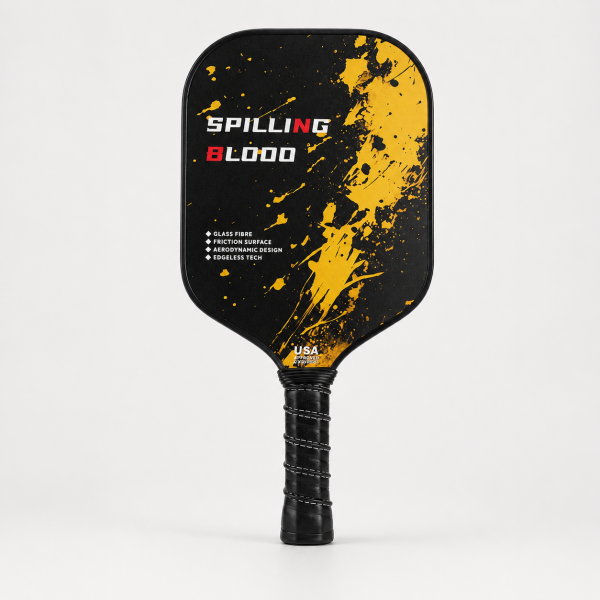
Fiberglass Pickleball Paddle – 16mm Defensive, Spilling Blood Gold Splatter, USA Approved
$17.99
8. Frequently Asked Questions (FAQ)
Q: Will carbon fiber rackets soften over time like fiberglass rackets?
A: Almost not. T700 carbon fiber is very stable. High-quality carbon fiber rackets can last 1-2 years without significant performance degradation, while fiberglass rackets may develop “dead spots” after 3-6 months.
Q: Are more expensive pickleball paddles always better?
A: Not necessarily. Many $200+ pickleball paddles use the same core materials (PP honeycomb + T700 carbon fiber) as some high-value brands costing $80-$100. You’re often paying for brand premium and advertising. Focus on materials and craftsmanship, not the price tag.
Q: What weight of pickleball paddles should I buy ?
A: For 90% of people, 7.8 oz – 8.2 oz is the ideal range. Too light and it’s easy to flip; too heavy and it can hurt your wrist. If you’re unsure, buy 8.0 oz. If you think it’s too light, you can add lead weights; if you think it’s too heavy, you can’t cut them off.
Q: How do I maintain my carbon fiber racket?
A: It’s simple. Buy a rubber eraser , wipe off any ball debris after playing, and it will restore friction. Try not to leave your pickleball paddles in the trunk of your car for extended periods in the summer, as the high temperatures may damage the glue structure.
In summary: Equipment is meant to help you enjoy the game more.
There is no such thing as the “best pickleball paddles in the world,” only the pickleball paddles that are “most suitable for your current stage . “
However, in 2026, the “T700 native carbon fiber + 16mm honeycomb core” will undoubtedly be the recognized gold standard. It balances spin, control, feel, and health. No matter what level of player you are, starting from this benchmark is the wisest choice.
Choosing equipment is essentially a process of understanding your own playing style. We suggest that if you have the opportunity, go to a local court and borrow a racket from a fellow player to try it out (demo), feel the “muffled” sound of the 16mm shock absorber, and feel the roughness of your fingers gliding over the T700 carbon fiber.
Ready to say goodbye to “blind selection” and choose your weapon?
Further Reading:
“2026 Pickleball Paddle Buying Guide: Why is T700 Carbon Fiber + 16mm Your Optimal Solution?“
“Bought a new paddle? Learn how to make it last longer in our [Pickleball Paddles Maintenance Guide ].”
Quick Pickleball Paddle Decision Table
If you are choosing a paddle in 2026, start with the playing problem you want to solve, not the brand name. Use this quick table before comparing models.
| Buyer Type | Choose This | Why |
|---|---|---|
| Beginner | 16mm fiberglass or value carbon paddle | Easier control and lower cost while you learn feel and placement. |
| Power player | 13mm or elongated paddle | Faster response and more drive when you already control the ball. |
| Control player | 16mm widebody paddle | More stable contact and a more forgiving feel. |
| Spin-focused player | Raw carbon or textured carbon face | Better surface grip when the face and core are built correctly. |
| Tennis elbow concern | 16mm lower-vibration paddle | A softer feel may be more comfortable, but it is not medical treatment. |
Specs to Compare Before You Buy
- Paddle weight
- 13mm vs 16mm core
- Fiberglass vs carbon fiber
- Paddle shape
- Grip size
- Beginner vs intermediate choices
- What to avoid before checkout
Next steps: compare the best pickleball paddles 2026, read the carbon fiber vs fiberglass pickleball paddles guide, and check best pickleball paddles under $100 if value is the main constraint.

About Jason Simmons
Jason S. Simmons has been obsessively dissecting racket sports equipment for over a decade. After transitioning from competitive tennis to Pickleball in 2020, Jason realized the market was flooded with confusing marketing jargon and overpriced gear.
His Mission: To help players—especially seniors and those recovering from Lateral Epicondylitis (Tennis Elbow)—find the perfect paddle setup that balances power, control, and health.
Why Trust Jason?
- Material Science Geek: He doesn't just play; he analyzes. From the weave patterns of Toray T700 Raw Carbon Fiber to the density of Polypropylene Honeycomb Cores, Jason understands the physics behind the "pop."
- Data-Driven Testing: Jason has play-tested over 50+ models, evaluating them on Swing Weight, Twist Weight, and Dwell Time rather than just subjective "feel."
- On the Court: Based in the US, Jason actively competes in regional 4.5+ level leagues. When he isn't drilling his third-shot drops, he is likely inspecting paddles for Core Crushing or Delamination issues.
Jason believes that "A dead paddle kills your game," and is dedicated to teaching players how to maintain their grit surface for peak performance.
View all posts by Jason Simmons