Pickleball Paddle “Core” Mechanism: The Impact of Polymer Core on Ball Control – A Must-Read for Hardcore Players!
I. Honestly, do you really understand the “core” inside your racket?
Hey guys! Let’s have a heart-to-heart talk.
Have you been feeling a bit off when playing basketball lately? Even though your movements are precise, the ball just won’t cooperate. Or, when you’re preparing to upgrade your gear, you open a webpage only to find a screen full of… Pickleball Paddles is bombarded with all sorts of “core technology” terms—polymers, honeycomb structures, Nomex—making its head ache.
Especially that much-hyped “polymer core providing ultimate ball control,” it sounds very high-tech, but what exactly is it? Is it a scam or the real deal?
Hold on, we’re not going to go through those fancy textbook definitions today. As a long-time friend who’s been in this circle for years, I’ll take you behind the scenes of the Pickleball Paddle to see what’s really going on inside. We’ll start with the most basic logic and help you completely understand the secrets of this “core” device. After reading this, the next time you talk about equipment with your fellow players, you’ll be a knowledgeable, hardcore player who can talk a good game, not just someone who can swing a racket.
II. Unveiling the “Polymer Core”: What does this thing actually look like?
To understand this thing, we need to remove its veil of mystery. To be honest, it’s not that mysterious, but it certainly contains a lot of knowledge.
2.1 The Polymer Family: More Than Just Plastics
First, let’s clarify a concept—polymer. In the world of Pickleball Paddle , when we talk about polymers, 90% of the time we’re actually talking about polypropylene (PP) .
What is polypropylene (PP)? Simply put, it’s a thermoplastic resin. It has very distinct characteristics: good toughness, durability, lightweight , and a uniquely soft feel. This is why manufacturers love using it—it absorbs energy and provides shock absorption.
Other “relatives”: You might occasionally hear about polyethylene (PE) . It’s softer and more elastic than PP, but it’s like needing both softness and strength; PE is slightly less durable. So, the racket you’re holding right now is most likely still made with a PP core.
Why do people (including myself) prefer polymers? Because they strike a perfect balance: they’re lightweight yet retain their structure even after thousands of powerful smashes. Most importantly, their elasticity is the source of ball control.
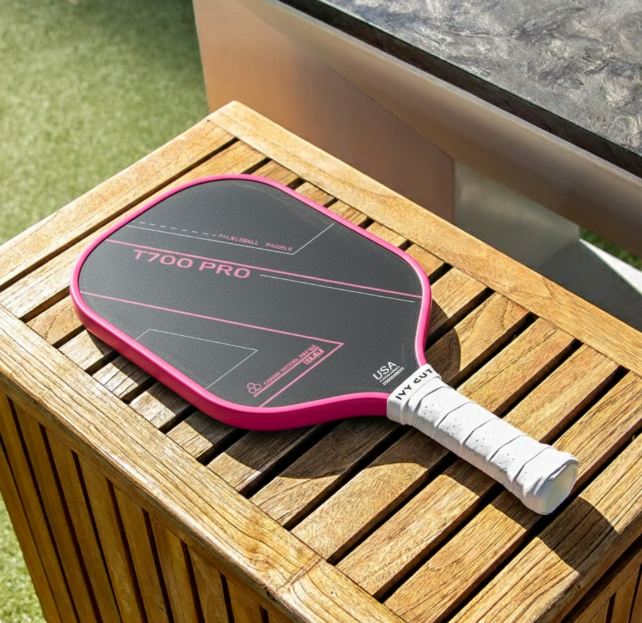
2.2 Core Structure: Micromechanics within a Honeycomb
Choosing the right materials is only the first step; the structure is the soul. Have you ever cut open a pickleball paddle ? Its interior actually looks like a bee’s nest, which is the famous honeycomb structure .
This design isn’t just for aesthetics (you can’t see it anyway). It’s actually a testament to sophisticated engineering ingenuity:
Lightweight: Using the least amount of material to achieve the greatest strength.
Energy Absorption Master: The cavities inside the honeycomb act like tiny airbags. When the ball hits, they absorb and disperse the energy. What does this mean? It means your racket can withstand heavy impacts, and the vibration won’t all travel down the handle to your hand.
Here’s a detail that only experienced users would understand: the size of the honeycomb is important.
Large Cell: Larger mesh, lighter weight, and greater elasticity. It feels like the ball stays on the racket a little longer when you hit it.
Small Cell: The mesh is denser, giving it a more solid feel and a slightly muffled sound. Power transmission is more direct, making it suitable for those who prefer a straightforward, hard-hitting sound.
2.3 The Birth of the “Core”: Manufacturing Process Determines the Lower Limit
Where does this honeycomb panel come from? It’s usually produced through injection molding or hot pressing. But just like cooking, the same ingredients can produce different flavors depending on the chef. Strict quality control ensures consistent density within the core, which directly determines whether your pickleball paddle will last three years or develop “dead spots” after only three months.
III. The core secret to ball control: How does polymer allow you to “shoot exactly where you point”?
Alright, that concludes the theory lesson. Now let’s get practical—how exactly does this plastic board help me win? That’s what we spec-obsessed folks care about most.
3.1 Dwell Time: The brief “embrace” between the racket and the ball.
You may have heard the term: Dwell Time .
Frankly, this is the soul of ball control. It refers to the instant the ball hits the racket face, sinks in, and bounces back. For the polymer core, because it is resilient, when the ball hits it, the honeycomb structure undergoes a tiny deformation—like a miniature trampoline.
This deformation process forces the ball to remain on the racket face for a fraction of a millisecond longer.
Don’t underestimate this seemingly insignificant moment! For experts, it makes all the difference. The longer you hold the ball, the stronger your “feel” for it. It’s as if you’re catching the ball with your hand and throwing it, allowing for precise control over the landing point. Moreover, this is the golden time to generate spin—the longer the contact time, the more friction, and the more spin the slice.
3.2 Shock Absorption and Feedback: The Mystery of Feel
Ball control is not just about physics, but also about psychology. If your hand goes numb from hitting the ball, how can you possibly think about where it will land?
Shock absorber: The polymer core acts like a sponge between you and the ball. It filters out those annoying high-frequency vibrations, protecting your wrists and elbows.
But it can’t be all cotton: A good pickleball paddle must retain “road feel.” If there’s no vibration at all, it’s called “wood,” and you won’t feel the weight of the ball. The beauty of polymers is that while they absorb shock, they still provide feedback on the impact force of the ball. This is the “clear feedback on the hit” we need.
3.3 Sweet Spot Optimization: A Lifeline
We’re not robots; we can’t hit the exact center every time. This is where the advantage of polymer honeycomb structures comes in. They can evenly distribute the impact force.
The result is that the sweet spot has become larger.
Even if your shot is slightly off-target, the polymer core still provides good elasticity and feedback, ensuring the ball still clears the net instead of hitting it directly or going out of bounds. For amateur players, this is called “high tolerance for error.” For advanced players, it means they can still save high-quality shots even in extremely passive situations.
3.4 Hearing and Touch: It’s a “high-end” feeling
Besides performance, user experience is also important.
Sound: Polymer cores typically produce a deep, muffled “plop” or “bang.” In contrast, the sharp “snap” of Nomex cores can sometimes be quite jarring. This deep sound has now almost become a hallmark of high-end rackets.
Feel: If I had to describe it in one word, it would be “soft and bouncy”. It is supportive without being stiff.
IV. Horizontal Comparison: You won’t know until you compare, and the difference will be astonishing.
Without comparison, there is no harm. To help you better understand the status of the polymer core, let’s take it to the ring and compare it with the other two contenders.
4.1 Polymer vs. Nomex Core (Representative of the Tough Guy)
Nomex is an aramid fiber paper, which you can think of as an ultra-hard cardboard impregnated with resin.
Feel: Nomex is extremely hard. Hitting it feels like hitting a rock.
Ball control: Because it is too hard, the ball bounces away as soon as it is touched, the time spent holding the ball is extremely short, and the ball control is very difficult.
Advantages: High power, fast ball speed, loud (even piercing) sound. It used to be popular with old-school power players, but it’s somewhat outdated now.
4.2 Polymer vs. Aluminum Core (Lightweight Choice)
This is an early technique, and now it’s basically only found on beginner rackets or oddly shaped rackets.
Feel: Aluminum is very light, but relatively soft and easily dented.
Disadvantages: The vibration is quite strong, and it’s easily deformed by bumps and knocks, making durability a major issue. It’s no longer a mainstream choice.
To summarize briefly (pay attention):
| characteristic | Polymer core (PP) | Nomex Core | aluminum core |
| ball control | King-level (long ball handling, large sweet spot) | Difficult (the ball is too bouncy) | generally |
| strength | Moderate and balanced | violent output | Moderate |
| damping | Comfortable and hand-protecting | Shaking hands | It was quite shocking. |
| sound | Deep and pleasant to listen to | Exploding loudly | crisp |
| Durability | Durable and robust | Easily cracked | Easy to dent |
V. How to Choose Your “Core”? Advice from an Experienced Driver
pickleball paddle should you buy ? Don’t worry about it, just choose according to your playing style.For a curated list of the best paddles matching these specific styles, check out our [2026 Pickleball Paddle Ultimate Buying Guide: Material, Specifications, and Playing Techniques Explained]
5.1 Dinking, Drop Shots Players
If you enjoy playing strategically at the net, like slice shots and drop shots, and strive for ultimate control over the landing point.
Take my advice: blindly choose polymer cores.
Key point: You need those extra fractions of a second to hold the ball and “chop” it. Find a polymer racket that’s a little thicker (like 16mm); the feel is amazing.
5.2 Bangers
“I’m going to use brute force; isn’t the polymer too soft?”
No: pure brute force is outdated. Modern power-based fighting styles also require control.
How to choose: Look for a polymer racket with a higher core density or a slightly thinner thickness (such as 13mm-14mm). Pair it with a carbon fiber or fiberglass head, and you’ll have more than enough power, and you won’t be hitting the ball to the other court.
5.3 All-rounder
If you want to handle both offense and defense.
The middle way: Choose a polymer racket of medium thickness. It will give you balanced feedback—both defensively and offensively.
VI. Maintenance and Care: Ensuring your camera lasts for many more years.
Although the polymer core is very robust, it can’t withstand being messed with.
Don’t treat it like a barbecue: Don’t leave your racket in a car under the blazing sun in the summer. High temperatures can soften the polymer and even cause it to delaminate.
Don’t smash your racket: Don’t take your anger out on your racket after losing. Although the core is durable, the frame can still crack under stress.
Signs that your pickleball needs replacing: If you notice a noticeable dent on the racket face, or if the tapping sound becomes a hollow “plastic” sound, or if you feel that the sweet spot has mysteriously disappeared—that means the core has collapsed and it’s time to replace the pickleball paddle .
VII. Peakball Community Q&A: People are asking…
In this section, I’ve compiled some frequently asked questions on the court, and we’ll give them a simple and straightforward answer.
Q1: How long can a polymer core racket last?
A: To be honest, the core itself rarely breaks. Usually, you’ll break the racket face first, or damage the edge guards, but the core will still be fine. With normal use, it should last two or three years without any problems.
Q2: Since polymers are so good, why do some people still miss Nomex?
A: Passion, coupled with extreme power. Some people enjoy the exhilarating feeling of the ball bouncing off the racket with a “thud” before it even really touches the racket face. But for most modern players, that kind of margin for error is too low.
Q3: Does thickness matter? Is there a big difference between a 13mm and a 16mm polymer core?
A: The difference is huge! It’s like sleeping on a firm mattress versus a soft mattress. A 16mm (thick) mattress absorbs shock better, provides more stable ball control, and is suitable for net play; a 13mm (thin) mattress produces a crisper shot, suitable for baseline drives. Beginners are advised to start with the thicker one.
VIII. Conclusion: Understanding the “chip” is key to playing well.
That’s all for today’s hardcore science lesson.
Hopefully, this long article hasn’t confused you. Remember, the polymer core of the Pickleball Paddle isn’t just a piece of plastic; it’s an extension of your feel and the foundation of your ball control. No matter how much the advertising hype goes, the best product is the one that suits your playing style.
Before your next match, touch your racket and feel its “core.” If you understand it, it will reward you on the court.
Alright, guys, grab your gear, see you on the court!

About Jason Simmons
Jason S. Simmons has been obsessively dissecting racket sports equipment for over a decade. After transitioning from competitive tennis to Pickleball in 2020, Jason realized the market was flooded with confusing marketing jargon and overpriced gear.
His Mission: To help players—especially seniors and those recovering from Lateral Epicondylitis (Tennis Elbow)—find the perfect paddle setup that balances power, control, and health.
Why Trust Jason?
- Material Science Geek: He doesn't just play; he analyzes. From the weave patterns of Toray T700 Raw Carbon Fiber to the density of Polypropylene Honeycomb Cores, Jason understands the physics behind the "pop."
- Data-Driven Testing: Jason has play-tested over 50+ models, evaluating them on Swing Weight, Twist Weight, and Dwell Time rather than just subjective "feel."
- On the Court: Based in the US, Jason actively competes in regional 4.5+ level leagues. When he isn't drilling his third-shot drops, he is likely inspecting paddles for Core Crushing or Delamination issues.
Jason believes that "A dead paddle kills your game," and is dedicated to teaching players how to maintain their grit surface for peak performance.
View all posts by Jason Simmons