Pickleball Paddle Selection Guide: From Beginner to Tournament, Find Your Perfect Partner!
Hey Padel lovers!
When you stand in front of a rack filled with all kinds of pickleball paddles in a sports arena or browse through various parameters and advertisements on a website, do you often find yourself in this dilemma?
“Round, diamond, or teardrop shape? Which one is right for me?”
“Is this racket too heavy?”
“Will a stiff core make it difficult to control the ball?”
Don’t worry, you’re not alone. In fact, choosing the right pickleball paddle requires more strategy and understanding than choosing shoes, jerseys, or even the ball itself.
Today, we’ll chat like old friends about the sport, helping you develop a complete racket selection logic from beginner to tournament player. Because the right pickleball paddle is more than just changing tools; it can give you a qualitative leap in control, power, and feel—it’s your “court partner,” your “secret weapon.”
Whether you’re a complete beginner or a professional player striving for the ultimate competitive experience, this guide will help you find the perfect pickleball paddle.
Quick Navigation
1. Quick Overview of Pickleball Paddle Basics: Understand “It” Before Choosing a Paddle
Before delving into how players of different skill levels should choose their rackets, let’s quickly understand the core components of the pickleball paddle. Remember: Know yourself and know your enemy, and you will never be defeated.
1.1 Core Components: Shape, Weight, Balance Point, Core, Surface Material, Grip
- Shape
- Round: Largest sweet spot, balance point close to the grip, optimal ball control. Suitable for beginners or players who focus on defense.
- Teardrop shape: Centered sweet spot, balancing power and control. Suitable for advanced players.
- Diamond: Located in the upper part of the sweet spot, it offers the greatest power output and is suitable for offensive or advanced players.
- Weight
- Lightweight: Flexible swing, suitable for players with insufficient ball control or wrist strength.
- Heavyweight: High strength and stability, but requires high physical fitness and technical skills.
- Balance Point
- Low balance (grip-dependent): Good ball control, easy swing.
- Balance: Balancing strength and control.
- High balance (relying on the racket head): powerful, but requires more effort to swing.
- Core
- Soft-core EVA/foam: good shock absorption, soft feel, and excellent ball control, but weak power transfer.
- Medium core: Balancing feel and power.
- The core elements are direct power and clear shot execution, but they require solid technique.
- Face Material
- Fiberglass: Flexible, high tolerance for error, and provides a soft impact.
- Carbon fiber: High stiffness, direct power transfer, and clear feedback on impact. The higher the K number, the finer the fiber, and the stronger the stiffness and power.
- Grip
- Length, thickness, and material all affect grip comfort and swing stability.
1.2 Understanding how these parameters affect your performance
With every swing, you’re interacting with the parameters of the pickleball paddle:
- Lightweight, round, and soft core → Like a gentle hand, it “sends” the ball over, offering high tolerance for error.
- Heavy Diamond’s core → Like a heavy hammer, it has explosive power and is suitable for an offensive playstyle.
Choosing a racket isn’t about blindly following trends but about finding a parameter combination that matches your playing style and skills.
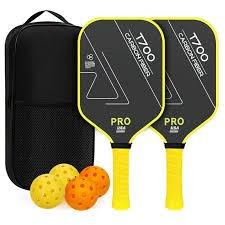
2. Beginner: Easy to learn and fall in love with Padel
Are you a beginner experiencing inconsistent ball control, fatigue, and unfamiliarity with power generation? No problem, this is precisely the most crucial period for choosing a racket.
2.1 Pain Points for Beginners
- I keep missing the sweet spot; my touch is stiff.
- The ball floats, often going out of bounds or into the net.
- My arms ache after swinging them a few times.
- If you can’t muster the strength, you can’t hit the ball far.
2.2 Keywords
High fault tolerance, easy to operate, comfortable
2.3 Recommended Pickleball Paddle Features
| Feature | Recommendation |
| Weight | Lightweight 340-360g |
| Shape | Circular |
| Core | Soft kernel EVA/Foam |
| Surface | Fiberglass |
Tip: Don’t pursue brute force; ball control and consistency are the keys to success for beginners!
3. Intermediate Player: Balanced offense and defense, exploration-oriented.
After mastering the basics, you want to improve your power without sacrificing ball control, so you start to develop your own playing style.
3.1 Advanced Pain Points
- The defense is solid, but the offense lacks penetration.
- I hope to try complex tactics such as slices and lobs.
- Dissatisfied with the feel of the current racket.
- Start exploring your own playing style preferences.
3.2 Keywords
Balance, strength, and control
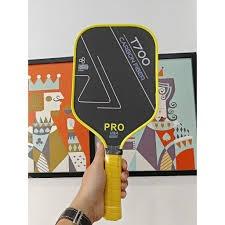
3.3 Recommended Pickleball Paddle Features
| Feature | Recommendation |
| Weight | Medium 360-375g |
| Shape | Teardrop/Hybrid |
| Core | Medium-hardness EVA |
| Surface | Carbon fiber or glass fiber/carbon fiber blend |
A friend’s advice: Try different playing styles and gradually find your preferred balance between offense and defense.
4. Advanced Players: Exquisite control, established style
With solid technical skills and the ability to employ tactics, you need a pickleball paddle to provide ultimate control and explosive power.
4.1 Advanced Pain Points
- Precise landing point control.
- High demand for explosive power.
- Sensitive to feedback from the shot.
- Pursuing to enhance individual playstyle.
4.2 Keywords
Precision, Explosiveness, Personalization, Feel
4.3 Recommended Pickleball Paddle Features
| Feature | Recommendation |
| Weight | 370-385g |
| Shape | Diamond / High-balanced circle |
| Core | Hard EVA |
| Surface | 12K or 18K carbon fiber |
a pickleball paddle that enhances your strengths or compensates for your weaknesses, making you one with the racket.
5. Tournament Players: Professionally Customized, Meticulous in Every Detail
At the pinnacle of competition, every gram of weight and every millimeter of balance on the pickleball paddle can affect the game.
5.1 Pain Points of the Competition
- Pursuing performance consistency.
- High strength and durability.
- Fine-tune features to adapt to different scenarios.
- Pay attention to every detail.
5.2 Keywords
Competition, Stability, Durability, Customization
5.3 Recommended Pickleball Paddle Features
| Feature | Recommendation |
| Weight | 375 g or more, adjustable with counterweights. |
| Shape | Power-oriented high-balanced diamond / Control-oriented high-balanced round |
| Core | Hard EVA |
| Surface | 18K/24K or Textreme carbon fiber |
5.4 Points to Note When Selecting a Photo for the Competition
- Communicate with the coach to ensure the racket suits your playing style.
- Considering sponsor requirements.
- Ensure that the backup racket has the same performance as the main racket.
6. Additional Notes on Shooting Selection
- Grip size: affects comfort and ball control.
- Budget: Live within your means; what suits you best is most important.
- Test Play Experience: Hands-on Testing is Key.
- Brand and Reputation: Big Brands Are More Reliable.
- Maintenance: Replace grip rubber regularly and avoid direct sunlight.
7. Summary: Your Pickleball Paddle, Your Style
Remember:
There is no best pickleball paddle, only the pickleball paddle that best suits your needs.
It should be as natural as an arm, as harmonious as a shadow, helping you perform at your best.
Be brave and try; find your “secret weapon” and make the court your stage!
Will the pickleball paddle be your next one? Feel free to share your stories and experiences in the comments section; let’s enjoy the fun of Padel together!
Start your pickleball paddle career here by choosing your partner!

About Jason Simmons
Jason S. Simmons has been obsessively dissecting racket sports equipment for over a decade. After transitioning from competitive tennis to Pickleball in 2020, Jason realized the market was flooded with confusing marketing jargon and overpriced gear.
His Mission: To help players—especially seniors and those recovering from Lateral Epicondylitis (Tennis Elbow)—find the perfect paddle setup that balances power, control, and health.
Why Trust Jason?
- Material Science Geek: He doesn't just play; he analyzes. From the weave patterns of Toray T700 Raw Carbon Fiber to the density of Polypropylene Honeycomb Cores, Jason understands the physics behind the "pop."
- Data-Driven Testing: Jason has play-tested over 50+ models, evaluating them on Swing Weight, Twist Weight, and Dwell Time rather than just subjective "feel."
- On the Court: Based in the US, Jason actively competes in regional 4.5+ level leagues. When he isn't drilling his third-shot drops, he is likely inspecting paddles for Core Crushing or Delamination issues.
Jason believes that "A dead paddle kills your game," and is dedicated to teaching players how to maintain their grit surface for peak performance.
View all posts by Jason Simmons