Pickleball Paddles: How does the weight of the paddle affect your power and ball control?
I. Introduction: Weight is never a “feeling issue.”
If you spend enough time on the court, you’ve probably heard discussions like, “This racket feels good,” “I prefer a lighter one,” “A heavier racket has more power,” and so on. But if you’re a data-driven player who likes to study the underlying logic of equipment, you’ll know that the weight difference of pickleball paddles is not some kind of mystery.
Even a change of just 0.1 oz can have an impact on:
Power output
Ball control consistency
Scope of application of sweet spot
Swingweight
arm fatigue
Even the risk of injury after long-term competition
So here’s the question: How does the weight of the paddle affect your power and ball control?
This is the most frequently asked question by competitive players, but it’s also the most easily misunderstood.
To make this article not only “easy to read” but also “easy to use,” I’ll incorporate some insights from real players, the principles of physics, and my own observations from testing the paddles on the court. After all, pickleball paddles aren’t cold, impersonal lab equipment; they’re real weapons in your hands, used in actual combat.
Let’s break down the weight parameter and see the science and real-world experience behind it.
II. Classification and Definition of Pickleball Paddles Weight
(Lightweight | Mid-weight | Heavyweight)
To accurately analyze how paddle weight affects power and control, we’ll first define the mainstream weight ranges in the market. These classifications are not absolute, but they are sufficient for most players to quickly identify their preferred weight range.
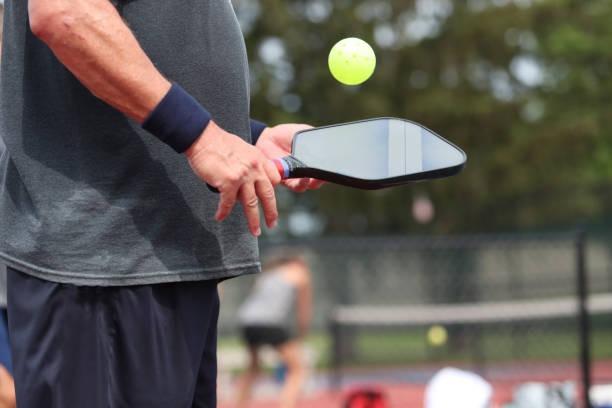
2.1 Lightweight Pickleball Paddles
7.0–7.7 oz (approximately 198–218 g)
Typical features:
High swing speed: low inertia → high acceleration
Quick reflexes: easier net play and quick change of direction
A dynamic, rhythmic style: suitable for players who enjoy constantly adjusting the racket angle and playing with rhythmic variations.
advantage:
Less strain on the arms
High flexibility
It’s easier to do touch shots, dips, cuts, and drops.
shortcoming:
Limited power reserves
They are easily “shaken away” when hitting heavy balls.
The stability is weaker than that of a double shot.
A light tap is more like a “small dagger” on the court—quick and agile, but not the kind of heavy weapon that can kill in one strike.
2.2 Mid-weight Pickleball Paddles
7.8–8.4 oz (approximately 221–238 g)
This is the weight range with the largest market share, and it is also the “golden weight” recommended by most coaches.
Features:
The sweet spot of power and control
It is suitable for a wide range of people (beginners, intermediate learners, and even most competition participants).
Both light and heavy weights can be used, with proper balance.
advantage:
Stability and sensitivity are online simultaneously
It can both smash and accurately drop shot.
It has a mature feel and doesn’t feel floaty.
shortcoming:
If you’re an extreme power-based or extreme feel-based player, you might find it “not extreme enough.”
These rackets are like all-rounders: they have no obvious weaknesses, but at the same time, they are not exceptionally strong in any one aspect.
2.3 Heavyweight Pickleball Paddles
8.5 oz (approximately 241 g) or more
This is the main weapon for power players, and it also has the range with the greatest hitting depth and penetration.
Features:
Huge power reserves
Solid sweet spot
High torsional strength (large weight)
It has a great advantage against heavy balls.
advantage:
Bottom line: strikes violence
Strong spiking power
Stable, composed, and without any tremors.
shortcoming:
Swing speed decreases
It puts a lot of strain on the wrist, forearm, and elbow.
Long matches can be tiring
A powerful shot is like a sledgehammer on the court; used well, it can be incredibly fierce, but used poorly, it can hurt yourself.
III. How does weight affect force output?—A direct answer from physics
To discuss force and control, we must start with hard physics. The force of a pickleball is essentially the transfer of momentum and energy.
3.1 Momentum Formula: Mass × Velocity = Source of Force
Momentum P = m × v
When the swing speed is constant, the heavier the pickleball paddles, the greater the momentum, and the stronger the impact on the ball.
This is why a heavy shot is always more “solid” and penetrating.
Inertia determines whether pickleball paddles are pushed away by the reaction force after impact.
A heavy, powerful shot has greater inertia, allowing for better ball control and reducing energy loss.
3.2 The trade-off between speed and mass: force is not linear
But heavier does not necessarily mean stronger.
Your swing speed v is also a key variable.
If the racket is so heavy that it affects your swing speed, then your power may actually decrease.
Power ∝ (m_paddle * v_swing^2) / (m_paddle + m_ball)
Simply put:
Swing speed has a greater weight than you think.
A light tap results in a fast swing speed but low mass.
The quality of the replay is high, but the swing speed may drop.
So which power is stronger?
It depends on you:
✔ Good arm strength → Maximize power with a heavy shot
✔ Average arm strength → Medium-weight shots are most effective
✔ Needs a lot of swing speed → Light shots are most efficient
3.3 Sweet Spot + Energy Transfer Efficiency
A reshot sweet spot is usually more stable because:
High rigidity
Small twist angle
Less vibration
Lower energy consumption
When the food is off-center, a re-tapping motion helps maintain its orientation and prevents it from flipping over.
This is why many power-type or professional players push their mid-weight to near-heavyweight – because power and consistency are key to winning .
IV. How does weight affect ball control? — It’s not just about “feel,” but also stability and fatigue.
Strength is easy to understand, but “ball control” is actually the most complex part of weight management.

4.1 The effect of weight on stability and torsional resistance (Twistweight)
The higher the torsional stability, the less likely the pickleball paddles are to rotate when hit off course.
A light tap: less inertia → easier to hit off-center.
A heavy shot: greater inertia → the racket face remains upright for longer → higher accuracy.
When your opponent hits a powerful shot, you will clearly feel:
A heavy hit is more stable and can “hold on” more firmly, while a light hit will cause the racket face to become unstable.
This also explains why:
Defensive players who like to receive heavy shots prefer to hit the ball hard.
Players who use touch controls at the net tend to tap lightly.
4.2 Hand feedback: Light taps are sensitive; heavy taps are “dull” but stable.
Pat:
The “stay” of the ball on the racket face is more pronounced.
Delicate ball feel
More suitable for dips, short drops, and soft shots/touch shots.
Reshoot:
Thrusting pleasure
Solid sweet spot
Touch smoothness decreased
My most noticeable feeling when switching to pickleball paddles is
A light tap is suitable for “sculpting” the ball, while a heavy tap is suitable for “smashing” the ball.
4.3 Fatigue: The Hidden Killer of Ball Control
The continuous swinging motion of a heavy hitter is a burden on the arm.
When the match reaches the 3rd or 4th set, you will find that:
Swing speed decreases
Unstable racket angle
Increased ball control errors
A light tap makes it easier to maintain a consistent output during long matches.
Therefore, a light tap equals insurance for high-quality ball control over extended periods.
V. How to Choose the Right Weight? — From Body Condition → Playing Style → Injuries to Fine-tuning
The following section is the most “practical” and also the most often overlooked.
5.1 First, assess your strength and endurance.
Strong players can start with heavy strokes
Weak players should start with medium or light strokes.
People with insufficient stamina will experience a significant decrease in ball control accuracy after 50 minutes—this has little to do with technique and a lot to do with fatigue.
5.2 What is your playing style?
Power Player
Pursuing Penetration Depth
Destroy the opponent
Short rounds, no grinding
→ Medium to heavy or heavy
Control Player
dink
drop shot
soft game
Strategic rather than brute force
→ Light or medium-light
All-around
→ Middleweight is the best balance
5.3 Injury risks: elbow, wrist, shoulder
If you:
Tennis elbow (also known as pickleball elbow)
My wrist was injured before.
Weak upper limb muscle endurance
⚠ Heavyweight pickleball paddles carry the greatest risk.
Light or moderate amounts are healthier and last longer.
5.4 Essential Learning for Advanced Players: Lead Tape Weighting and Fine-tuning
This part is like having a cheat code for many people.
Lead tape can change:
gross weight
Swingweight
Balance Point
Sweet Spot Performance
Adding it to a different location → completely different results:
Adding weight to the racket head increases power and stabilizes the sweet spot but decreases swing speed.
Weighted handle: more agile and better ball control, but less power.
Increased weight on the sides → Improved torsional stability and more accurate ball control
I’ve applied lead tape to the mid-weight edge myself, and my experience is
Backhand is more stable
A more solid cut
The depth of the thrust increased significantly.
But it won’t be too heavy.
This is the “advanced training” that advanced players should definitely try.
VI. Conclusion: Weight is a science and also an extension of personal style.
After a complete analysis, we have actually arrived at a very clear conclusion:
There is no single “best” weight;
There is only the weight that best suits your playing style.
Weight affects:
strength
ball control
stability
Mechanical behavior
Sweet Spot’s Working Method
Swing speed
fatigue
Injury risk
Game Strategy
Even your technology development roadmap
You should treat pickleball paddle weight as a “multidimensional decision”:
Your physical condition
Your skills
Your playing style
Your strength and endurance
Your sensitivity to touching the ball
Are you willing to fine-tune the lead tape?
Only by combining all of these can you truly find your destined pickleball paddles.
Pickleball is both science and art. The weight of
pickleball paddle is the first stroke you make on the court to define your style.

About Jason Simmons
Jason S. Simmons has been obsessively dissecting racket sports equipment for over a decade. After transitioning from competitive tennis to Pickleball in 2020, Jason realized the market was flooded with confusing marketing jargon and overpriced gear.
His Mission: To help players—especially seniors and those recovering from Lateral Epicondylitis (Tennis Elbow)—find the perfect paddle setup that balances power, control, and health.
Why Trust Jason?
- Material Science Geek: He doesn't just play; he analyzes. From the weave patterns of Toray T700 Raw Carbon Fiber to the density of Polypropylene Honeycomb Cores, Jason understands the physics behind the "pop."
- Data-Driven Testing: Jason has play-tested over 50+ models, evaluating them on Swing Weight, Twist Weight, and Dwell Time rather than just subjective "feel."
- On the Court: Based in the US, Jason actively competes in regional 4.5+ level leagues. When he isn't drilling his third-shot drops, he is likely inspecting paddles for Core Crushing or Delamination issues.
Jason believes that "A dead paddle kills your game," and is dedicated to teaching players how to maintain their grit surface for peak performance.
View all posts by Jason Simmons