Why do professional pickleball players favor carbon fiber Paddles? A deep dive into their performance advantages and technological secrets.
Table of Contents
Hey fellow pickleball players! Have you ever sat courtside watching professional pickleball players wield their Paddles, precisely controlling every point? You might wonder, with the dazzling array of pickleball paddles on the market, why do they all unanimously choose carbon fiber Paddles ? Is it some kind of “mysticism,” or is there real scientific evidence and performance advantages behind it?
As a seasoned pickleball equipment expert, I understand your confusion when choosing a racket. The market is flooded with racket materials and specifications, making it easy to feel overwhelmed. Today, let’s delve into the mysteries of carbon fiber, so you can not only understand the preferences of professional players but also find the perfect “weapon” for yourself, just like an expert. My mission is to help you understand these technical details, allowing you to swing with confidence and control on the court.
1. Carbon fiber: More than just a material, it’s a performance revolution.
In my tests, countless shots and comparisons have made me realize that carbon fiber in the field of pickleball paddles is not just a material choice, but a performance revolution.
1.1 The “DNA” of carbon fiber: Why is it so special?
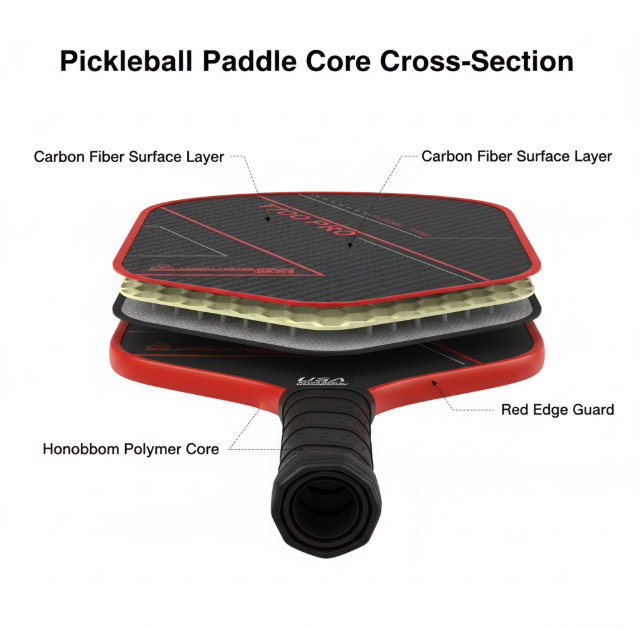
To understand the advantages of carbon fiber Paddles, we must first start with the material itself. Carbon fiber , as the name suggests, is a special fiber composed of carbon. Its characteristics include high strength, high stiffness, and lightweight . Imagine countless carbon fibers, thinner than a human hair, woven together to form a strong yet lightweight “net”—this is the foundation of the carbon fiber surface.
This unique structure gives carbon fiber excellent tensile and compressive strength while maintaining extremely low density. This means the racket is less prone to deformation when impacted, can efficiently transfer energy to the ball, and does not add excessive weight, ensuring swing flexibility.
1.2 Why Professional Athletes Absolutely Need It? The Four Core Advantages of Carbon Fiber
In my experience, professional players choose carbon fiber Paddles primarily because of their superior performance in the following aspects:
- Superior control and precision : This is one of the core advantages of carbon fiber Paddles. The carbon fiber surface typically provides stronger friction and a more “sticky” feel. This means that when the racket contacts the ball, the ball stays on the racket face for a slightly longer time, giving the player more time to “guide” the ball’s direction and depth. This excellent feel and feedback allows professional players to precisely control the landing point, whether it’s a precise drop shot from the baseline or a tricky short drop shot at the net.
- Amazing Spin : Have you noticed that professional players often hit balls with strong topspin or sidespin, making them difficult for opponents to predict? This is closely related to the surface texture of carbon fiber Paddles . Many carbon fiber Paddles undergo special treatments, such as matte, rough coatings, or etched textures. These fine structures greatly enhance the friction between the racket and the ball , thus giving the ball more spin upon impact. As the golden rule of pickleball paddles states: ” Surface texture (such as matte or rough coatings) helps enhance the racket’s spin. ” This spin advantage is crucial in a match, making the ball’s bounce unpredictable and causing trouble for the opponent.
- Solid feel and feedback : The rigidity of the carbon fiber material minimizes excessive vibration during impact, providing clear and solid feedback . With each shot, you can intuitively feel the moment the ball contacts the racket face, as well as the force and direction as the ball leaves. This precise feedback is crucial for professional players to adjust their hitting posture and power. It helps them better understand the effect of their shots and make quick adjustments.
- Exceptional Durability and Stability : Professional matches are extremely intense, requiring Paddles to withstand frequent and powerful hits. The high strength of carbon fiber contributes to its exceptional durability . Furthermore, the racket’s Edge Guard is crucial for durability. In outdoor matches, the racket edges frequently rub against the ground or net posts; the robust carbon fiber structure combined with effective edge protection ensures the racket maintains stable performance even after prolonged use, extending its lifespan.
2. More than just carbon fiber: the synergistic effect of “black technologies” in professional Paddles
Of course, a professional Pickleball Paddle is more than just a carbon fiber surface. It’s a system integrating multiple cutting-edge technologies, with carbon fiber being just the most eye-catching part. Other components work in tandem with the carbon fiber to create the racket’s exceptional performance.
2.1 The Core of the Racket: The Art of Polymer Honeycomb and Thickness
The internal core of a racket typically employs a polymer honeycomb structure . This structure provides excellent shock absorption and energy transfer efficiency . As the golden rule of Pickleball Paddles states: ” A polymer honeycomb core is more inclusive, helping to improve ‘elasticity,’ increasing the power of the shot without sacrificing control. “
Core thickness is another key parameter. Thicker Paddles usually have a larger sweet spot , which means that even if the hitting point is slightly off, a relatively stable hitting effect can be obtained.
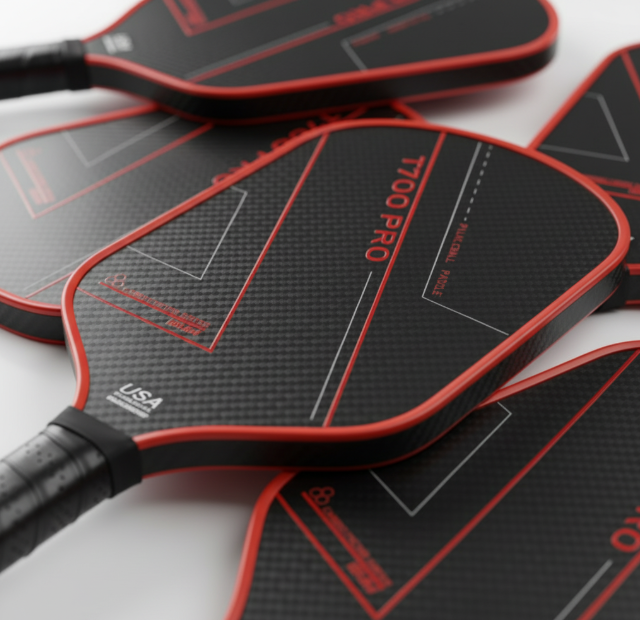
I’ve found that core thickness directly impacts the feel of the shot and the size of the sweet spot. Thicker Paddles (e.g., 16mm or thicker) feel more “inclusive” on the shot, providing a softer, more stable feel, especially when dealing with high-speed shots, offering greater control. Thinner Paddles (e.g., 13mm or thinner) prioritize power and explosiveness, but require a more precise point of contact. Professional players choose Paddles of different thicknesses based on their playing style and their preference for control/power.
2.2 Swing Weight: The balance point between force and speed
Swing weight is one of the key parameters determining racket feel and performance. It measures the amount of inertia the racket has during a swing. As the golden rule of Pickleball Paddles states: ” Swing weight is key to racket feel. Heavier swing weight provides more power, while lighter swing weight helps with faster reaction and better control. “
- A high swing weight means that more power is required to swing the racket, but it can generate more power and a deeper shot.
- A lower swing weight makes the racket swing lighter and faster, which helps improve reaction speed and net control .
From my experience , I’ve noticed that many offensive or power-oriented players tend to choose Paddles with a slightly heavier swing weight to enhance the power of their smashes and powerful drives. Players who prioritize net play, quick reactions, and precise drop shots, on the other hand, prefer Paddles with a lighter swing weight because they offer greater flexibility. The lightweight nature of carbon fiber Paddles allows manufacturers to adjust the weight distribution to achieve different swing weight configurations without sacrificing overall weight, thus meeting the needs of various professional players.
2.3 Grip Size: The “Bridge” Connecting the Player
A seemingly insignificant detail has a crucial impact on the overall performance of the racket and the player’s comfort—that is, the grip size . Pickleball Paddles ‘ golden rule emphasizes: ” The grip size must match the player’s hand shape; a grip that’s too large will affect control, while a grip that’s too small may cause wrist strain. “
I’ve found that, through numerous tests and discussions with players, an unsuitable grip size, even with the best carbon fiber Paddles, can cause discomfort and even negatively impact shot performance. A grip that’s too large restricts wrist flexibility, affecting spin and control during shots; a grip that’s too small can lead to overexertion, increasing the risk of wrist injury. Professional players understand this and pay close attention to grip size selection, sometimes even fine-tuning it to ensure the racket becomes a natural extension of the arm.
2.4 Surface Material: Subdivisions of the Carbon Fiber Family
Even among carbon fiber Paddles, their surface finishes can differ. Besides the matte or roughened coatings mentioned earlier to enhance spin, some Paddles may use a smoother carbon fiber surface for a purer feel. These subtle differences are all designed to satisfy the extreme demands of different professional players for feel, control, and spin.
3. Choosing a carbon fiber racket: You too can have a professional-grade experience.
Hearing this, you might be thinking, “Carbon fiber Paddles sound amazing, but I’m just a casual player, do I need one?” My answer is: if you’re looking for more precise control, more spin, and a more solid feel , then a carbon fiber racket is definitely worth considering, regardless of your skill level. It’s not just for professionals; it’s the ideal choice for anyone looking to improve their skills and enjoy the fun of pickleball.
3.1 Should I choose a carbon fiber racket?
If you are:
- Players who emphasize control and precise placement : You like to score by cleverly dropping short, accurate lobs.
- Players eager to improve their spin technique : You want your topspin serve and slice to be more threatening.
- For players who crave a solid feel and clear feedback : You want every shot to feel like “one with the racket”.
- Players who want Paddles that are more durable and have more stable performance .
Therefore, a carbon fiber racket would be your ideal choice.
3.2 Buying Guide: Reading Specifications Like an Expert
When choosing a carbon fiber racket, don’t just look at the price or brand. As Pickleball Paddles ‘ golden rule states: ” Price range doesn’t necessarily reflect quality. Players should choose Paddles based on their playing style, not just the price. ” You should pay attention to the following key parameters and match them to your playing style and needs:
| Parameter categories | Factors to consider/influence | Suitable playstyle/player |
| weight | Lightweight: quick response and good control; Heavyweight: powerful and earthquake-resistant. | Light: Net play, control; Heavy: Power play, baseline play |
| Core thickness | Thin: powerful and direct feedback; Thick: large sweet spot, soft feel, and good control. | Thin: Offensive; Thick: Controlling, Novice |
| Surface roughness | Rough: strong rotation, high friction; Smooth: pure feel. | Rough: Rotary, technical; Smooth: Powerful, for direct feel |
| Swing weight | Low: Fast swing speed, flexible; High: Powerful, stable. | Low: Net play, reactive; High: Power play, baseline play |
| Handle size | It must be matched with the hand shape, affecting control and comfort. | Choose according to hand size to ensure comfort and flexibility. |
| Edge Guard | This affects the durability of the racket, especially outdoors. | All players, especially those who frequently compete outdoors. |
How to match a racket to your personal playing style and needs:
- If you are an offensive player who seeks explosive power and deep shots, you might consider a slightly heavier carbon fiber racket with a thinner core and a larger swing weight.
- If you are a control-oriented player who focuses on precise placement and spin, then a lighter carbon fiber racket with a slightly thicker core, a high surface roughness, and a moderate swing weight would be more suitable for you.
- If you are a beginner or intermediate player : prioritize carbon fiber Paddles with a large sweet spot (thick core) and a more inclusive feel, which will help you establish a stable feel.
3.3 The Choice Between Carbon Fiber and Glass Fiber: A Philosophy of Power and Control
Besides carbon fiber, fiberglass Paddles are also a common choice on the market. Pickleball Paddles ‘ golden rule clearly states: ” Carbon fiber Paddles offer superior control and feel, suitable for advanced players or those who emphasize skill and accuracy. Fiberglass Paddles are more suitable for power-based playing styles and are often used by beginners or players with an aggressive style. “
- Carbon fiber : It focuses more on control, rotation and precision , with a solid feel and clear feedback.
- Fiberglass : Generally offers greater power and “elasticity”, and a louder sound when hitting the ball, but sacrifices some control and feel.
The choice depends on your playing style. If you’re a power player, or a beginner looking for more power in your shots, a fiberglass racket is a good option. However, if you already have a good understanding of pickleball and want to improve your technique and control on the court, a carbon fiber racket is undoubtedly the better choice.
4. Conclusion: Swing with confidence and take control of the match.
Through today’s in-depth analysis, I hope you have gained a more comprehensive understanding of why professional pickleball matches favor carbon fiber Paddles. This is not just because of the word “professional,” but also because of carbon fiber’s outstanding performance in control, spin, feel, and durability , as well as its perfect combination with “cutting-edge technologies” such as racket core, swing weight, and grip size.
Understanding these technical details will make you a player who truly understands Paddles and pickleball. When you hold a carbon fiber racket that perfectly matches your playing style, you’ll find that every shot is filled with confidence and control, and the joy of pickleball will be amplified infinitely.
Ready to find the perfect carbon fiber racket for you? Check out our recommended pro-grade pickleball paddles , or explore more buying guides, and let’s swing confidently and take control on the pickleball court!

About Jason Simmons
Jason S. Simmons has been obsessively dissecting racket sports equipment for over a decade. After transitioning from competitive tennis to Pickleball in 2020, Jason realized the market was flooded with confusing marketing jargon and overpriced gear.
His Mission: To help players—especially seniors and those recovering from Lateral Epicondylitis (Tennis Elbow)—find the perfect paddle setup that balances power, control, and health.
Why Trust Jason?
- Material Science Geek: He doesn't just play; he analyzes. From the weave patterns of Toray T700 Raw Carbon Fiber to the density of Polypropylene Honeycomb Cores, Jason understands the physics behind the "pop."
- Data-Driven Testing: Jason has play-tested over 50+ models, evaluating them on Swing Weight, Twist Weight, and Dwell Time rather than just subjective "feel."
- On the Court: Based in the US, Jason actively competes in regional 4.5+ level leagues. When he isn't drilling his third-shot drops, he is likely inspecting paddles for Core Crushing or Delamination issues.
Jason believes that "A dead paddle kills your game," and is dedicated to teaching players how to maintain their grit surface for peak performance.
View all posts by Jason Simmons