2026 Pickleball Paddle Buying Guide: Why is T700 Carbon Fiber + 16 mm the Optimal Solution for You?
To be honest, I’m all too familiar with that overwhelming feeling of suffocation when you first open Amazon or those professional pickleball gear websites.
Hundreds and thousands of pickleball paddles are laid out there, each claiming to be “revolutionary.” If you are confused by the jargon, our [2026 Pickleball Paddle Ultimate Buying Guide] covers every term you need to know.If you read the spec sheets, terms like “polymer honeycomb core,” “raw carbon,” and “swing weight”… these terms are enough to make even beginners give up immediately.
When I first started playing, I paid my dues in this area, buying those rigid fiberglass paddles that made my elbows ache for weeks, and also following the trend and buying those ridiculously expensive big brands, only to find that apart from the nice paint job, they weren’t that great to play with.
Today, I want to save you from wasting money and time on trial and error.
As someone who’s been in this industry for years, I don’t want to give you a physics lesson. I just want to focus on the practical feel, stripping away the marketing hype, and showing you what a truly good pickleball paddle actually looks like.
Spoiler alert: you really don’t need to spend $200 for a good feel.
Core Materials: Don’t be fooled by “high technology.”
Although you can’t see what’s inside the pickleball paddle, believe me, the core is the key to whether you’re comfortable playing with it.
90% of good pickleball paddles on the market use a polypropylene honeycomb core. It sounds long, but just remember this: if it’s not made of this material, skip it.
I once tried an old-fashioned Nomex core, and hitting it felt like hitting a rock—loud enough to wake the whole neighborhood. The gentle shock absorption of a polymer honeycomb core is the foundation for playing for extended periods without fatigue.
But there’s a huge pitfall here: thickness.
You will usually see two numbers on the specification sheet:
- 13 mm
- 16 mm
A few years ago, I also pursued a thin 13 mm racket, thinking it would give me faster ball speed and a more satisfying smash. But this thrill was short-lived.
Because it’s thin, the ball spends very little time on the racket face, leaving very little room for error. If you miss the center of the sweet spot even slightly, the ball will fly wildly.
What’s worse, the vibration transmitted directly to the wrist is practically a catalyst for tennis elbow for ordinary people like us who don’t spend every day in the gym building forearm strength.
Later, I replaced all my equipment with 16 mm thick rackets, and the world instantly became quieter.
The 16 mm thickness is like adding a cushioning pad to the racket face; it can absorb the opponent’s powerful smashes and then steadily block them back.
If you want to play those delicate dinking shots at the net, the control provided by 16 mm is something that 13 mm simply cannot offer.
So unless you’re the kind of player who only knows how to use brute force to achieve miracles, listen to me; just blindly choose 16 mm.
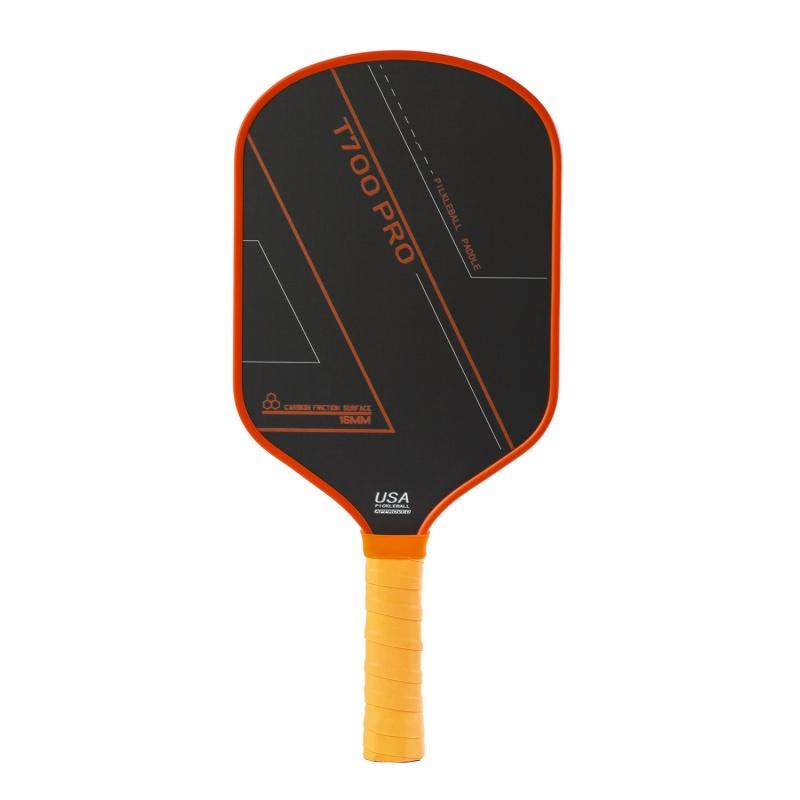
Surface material: Why insist on “roughness”?
If you have the chance to touch my pickleball paddle, you’ll find that its surface isn’t smooth; it feels like a fine piece of sandpaper.
This is Raw T700 Carbon Fiber.
Many beginners buy fiberglass pickleball paddles because they’re cheap and produce a fast pop. But I have to pour cold water on that: fiberglass is too bouncy.
When you try to gently place the ball at your opponent’s feet near the net, the fiberglass often bounces the ball too high, giving them a chance to smash. That feeling is really frustrating.
T700 carbon fiber solves this problem. It has a natural rigidity that allows you to aim precisely. More importantly, it has a woven texture on its surface.
In actual use, this rough texture grips the ball tightly. Whether you want to serve a strong topspin or slice a low backspin, Raw Carbon provides ample friction.
I previously used a Spray Grit Pickleball Paddle, which worked great when I first bought it, but after two months the sand wore off, leaving it bare.
The T700’s texture, however, is inherent to the material itself; even when you need to replace your grip tape, its surface still grips the ball like new.
That’s why, even for beginners, I recommend going straight for the T700. It used to be because it was expensive, but now that the technology has become more accessible, there’s no need to tolerate the unpredictability of fiberglass anymore.
Shape and handle: This is a matter of personal style.
Once you’ve chosen the material (T700) and thickness (16 mm), the rest depends on your playing style. It’s like buying shoes; even if the size (specifications) is right, you still need to consider whether the shoe shape fits.
If you often feel like you’re “missing” the ball or hitting it onto the frame, your pickleball paddle might be too narrow. In that case, I’d recommend checking out a widebody design.
This type of pickleball paddle is like a wall, with an enormous sweet spot. I’ve recommended widebody rackets to many friends who are new to pickleball, and they say the most immediate feeling is increased confidence; they’re more comfortable receiving the ball.
However, if you have a tennis background and are used to a two-handed backhand, the standard short handle might drive you crazy—because there’s practically no place to put your second hand.
In this case, you need to look for a model with a handle length of 5.3 inches or more, which usually also has a longer, thinner face.
This design not only allows you to comfortably generate power with both hands but also increases the power of your serve due to the longer lever arm.
As for the color? Don’t laugh; it’s a serious parameter too. Professional pickleball paddles used to be all black, which looked dull.
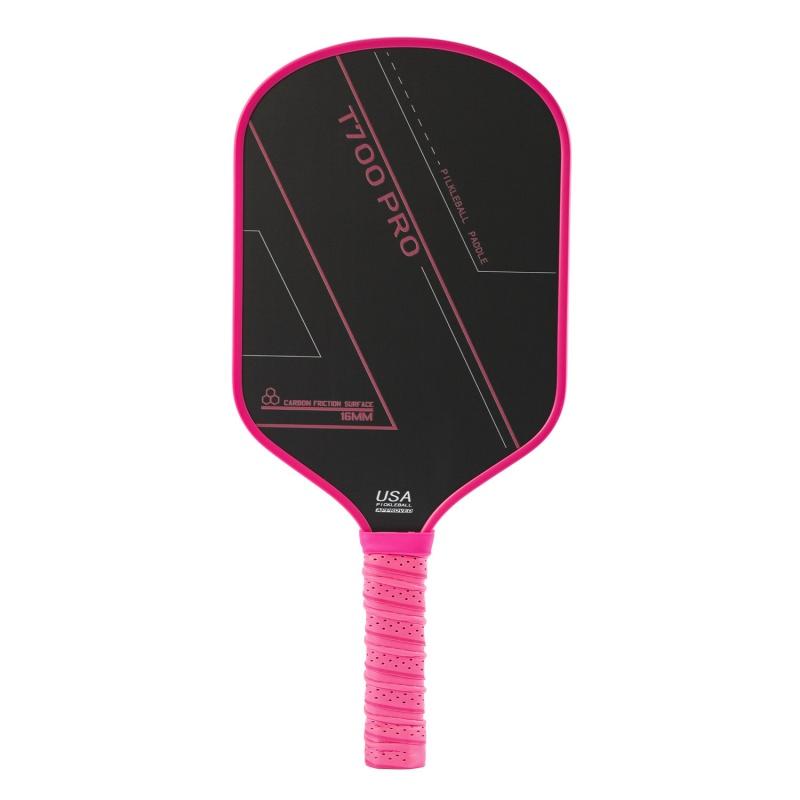
Now, some T700 rackets can be made in beautiful colors. Holding a bright yellow or rose-red racket on the court puts you in a good mood, and naturally, it improves your performance.
Summary: Your next Pickleball Paddle
After all that, the selection logic is actually quite simple. In 2026, a truly good, durable pickleball paddle that can grow with your skills should look like this:
- It must be thick: look for 16 mm to protect your elbows and improve your control.
- It must be “sharp” enough: look for Raw T700 Carbon Fiber; that’s the source of the spin.
- The manufacturing process must be robust: ideally, it should be thermoformed, which ensures the racket won’t collapse over time.
When you have a pickleball paddle like this in your hand, you no longer need to think about “whether my equipment is bad.”
All that’s left is to enjoy the sound of each shot.
If you’re planning to replace your current entry-level wooden board, or don’t want to pay for the high marketing costs of big brands, and are looking for a practical weapon that perfectly meets the above “gold standard” and is reasonably priced, then take a look at this series I’ve compiled for you.
Pickleball paddle series models that meet the T700 + 16 mm gold standard.

About Jason Simmons
Jason S. Simmons has been obsessively dissecting racket sports equipment for over a decade. After transitioning from competitive tennis to Pickleball in 2020, Jason realized the market was flooded with confusing marketing jargon and overpriced gear.
His Mission: To help players—especially seniors and those recovering from Lateral Epicondylitis (Tennis Elbow)—find the perfect paddle setup that balances power, control, and health.
Why Trust Jason?
- Material Science Geek: He doesn't just play; he analyzes. From the weave patterns of Toray T700 Raw Carbon Fiber to the density of Polypropylene Honeycomb Cores, Jason understands the physics behind the "pop."
- Data-Driven Testing: Jason has play-tested over 50+ models, evaluating them on Swing Weight, Twist Weight, and Dwell Time rather than just subjective "feel."
- On the Court: Based in the US, Jason actively competes in regional 4.5+ level leagues. When he isn't drilling his third-shot drops, he is likely inspecting paddles for Core Crushing or Delamination issues.
Jason believes that "A dead paddle kills your game," and is dedicated to teaching players how to maintain their grit surface for peak performance.
View all posts by Jason Simmons