Lightweight vs. Midweight vs. Heavyweight Pickleball Paddles: The Ultimate Weight Guide
Hey Pickleballers! As an equipment expert who loves this sport and has play-tested countless pickleball paddles, I often hear this question: “Is a lighter paddle always better?”
It sounds intuitive. After all, a lighter paddle feels easier to swing, promising faster reactions. However, on the pickleball court, this mindset can be a “sweet trap”—one that hurts your performance and, worse, your elbow.
Have you ever wondered why your swings feel hard but the ball lands short? Why, when blocking a heavy smash, does your paddle get “pushed around” by the ball? Or why your wrist aches after a match? The root cause is likely your paddle weight.
Today, we are going to deep dive into the three weight classes of pickleball paddles. I will break some common myths and give you an expert strategy to find your “Golden Partner.”
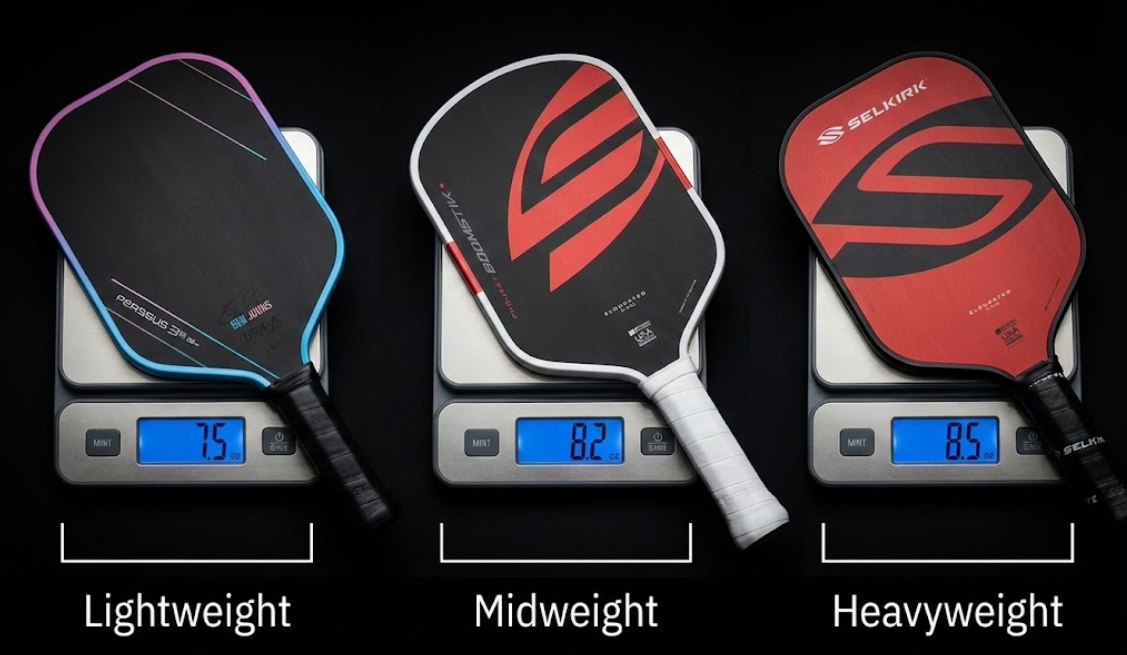
The Three Weight Classes: Define Your Range
Before we dive deep, let’s clarify the standard classifications. While brands vary slightly, here is the industry standard for 2026:
| Paddle Weight Class | Weight Range |
|---|---|
| Lightweight Paddles | 7.3 oz – 7.6 oz |
| Midweight Paddles (The “Golden Zone”) | 7.7 oz – 8.2 oz |
| Heavyweight Paddles | 8.3 oz and above |
Understanding these ranges is step one. Now, let’s analyze how they affect your game.
1. Lightweight: Speed vs. Stability
Lightweight pickleball paddles are synonymous with speed.
The Pros:
- Fast Hands: The most significant advantage. You get lightning-fast reaction times at the net, perfect for volley battles.
- Wrist Friendly (Short Term): For beginners with very weak wrist strength, they feel easier to pick up initially.
The Cons:
As an expert, I must warn you about the downsides that are often ignored:
- Poor Stability: This is the fatal flaw. When facing a hard drive, a light paddle lacks the mass to absorb the energy. The paddle twists in your hand, leading to errors.
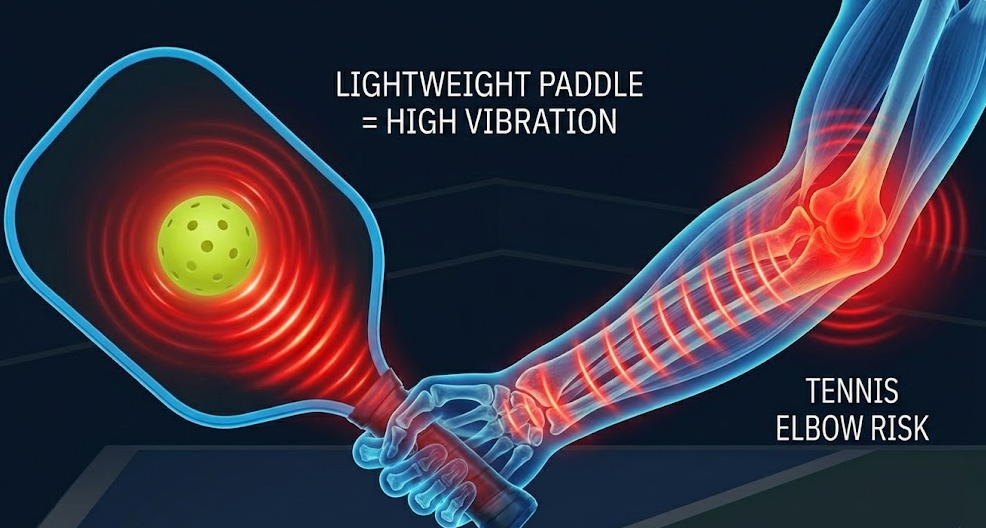
- High Vibration: Physics dictates that lighter objects vibrate more upon impact. Much of that shock travels straight up your arm. This significantly increases the risk of tennis elbow!
- Lack of Power: You have to swing harder to generate pace. This leads to overexertion and fatigue.
Many beginners chase “lightness” for flexibility, only to find they lack power and stability. In my testing, overly light paddles are often a trap that leads to injury.
2. Heavyweight: Power vs. Fatigue (The Sledgehammer)
Heavyweight pickleball paddles go to the other extreme.
The Pros:
- Built-in Power: With high mass comes high momentum. You don’t need to swing hard; the paddle does the work for deep baseline drives.
- Rock-Solid Blocking: The extra mass absorbs incoming smashes easily. The paddle doesn’t budge.
The Cons:
- Fatigue: Swinging a heavy paddle takes a toll. Shoulders and wrists tire quickly during long matches.
- Slow Hands: In fast kitchen exchanges, you will be a split second slower. That delay causes you to miss crucial volleys.
Ideal For: Singles players or former tennis players who have the strength to wield a “hammer” and don’t rely as much on quick wrist flicks.
3. Midweight: The “Goldilocks” Zone (Your Perfect Canvas)
Now we arrive at the sweet spot. Midweight pickleball paddles (7.7 oz – 8.2 oz) are the choice of 90% of pros and amateurs.
Why is it the Golden Balance?
- Sufficient Shock Absorption: They have enough mass to dampen vibration, protecting your arm.
- Nimble Yet Stable: Light enough for fast hands but heavy enough to remain stable on blocks.
- Versatile: Perfect for drops, dinks, drives, and resets.
Customizability: You Can Add, But You Can’t Subtract
This is a huge advantage. You can buy a midweight paddle and add lead tape to make it heavier or adjust the balance. However, you can never make a heavy paddle lighter.
Jason’s Rule: Buying too light is risky; buying heavy is irreversible. Buying Midweight is safe because it’s a perfect canvas you can customize.
Pop Quiz: Static Weight vs. Swing Weight
We are talking about the weight on the scale (static weight). But there is a deeper metric: swing weight. This determines how heavy the paddle feels when you swing it. A light paddle can feel heavy if the weight is all in the head!
Want to nerd out? Read our deep dive: What is Swing Weight? How It Affects Your Game] to understand why this hidden stat matters more than you think.
Final Verdict
Stop guessing. For the vast majority of players, a midweight paddle (7.8 oz – 8.2 oz) is the smartest investment. It gives you the flexibility to adapt to any playstyle while keeping your arm safe.
Health Alert: Protect Your Elbow!
If you suffer from tennis elbow, take my advice: do NOT buy a lightweight paddle. The high vibration will aggravate your injury. Instead, choose a midweight paddle with a 16 mm core. The thickness combined with the mass acts as a shield for your joints.
Learn More: Check out our guide on [13mm vs 16mm Pickleball Paddles] to see why thicker cores are the best medicine for sore arms.
Ready to Find Your Perfect Match?
Based on our testing, here are our top recommendations for the perfect balance of power, control, and health:
- For Speed & Agility (7.5 oz): [Check out our Carbon Fiber Series.] Perfect for players who prioritize lightning-fast hand speed.
- For Stability & Power (8.2 oz): [Check out our Colorful T700 Raw Carbon Series] The ultimate midweight choice for stability and blocking power.
- Still unsure? Read our complete [Pickleball Paddle Ultimate Buying Guide] for more tips!
Frequently Asked Questions About Pickleball Paddle Weight
Is a lighter pickleball paddle better for tennis elbow?
What is considered a midweight pickleball paddle?
Can I make a heavy pickleball paddle lighter?
What are the disadvantages of a lightweight paddle?

About Jason Simmons
Jason S. Simmons has been obsessively dissecting racket sports equipment for over a decade. After transitioning from competitive tennis to Pickleball in 2020, Jason realized the market was flooded with confusing marketing jargon and overpriced gear.
His Mission: To help players—especially seniors and those recovering from Lateral Epicondylitis (Tennis Elbow)—find the perfect paddle setup that balances power, control, and health.
Why Trust Jason?
- Material Science Geek: He doesn't just play; he analyzes. From the weave patterns of Toray T700 Raw Carbon Fiber to the density of Polypropylene Honeycomb Cores, Jason understands the physics behind the "pop."
- Data-Driven Testing: Jason has play-tested over 50+ models, evaluating them on Swing Weight, Twist Weight, and Dwell Time rather than just subjective "feel."
- On the Court: Based in the US, Jason actively competes in regional 4.5+ level leagues. When he isn't drilling his third-shot drops, he is likely inspecting paddles for Core Crushing or Delamination issues.
Jason believes that "A dead paddle kills your game," and is dedicated to teaching players how to maintain their grit surface for peak performance.
View all posts by Jason Simmons