13mm vs 16mm Pickleball Paddles: How Core Thickness Impacts Your Game
Hey Pickleballers! Have you ever felt overwhelmed when browsing online for new gear? You look at the detailed specs, and besides the colors and shapes, you are confronted with a mysterious number: 13mm, 14mm, or 16mm.
Does a measly 3-millimeter difference really decide the fate of pickleball paddles? Does it actually affect your touch, power output, or even your arm comfort?
The answer is: YES. The difference is huge, and it is far more significant than you might think. That tiny gap determines whether your paddle acts like a soft “pillow” that absorbs energy or a rigid “wall” that fires the ball back like a rocket.
As a seasoned player who has dissected and play-tested countless pickleball paddles for our [2026 Pickleball Paddle Ultimate Buying Guide], I know how frustrating this “analysis paralysis” can be. Today, I’m going to combine simple physics with real-world court experience to help you crack the core thickness code. Let’s stop guessing and start selecting scientifically!
I. The “Millimeter” Dilemma
Imagine standing on the court, facing a heavy drive or a delicate dink. The paddle in your hand is your only connection to the ball. The core thickness is the critical joint in that connection.
Many players, especially those transitioning from beginner to intermediate levels, focus heavily on surface materials (like Carbon Fiber or Fiberglass) or textures, but they often overlook the core thickness—the “hidden champion” that truly dictates the feel of most pickleball paddles.
This 3-millimeter difference isn’t just a minor numerical variance; it represents the depth of the internal honeycomb structure (usually a polymer core). This change in depth directly reshapes how energy is transferred when the paddle contacts the ball, impacting your:
- Power
- Control
- Sweet Spot (Forgiveness)
- Arm Comfort (Health) — Crucial!
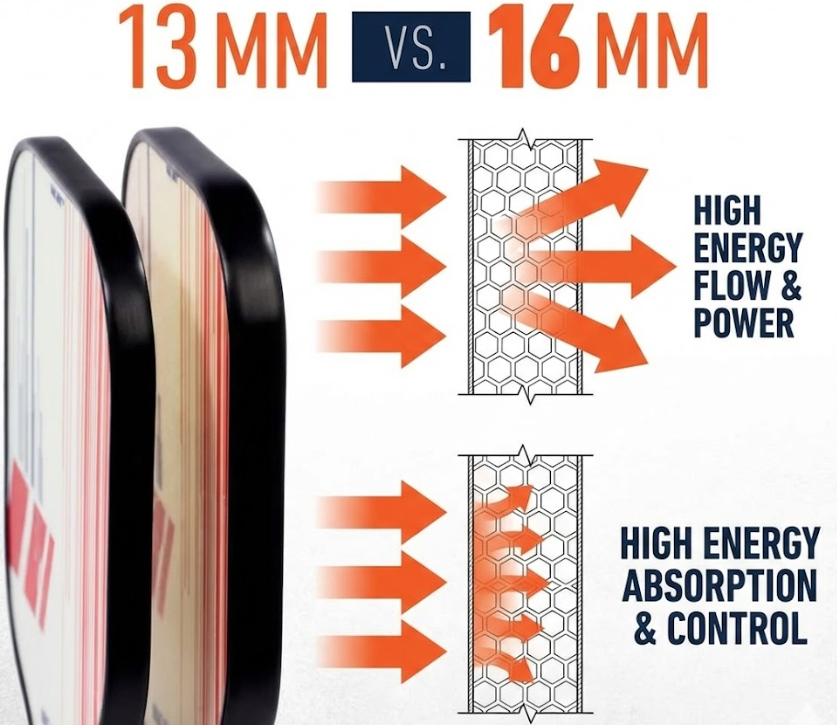
II. The Physics: Pillow vs. Wall
There is a common misconception that thicker pickleball paddles have a “trampoline effect” and provide more elasticity. From my testing and basic physics, the opposite is true! Let’s dive into the art of the “Pillow” versus the “Wall.”
13mm (The Wall): The Symbol of Stiffness & Power
When pickleball paddles have a thinner core (13mm or even thinner), the internal honeycomb structure is shorter and flatter, resulting in higher overall stiffness.
Imagine hitting a ball with a thin wooden board. The contact time between the ball and the board is short, and there is very little energy loss. The paddle acts like a “Wall”—it doesn’t absorb much of the incoming energy but instead rebounds it rapidly.
- Core Characteristic: High stiffness, minimal deformation.
- Energy Transfer: Low energy loss, high rebound efficiency.
- On-Court Performance: Delivers direct Power and explosive Pop. The “road feel” of the paddle against the ball is very clear and crisp.
In my early days testing different thicknesses, 13mm paddles definitely offered a stronger “penetration” feeling on baseline drives with faster ball speeds, but the price was a much higher demand on my control skills.
16mm (The Pillow): The Art of Cushioning & Control
When you move up to 16mm (or thicker) pickleball paddles, the deeper honeycomb core provides a much deeper buffer layer.
Think of this like catching a ball with a thick “Pillow.” The contact time (Dwell Time) extends, and the deformation and recovery process of the paddle absorbs some of the incoming energy, providing a softer, “wrapping” sensation.
- Core Characteristic: Deep buffer layer, greater deformation, excellent shock absorption.
- Energy Transfer: Energy is absorbed and released slowly after deformation, providing a “ball-holding” feel.
- On-Court Performance: Offers superior Control and Absorption. The ball stays on the face longer, giving you more time to guide placement and spin.
After switching to 16mm pickleball paddles, I found my dinks and drops became significantly more stable and precise. I stopped popping the ball up as often. This sensation of “absorption” gave me much more confidence in my placement.
III. The Case for 16mm: The “Control King” (Why is it the Majority Choice?)
In my opinion, if you are on the fence, 16mm pickleball paddles are the “safe bet” for 90% of players and the final destination for most. The benefits it brings go far beyond what you might imagine.
1. Soft Game Mastery (Dinking & Resets)
The essence of pickleball lies in the delicate battles at the kitchen line. When you need to gently place the ball over the net or “reset” a hard shot to your opponent’s feet, the absorption characteristics of 16mm paddles are vital.
The Master of De-escalation: It effectively “kills” the impact of the incoming ball, keeping it on the face longer. This allows you to execute precise, low-arc dinks and resets, preventing pop-ups that get smashed by opponents.
I’ve noticed many players starting with 13mm paddles often struggle with dinks flying high or long. When I have them try 16mm pickleball paddles, their net control improves instantly, and their drops land closer to the net cord.
2. Sweet Spot & Forgiveness
A thicker core means a deeper honeycomb structure, which increases the paddle’s overall stability and creates a larger Sweet Spot.
Stable Twist Weight: A thick core better resists twisting upon impact. This reduces face wobble, keeping off-center shots stable in both power and direction. This massively boosts forgiveness.
Especially during fast volley exchanges, contact points aren’t always perfect. The forgiveness of 16mm pickleball paddles allows me to hit high-quality shots even when rushed, reducing unforced errors.
3. Health Benefit: The Savior for Tennis Elbow!
For many senior players or those with a history of sports injuries, this point is a godsend. Pickleball puts significant stress on the arm and wrist. Using stiff, high-vibration paddles long-term can easily lead to Tennis Elbow.
Superior Shock Absorption: The thick polymer honeycomb core of 16mm paddles acts like a built-in shock absorber. It dampens the vibration generated at impact, minimizing the shock traveling up your arm.
My Advice: If your elbow or wrist aches after playing, or if you already battle Tennis Elbow, switch to a 16mm paddle immediately. You might discover a whole new world. Friends I’ve recommended this to report significantly reduced pain and a return to enjoying the game. This is one of the most profound advantages I’ve felt in testing.
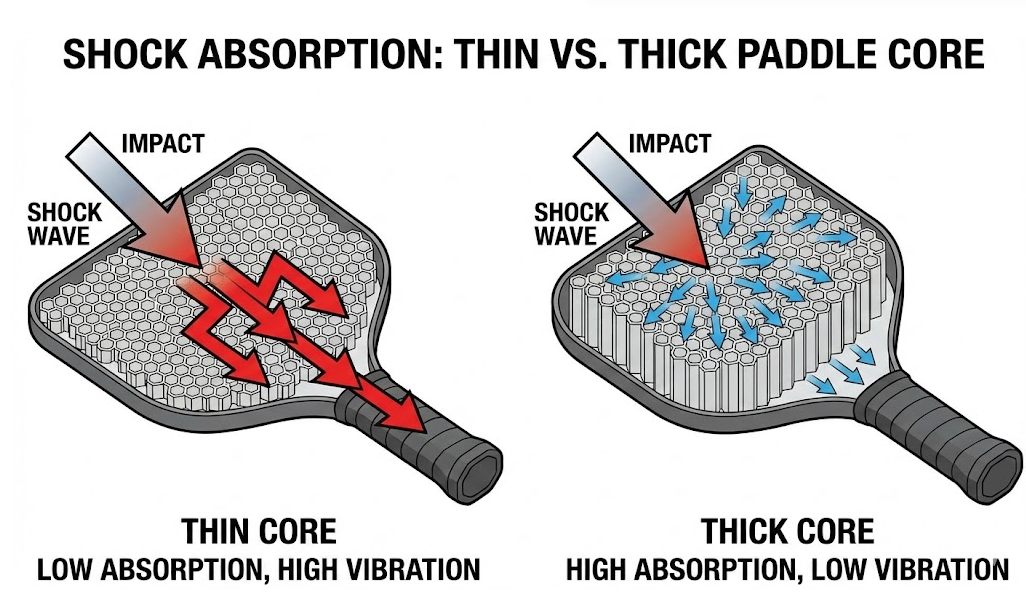
Best Suited For:
- Beginners: Need higher forgiveness and control to build fundamentals.
- 3.0 to 4.0 Players: Focusing on strategy, dinks, and resets; need refined control.
- Players with Injury Concerns: Seeking maximum arm comfort and shock absorption.
- Anyone seeking balanced, all-around performance.
IV. The Case for 13mm/14mm: The “Power House”
Of course, thinner pickleball paddles (13mm or 14mm) are not without merit. They still offer unique advantages for specific playstyles and needs.
1. Hand Speed & Quick Reflexes
Generally, thinner core paddles are slightly lighter (though this depends on overall build), making them faster in hand speed battles at the net.
Fast Swing: A lower Swing Weight allows you to react faster, helping you seize the initiative in rapid-fire volley exchanges.
For players transitioning from Table Tennis or Badminton who are used to rapid wrist actions and snap shots, 13mm pickleball paddles allow them to better utilize those existing skills.
2. Pop & Drives: The Key to Baseline Dominance
The “Wall Effect” of thin cores means they more effectively convert your swing power and the incoming ball’s energy into exit speed, providing massive Pop.
Baseline Drives: If you love hitting hard drives from the baseline or rely on the paddle to provide extra “borrowed power” for deep, fast shots, a 13mm core will feel explosive.
Singles players often prefer 13mm pickleball paddles because the extra penetration helps them hit passing shots and winners more easily.
3. Feedback: A Crisp, Direct Experience
Due to their higher stiffness, 13mm paddles offer much clearer Feedback.
Crisp Feel: You feel the direct contact between the ball and the face on every shot.
Some players simply prefer this “hardcore” feedback, feeling it gives them better awareness of the ball. It’s like driving a sports car—the road feel is clear, but it requires higher driving skills to handle.
Best Suited For:
- Table Tennis/Badminton Converts: Used to fast wrist action.
- Singles Players: Seeking maximum power and offense.
- Low-Power Players: Looking for a paddle that provides extra “pop” (borrowed power).
V. Scenario Test: Who Are You?
Let’s verify which of these pickleball paddles fits your game profile with a quick test.
Scenario A: “I keep popping the ball up too high at the net, or my drop shots sit up for my opponent to smash.”
Your Choice: 16mm. You need better control and absorption to “kill” the ball’s speed for precise dinking.
Scenario B: “My elbow or wrist hurts after playing, or I’m worried about Tennis Elbow.”
Your Choice: 16mm. Without a doubt. You need maximum shock absorption to protect your arm.
Scenario C: “My shots feel like hitting a marshmallow; I can’t generate power, especially from the baseline.”
Your Choice: 13mm. You might need the extra pop and direct feedback to boost your ball speed. (Note: Ensure your technique is sound first).
Scenario D: “I am an all-around player who wants to balance offense and defense without sacrificing too much power.”
Your Choice: 16mm. This is the most balanced choice, allowing you to navigate transition zones with ease.
VI. The 20mm Trend? (The Future is Thicker?)
It is worth noting that innovation in pickleball paddles never stops. Beyond the mainstream 13mm and 16mm, we are seeing 19mm or even 20mm paddles (like Diadem) hitting the market. These ultra-thick cores push “Control” and “Absorption” to the extreme.
My Take: This trend highlights the player demand for maximum control and comfort. However, for most, 16mm pickleball paddles remain the perfect “Goldilocks” zone between power and control. Ultra-thick paddles may sacrifice too much power and feel, making them niche tools for specific players who rely purely on touch.
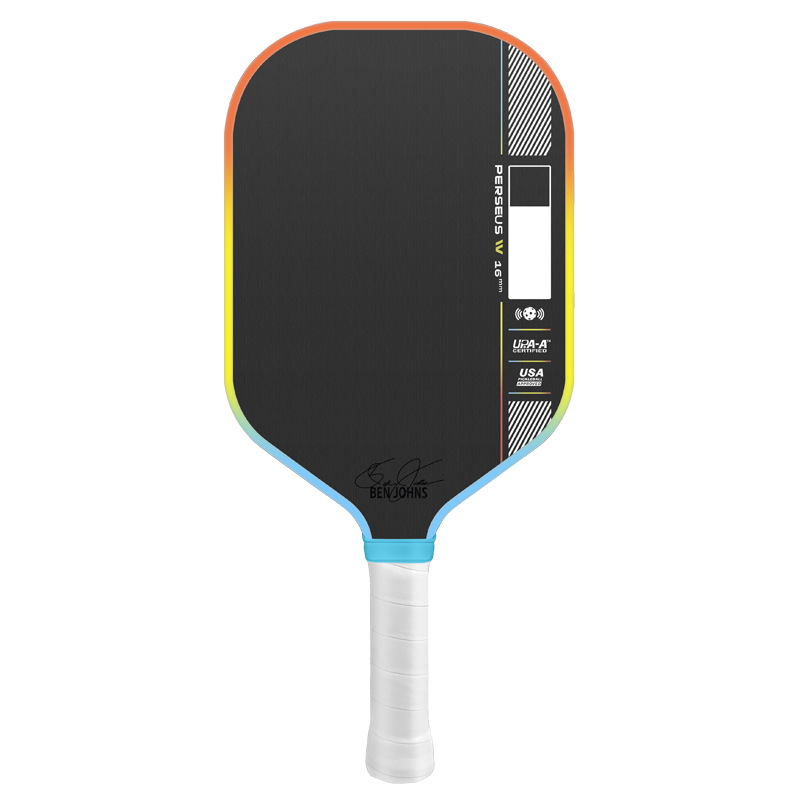
VII. Jason’s Verdict: The Smart Choice
After today’s deep dive, I hope you have a clearer understanding of core thickness.
Here is my final recommendation:
Unless you are a high-level singles player or a power-hitter with strong mechanics (and healthy elbows), 16mm core thickness is the best choice for 90% of pickleball players.
Choosing a 16mm Core + T700 Carbon Fiber Face combination gives you:
- Superior Control: Dominate the net with precise dinks.
- High Forgiveness: Stability on off-center hits.
- Unmatched Comfort: Maximum vibration dampening for injury prevention.
You will never regret having too much control, but you will definitely regret popping the ball up to your opponent’s smash zone. Choosing 16mm is choosing peace of mind, stability, and a path to improvement.
Ready to find the perfect paddle to elevate your game? Check out our curated list of [Top-Rated 16mm Control Pickleball Paddles] and discover your next “winning weapon”!
Frequently Asked Questions About Pickleball Paddle Thickness
What is the difference between 13mm and 16mm pickleball paddles?
Which pickleball paddle thickness is best for tennis elbow?
Do pros use 14mm or 16mm pickleball paddles?
Is a thicker core pickleball paddle better for beginners?

About Jason Simmons
Jason S. Simmons has been obsessively dissecting racket sports equipment for over a decade. After transitioning from competitive tennis to Pickleball in 2020, Jason realized the market was flooded with confusing marketing jargon and overpriced gear.
His Mission: To help players—especially seniors and those recovering from Lateral Epicondylitis (Tennis Elbow)—find the perfect paddle setup that balances power, control, and health.
Why Trust Jason?
- Material Science Geek: He doesn't just play; he analyzes. From the weave patterns of Toray T700 Raw Carbon Fiber to the density of Polypropylene Honeycomb Cores, Jason understands the physics behind the "pop."
- Data-Driven Testing: Jason has play-tested over 50+ models, evaluating them on Swing Weight, Twist Weight, and Dwell Time rather than just subjective "feel."
- On the Court: Based in the US, Jason actively competes in regional 4.5+ level leagues. When he isn't drilling his third-shot drops, he is likely inspecting paddles for Core Crushing or Delamination issues.
Jason believes that "A dead paddle kills your game," and is dedicated to teaching players how to maintain their grit surface for peak performance.
View all posts by Jason Simmons