Elongated vs. Standard Pickleball Paddles: Why “Wider” is Your Secret Weapon
Hey Pickleballers! Jason here. Lately, I’ve noticed a fascinating phenomenon on the courts: everyone seems to be chasing those sleek, professional-looking elongated pickleball paddles. It’s true, many pros use them, and they do look cool.
But as a gear addict who has tested pickleball equipment for years, I have a controversial warning for you: for 95% of amateur players, blindly following the “elongated” hype might be the biggest mistake you make!
Today, I’m going to deep dive into the mysteries of paddle shapes. I’ll reveal why the classic Standard/Wide Body shape—especially when paired with a 16mm Core—is the true “hidden champion” that will boost your win rate and fun. Let’s look past the marketing and find the [Standard Shape Pickleball Paddles] that actually fit your game.
The “Invisible Cost” of Elongated Pickleball Paddles
You might ask, “Don’t elongated paddles give me more reach? If the pros use them, they must be better, right?”
That’s a fair point. But in amateur play, the slight advantage of “reach” is often completely canceled out by huge invisible downsides.
The Sweet Spot Trap: Longer ≠ Larger
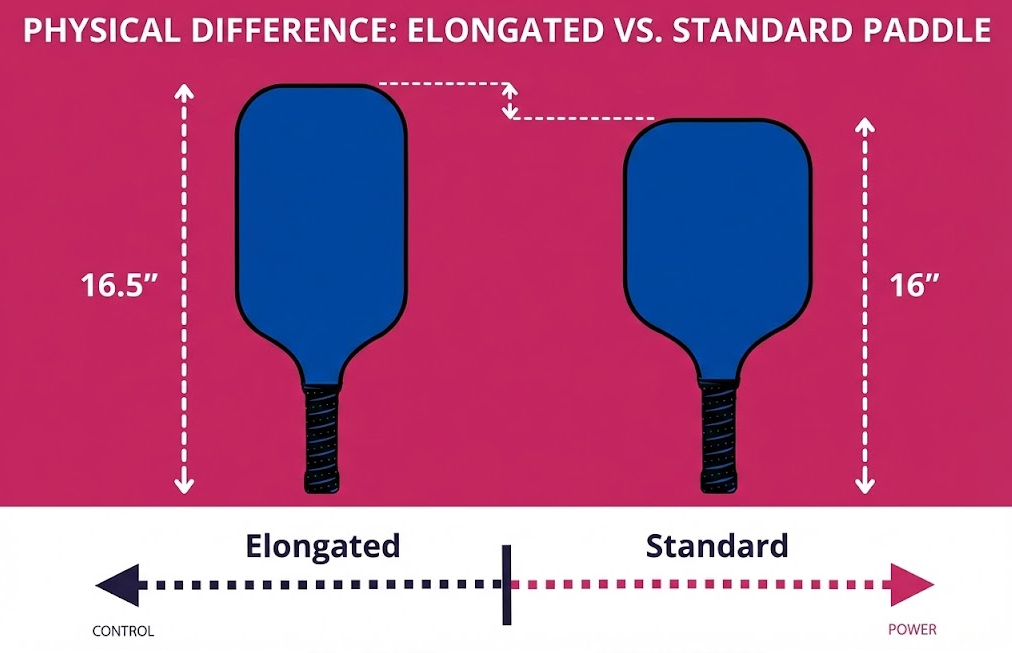
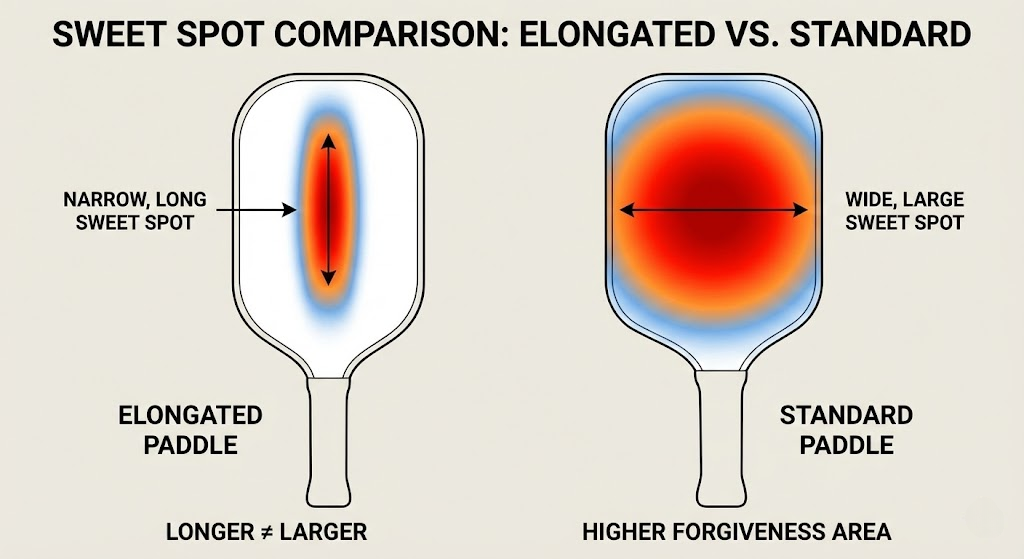
While elongated pickleball paddles offer more length, they sacrifice width. This leads to a brutal truth: the sweet spot becomes narrow and unforgiving.
Imagine a long, thin hitting zone. If you miss the center by just a fraction of an inch, the ball dies. It either hits the edge guard or lacks power entirely.
My Testing Data: I’ve seen countless players switch to elongated pickleball paddles and watch their unforced error rate skyrocket.
The Reality: In fast net volleys, you simply don’t have time to aim perfectly for that tiny sweet spot. This “unforgiving” nature kills your confidence and leads to frustration.
The Pain of Swing Weight: The “Head-Heavy” Effect
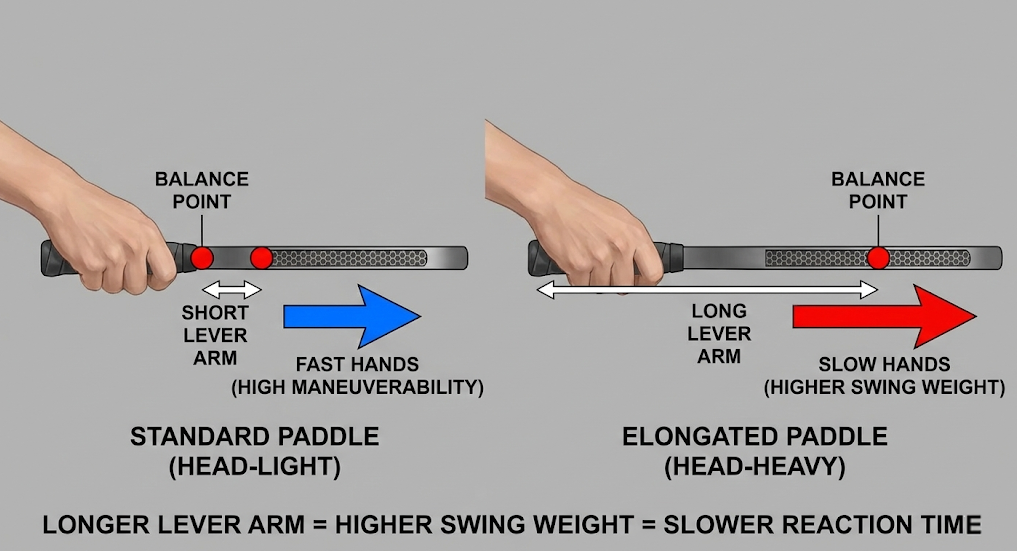
We know that swing weight is the key metric for hand speed. Due to the laws of leverage, the center of gravity in an elongated paddle is further from your hand. This makes the paddle feel significantly “heavier” to swing.
What this means for you: In fast kitchen exchanges (firefights), your hands will feel slow. Adjusting your paddle angle for a block, a quick volley, or a backhand flick becomes a struggle. Your opponent has already reset the ball while you are still dragging your paddle head through the air. In high-level play, this is fatal.
Why Standard/Wide Body is the “King’s Choice”
Now, let’s look at the often-overlooked veteran: the Standard/Wide Body pickleball paddles. They might not look as “trendy,” but their practical performance and friendliness to players are unmatched.
The “Shield Effect”: Ultimate Defense
Standard or wide-body paddles have a larger lateral surface area. I like to call this the “Shield Effect.”
When you are under attack and need to block a hard drive, this wide face is your best friend. No matter where the ball hits, you have a much higher chance of blocking it back into play. This drastically reduces your error rate, building defensive confidence and creating opportunities for counterattacks.
A Massive Sweet Spot: Consistency is Key!
A wider face directly translates to a massive sweet spot. This means even on off-center hits, the ball response remains stable and powerful. Consistency is the key to winning.
Most modern standard pickleball paddles feature a polymer honeycomb core. This material, combined with the wide shape, offers a forgiving feel that improves energy return without sacrificing control. Whether driving from the baseline or dropping at the net, the stability is palpable.
Lightning Fast Hands
Because the weight is concentrated closer to the handle, standard pickleball paddles typically have a lower swing weight. This gives you Lightning Hand Speed.
A standard paddle allows me to adjust the face instantly. Whether it’s a quick block, a deceptive fake, or a sudden change of direction, the nimble feel gives you the upper hand. Remember, pickleball is often won or lost at the net, and hand speed decides the victor.
Core Thickness: 13mm vs. 16mm
Beyond shape, core thickness is the other critical spec that defines the performance of pickleball paddles. The difference between 13 mm and 16 mm is bigger than you think.
|
Feature | 13 mm Core Paddles | 16 mm Core Paddles |
|---|---|---|
|
Feel |
Stiff, crisp, direct “Pop” |
Soft, plush, longer “Dwell Time” |
|
Power |
High output, fast exit speed |
Moderate, stable energy return |
|
Control |
Lower, requires precision |
Superior, excellent placement |
|
Sweet Spot |
Smaller, unforgiving |
Massive, high forgiveness |
|
Shock Absorption |
Poor, more vibration |
Excellent, reduces arm fatigue |
|
Ideal For |
Power hitters, Singles players | 90% of players are control-focused. |
13mm Core: The “Hardcore” Power Choice
A 13 mm core is thinner and stiffer, giving your shots an explosive “pop.” The ball spends less time on the face, rocketing off with high speed. If you are an aggressive offensive player who loves to end points quickly and has pinpoint accuracy, a 13 mm core might surprise you. However, the trade-off is less control and a smaller sweet spot.
16mm Core: The “Golden Balance” of Control
A 16mm core is thicker and softer. It increases dwell time (the time the ball stays on the paddle), allowing you to “wrap” the ball for better spin and placement.
More importantly, 16 mm pickleball paddles excel at shock absorption. They dampen the impact, protecting your arm from fatigue over long matches. For the vast majority of players who value control, stability, and health, 16mm is the undisputed “Golden Standard.”
Why 16 mm + Wide Body Is a Match Made in Heaven:
The wide face provides a huge lateral sweet spot, while the 16 mm thickness adds depth to that sweet spot. This combination is literally designed to maximize your consistency!
The Verdict: Reach vs. Speed
Let’s circle back to the “Reach” argument. Does that extra 0.5 inch on an elongated paddle really change your game?
In pickleball, speed and agility are greater than reach.
Being able to move your feet one step to hit a balanced shot is infinitely better than standing still and reaching with the tip of your paddle for a mediocre shot. The lighter swing weight of standard pickleball paddles allows you to move faster and be more proactive.
“I’d rather run one step to hit a perfect shot than stand still and reach for a bad one.”
Trust me, active footwork beats passive reaching every time.
Final Verdict: Don’t Follow the Hype!
Choosing pickleball paddles isn’t about following trends; it’s about finding the partner that fits YOUR game and body type.
Remember, pros use elongated paddles because they drill for 5+ hours a day. Their accuracy is laser-sharp. But for the rest of us who play for fun, health, and victory, the Standard Shape + 16mm Core is the ultimate partner.
It offers exactly what you need:
- A Massive Sweet Spot
- Unmatched Forgiveness
- Lightning Hand Speed
- Superior Comfort
I have seen this combination boost the confidence and consistency of my students time and time again. Stop letting the “longer is better” marketing myth hold you back. Choose the gear that actually helps you win.
Ready to find your perfect match?
Experience the biggest sweet spot and fastest hands on the market. Check out our best-selling [Standard Shape 16mm Carbon Fiber Pickleball Paddles] and start your winning streak today!
Frequently Asked Questions About Pickleball Paddle Shapes
Are elongated pickleball paddles better than standard ones?
What are the benefits of a wide body pickleball paddle?
Do I need an elongated paddle for more reach?
What is the best paddle shape for beginners?

About Jason Simmons
Jason S. Simmons has been obsessively dissecting racket sports equipment for over a decade. After transitioning from competitive tennis to Pickleball in 2020, Jason realized the market was flooded with confusing marketing jargon and overpriced gear.
His Mission: To help players—especially seniors and those recovering from Lateral Epicondylitis (Tennis Elbow)—find the perfect paddle setup that balances power, control, and health.
Why Trust Jason?
- Material Science Geek: He doesn't just play; he analyzes. From the weave patterns of Toray T700 Raw Carbon Fiber to the density of Polypropylene Honeycomb Cores, Jason understands the physics behind the "pop."
- Data-Driven Testing: Jason has play-tested over 50+ models, evaluating them on Swing Weight, Twist Weight, and Dwell Time rather than just subjective "feel."
- On the Court: Based in the US, Jason actively competes in regional 4.5+ level leagues. When he isn't drilling his third-shot drops, he is likely inspecting paddles for Core Crushing or Delamination issues.
Jason believes that "A dead paddle kills your game," and is dedicated to teaching players how to maintain their grit surface for peak performance.
View all posts by Jason Simmons