Pickleball Paddle Grip Guide: How to Measure Size, Wrap Overgrips & Prevent Injury
Have you ever felt your paddle slip during a crucial smash? Or maybe you’ve walked off the court with a sore forearm, dreading the onset of the dreaded “Pickleball Elbow”?
We often blame the paddle itself—its weight, its core, or its surface. But as a seasoned pickleball equipment expert, I’ve found the real culprit is often the most overlooked detail: your grip.
It is your only point of contact with the paddle. If this connection is flawed, even a $250 carbon fiber paddle won’t save your game.
Improper pickleball paddle grip size or poor maintenance kills your touch, saps your power, and is a leading cause of injury. In this guide, I’ll reveal the “Goldilocks Rule” of grip sizing, teach you how to measure perfectly, and share my secret weapon: The Overgrip.
Grip Size: The “Goldilocks Rule”
Choosing the right grip size is just like choosing running shoes—it has to fit “just right.”
The Dangers of a Grip That is Too Small
If your grip is too thin, you will subconsciously squeeze the handle harder to prevent it from twisting or slipping.
- Muscle Tension: This constant death grip fatigues your forearm muscles, killing your snap and power.
- Tennis Elbow Risk: Overworking these forearm tendons is the #1 cause of Lateral Epicondylitis (Pickleball Elbow).
- Loss of Touch: Tense muscles have zero feel. Your dinks will become clunky and hard.
The Dangers of a Grip That is Too Large
If the grip is too thick, your hand can’t fully wrap around it.
- Wrist Restriction: Pickleball requires a snappy wrist for generating spin and changing angles. A bulky grip locks your wrist.
- Weak Power: You can’t leverage the handle properly, leading to weak drives.
- Slippage: Ironically, a big grip is harder to hold securely, leading to the paddle flying out of your hand.

How to Measure Your Grip Size: 2 Proven Methods
To find your perfect pickleball paddle grip size, use these two industry-standard tests.
Method 1: The Ruler Test (Scientific)
Open your dominant hand, palm up, fingers extended together.
Locate the bottom lateral crease of your palm (the one closest to your wrist).
Measure from that crease to the tip of your Ring Finger.
This measurement (usually between 4″ and 4.5″) is your ideal grip circumference.
Method 2: The Index Finger Test
Some say this is only for tennis, but in my experience, The Index Finger Test is the gold standard for pickleball too.
Hold your paddle with your dominant hand using a standard Continental or Eastern grip.
Take the index finger of your other hand.
Try to slide it into the gap between your fingertips and the heel of your palm.
Gap is too small? Your grip is too thin.
Gap is huge? Your grip is too thick.
Fits perfectly (snug)? Congratulations, you found your size!
If you are between sizes, always choose the smaller size. Why? Because you can easily build it up with an overgrip. You cannot shrink a handle that is too big.
The Secret Weapon: Overgrips (Don’t Go Naked!)
This is the most underrated piece of gear in your bag. I strongly recommend: Never play with a “naked” factory grip.
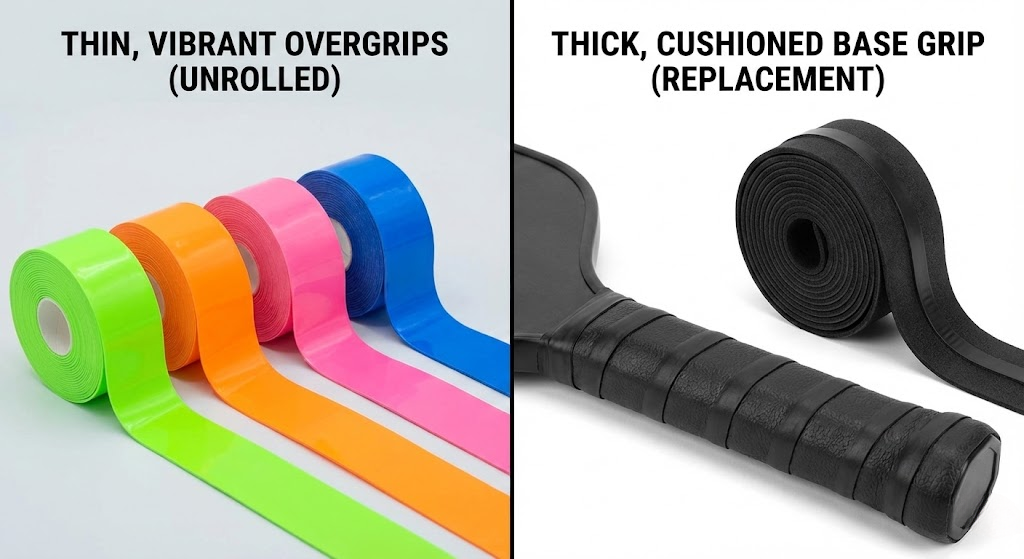
What is an Overgrip?
It is a thin, soft tape that wraps over your original base grip.
Why You MUST Use One
- Sweat Absorption: Factory grips get slippery when wet. A good overgrip absorbs sweat instantly, keeping your hand dry.
- Tackiness: It provides a “sticky” feel, allowing you to hold the paddle loosely (relaxed muscles) without it slipping.
- Custom Sizing: It adds about 1/16th of an inch to the thickness, helping you fine-tune your size.
- Protection: It protects the expensive base grip from wear and tear, which is a key part of proper [paddle maintenance].
- Cheap: They cost $2. Changing them is cheap; changing a paddle is expensive.
Replacement Grip vs. Overgrip
Don’t confuse the two!
Base Grip (Replacement Grip): This is the thick, cushioned grip attached directly to the handle. It provides the structure and comfort. You rarely need to change this unless it’s destroyed.
Overgrip: This is the thin layer you wrap on top. It is disposable.
My Advice: Treat your Base Grip like the mattress, and the Overgrip like the sheets. Change the sheets often; keep the mattress for years.
When to Replace Your Grip?
Overgrips are consumables. Don’t be the player with a black, tattered grip that smells like a locker room.
Signs It’s Time to Change:
- Visual: It looks dirty, frayed, or shredded.
- Feel: It feels smooth and slippery instead of tacky.
- Performance: The paddle twists in your hand on off-center hits.
- Smell: (Do I need to explain?)
Rule of Thumb:
- Frequent Players (3+ times/week): Change every 10-20 hours of play.
- Casual Players: Change every 1-2 months.
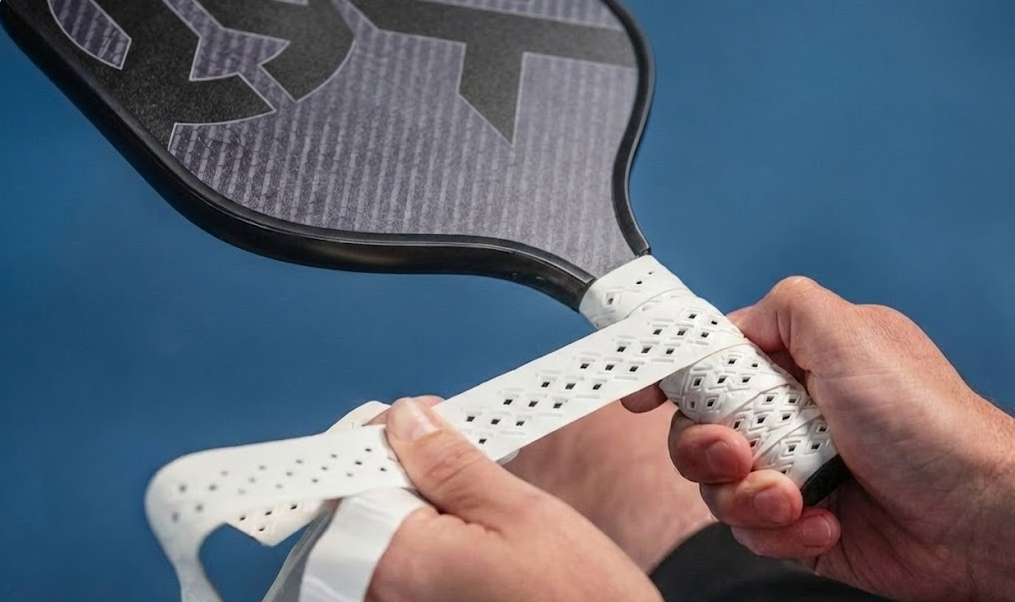
How to Wrap an Overgrip (4 Easy Steps)
It takes 2 minutes and requires no tools (except maybe scissors).
- Remove Old Overgrip: Take off the old one (leave the thick Base Grip on!).
- Start at the Bottom: Peel the plastic off the new grip. Place the tapered end at the very bottom of the handle.
- Wrap Upwards: Pull tight (stretch it slightly) and wrap upwards, overlapping the previous layer by about 1/8 inch. Keep it consistent!
- Finish Top: When you reach the top, cut the excess and secure it with the finishing tape (usually included).
Expert Tip: Don’t be afraid to pull it tight. A loose wrap will bunch up and cause blisters.
Conclusion: Don’t Let a $2 Grip Ruin Your Game
Pickleball is a game of touch and precision. Don’t let a slippery handle or the wrong size handicap your skills.
Take 5 minutes today to check your grip. Measure your hand, buy a pack of tacky overgrips, and wrap a fresh one. You will be amazed at how much more control you have—and your elbow will thank you.
Ready to optimize your gear? Learn more about choosing the right paddle to match your new grip in our [Ultimate Pickleball Paddle Buying Guide].
Frequently Asked Questions About Pickleball Paddle Grips
How do I know if my pickleball paddle grip is too small?
Can a wrong grip size cause tennis elbow?
What is the difference between an overgrip and a replacement grip?
How often should I change my pickleball overgrip?

About Jason Simmons
Jason S. Simmons has been obsessively dissecting racket sports equipment for over a decade. After transitioning from competitive tennis to Pickleball in 2020, Jason realized the market was flooded with confusing marketing jargon and overpriced gear.
His Mission: To help players—especially seniors and those recovering from Lateral Epicondylitis (Tennis Elbow)—find the perfect paddle setup that balances power, control, and health.
Why Trust Jason?
- Material Science Geek: He doesn't just play; he analyzes. From the weave patterns of Toray T700 Raw Carbon Fiber to the density of Polypropylene Honeycomb Cores, Jason understands the physics behind the "pop."
- Data-Driven Testing: Jason has play-tested over 50+ models, evaluating them on Swing Weight, Twist Weight, and Dwell Time rather than just subjective "feel."
- On the Court: Based in the US, Jason actively competes in regional 4.5+ level leagues. When he isn't drilling his third-shot drops, he is likely inspecting paddles for Core Crushing or Delamination issues.
Jason believes that "A dead paddle kills your game," and is dedicated to teaching players how to maintain their grit surface for peak performance.
View all posts by Jason Simmons