5 Fatal Mistakes Beginners Make When Buying a Pickleball Paddle (And How to Avoid Them)
I. Overcoming “Analysis Paralysis”: Your First Pickleball Paddle
Hey there, fellow pickleball enthusiasts! Jason here.
Are you currently staring at Amazon or Dick’s Sporting Goods, overwhelmed by hundreds of paddle options ranging from $20 to $250? Are you thinking, “Which one do I pick? Is expensive always better? What if I make the wrong choice?”
I feel you. As a dedicated pickleball equipment expert, I’ve tested countless paddles. But back when I started, I made my fair share of “toy paddle” mistakes. It cost me money, frustrated me on the court, and frankly, put my elbow through unnecessary strain. That “analysis paralysis” is real!
But don’t worry. Consider me your seasoned pickleball friend. Today, I’m revealing the 5 fatal mistakes 90% of beginners make when buying their first paddle. Avoiding these pitfalls will save you hundreds of dollars and safeguard your arm, ensuring your pickleball journey starts strong, stays healthy, and is packed with fun.
II. Mistake #1: Falling for the “Amazon Bargain” Trap
Ever been tempted by those “2 paddles for $30” sets? Or perhaps a cool-looking aluminum core paddle caught your eye?
The Error:
Buying cheap wooden or aluminum core paddles.
Fatal Consequences:
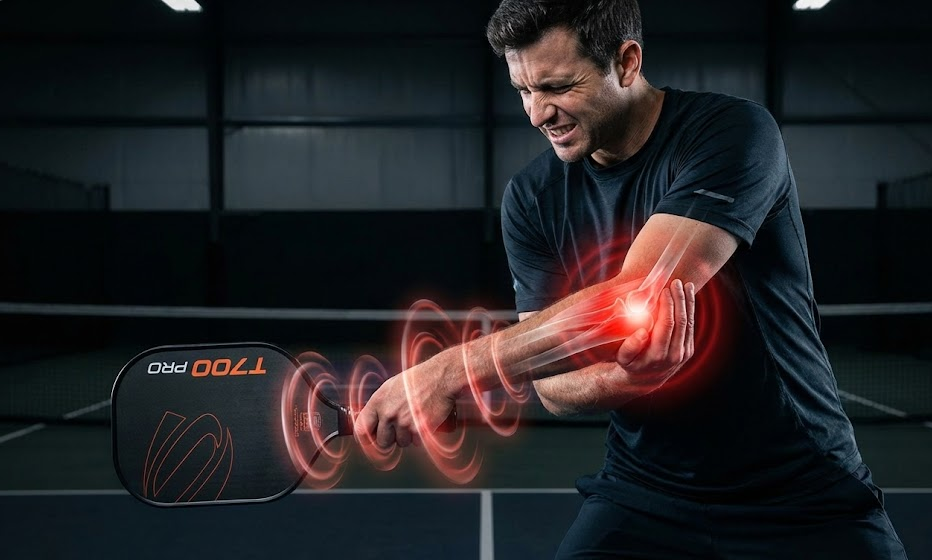
- Vibration City – A Direct Route to Pickleball Elbow: These paddles offer almost zero vibration dampening. Every shot sends jarring vibrations straight up your wrist and elbow. It’s not a matter of if your arm will hurt, but when.
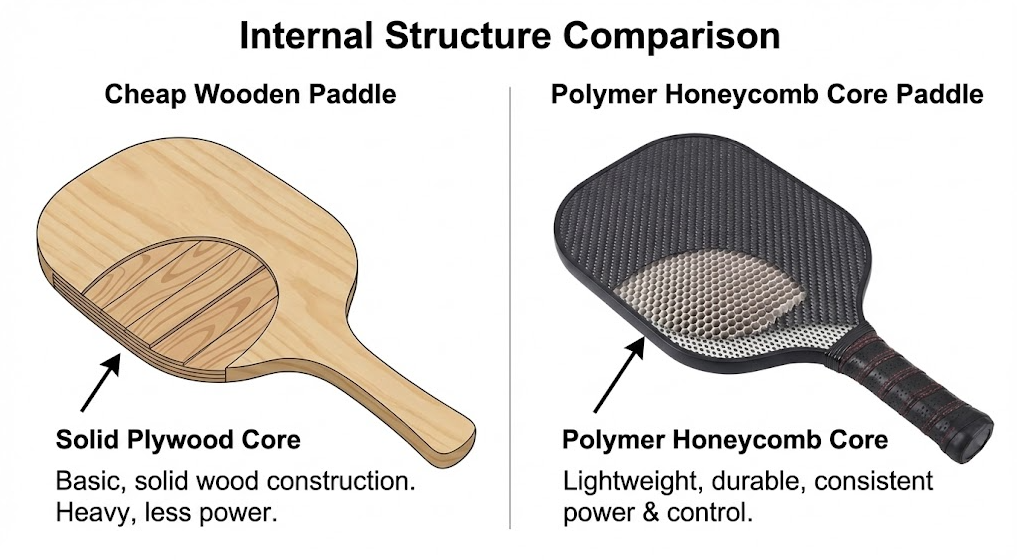
- Slippery Surface, Zero Spin: Wooden faces are typically smooth. You’ll struggle to generate any meaningful spin, meaning your shots will be flat, predictable, and easy for opponents to smash back.
- Tiny Sweet Spot: Cheap paddles have a notoriously small effective hitting area. Even a slight off-center hit results in a dead ball or a mishit. This kills a beginner’s confidence instantly.
I remember being drawn to those flashy “starter sets” when I first started. I quickly found that those wooden paddles made my arm go numb after just 20 minutes, and I couldn’t control the ball to save my life. I tossed them aside pretty fast. That experience taught me that material matters more than price.
The Fix:
Even for your very first paddle, invest in one with a Polymer Honeycomb Core. This is the industry standard for a reason—it offers superior shock absorption and a generous sweet spot.
III. Mistake #2: Obsessing Over “Lightweight”
Many beginners assume “lighter is always better,” believing it allows for faster swings and less fatigue. They often grab paddles weighing 7.3 oz or less.
The Error:
Buying an excessively light paddle (under 7.5 oz) without understanding the physics.
Fatal Consequences:
- Poor Stability: A featherlight paddle lacks the mass to block faster shots. You’ll feel the ball “pushing” your paddle around, leading to wobbly returns.
- Injury Risk ($F=ma$): While light paddles swing fast, they lack “plow-through” mass. This means your arm has to absorb all the shock of the ball impact, rather than the paddle absorbing it. This is a leading cause of tennis elbow.
In my testing, I’ve seen many beginners prematurely chase ultra-light paddles. They end up looking like they are swatting flies, with the paddle fluttering in their hand against power shots. I’ve found that paddles in the 7.8 – 8.2 oz range offer the perfect balance of agility and stability.
The Fix:
Aim for the Midweight Category (7.8 – 8.2 oz). It is the “Goldilocks” zone—light enough to be quick at the net, but heavy enough to absorb shock and drive the ball.
IV. Mistake #3: Prioritizing Power Over Control
You might have heard that “thin paddles generate more power” and picked up a 13mm paddle to hit harder.
The Error:
Buying a thin core paddle (13mm or less) in pursuit of “power.”
Fatal Consequences:
- The “Trampoline Effect”: Thin paddles make the ball pop off the face instantly. For a beginner, this usually means the ball springs off the paddle and flies out of bounds or pops up high for the opponent to smash.
- Low Forgiveness: Thin cores are less stable. If you don’t hit the absolute center, the paddle twists in your hand.
The Reality Check: As a beginner, you don’t need more power to hit the ball out; you need control to keep the ball in.
I’ve seen countless beginners get frustrated because they bought a “Power Paddle” but couldn’t keep a rally going. Switching them to a 16mm paddle was like magic—suddenly, their shots were landing in the court.
The Fix:
Choose a 16mm (thick) Core. This thickness acts like a pillow, absorbing energy and holding the ball on the face longer. It gives you the control you need to master the soft game.
Dive Deeper: 13mm vs. 16mm? Read our [Pickleball Paddle Core Thickness Explained].
V. Mistake #4: Ignoring the Handle – Grip Is Everything
You might have focused solely on the paddle face, neglecting the only part that actually touches you: the handle.
The Error:
Choosing the wrong grip size (too thin) or ignoring grip texture.
Fatal Consequences:
- The “Death Grip” (Tendonitis Alert): If a grip is too thin, your instinct is to squeeze it tight to prevent it from twisting. This constant tension travels up your forearm and inflames your tendons.
- Loss of Control: A handle that is too small or slippery (from sweat) means the paddle face will twist on off-center hits. You think you hit it straight, but the paddle turned in your hand.
I once played a tournament with a grip that was too small for my hand. By the third game, my forearm was burning so bad I could barely hold my water bottle. Never again.
The Fix:
- Measure: Ensure you can fit one finger between your palm and fingertips when holding the paddle.
- Overgrip: Always, always use an Overgrip. It costs $2, adds a bit of cushion, and keeps the paddle secure without needing a death grip.
Dive Deeper: How to measure your hand? Read our [Grip Size & Overgrip Guide].
VI. Mistake #5: Paying the “Hype Tax”
This is the most expensive mistake of all. Thinking that spending $250 will instantly make you a 4.0 player.
The Error:
Buying an overpriced “Pro Signature” paddle just for the brand name.
Fatal Consequences:
- Wasted Budget: You spend $250 on a paddle that uses the exact same T700 Carbon Fiber and Polymer Core as a $90 paddle from a Direct-to-Consumer brand.
- Diminishing Returns: The difference between a $30 paddle and a $90 paddle is massive. The difference between a $90 paddle and a $250 paddle? It’s mostly marketing, player sponsorship fees, and paint.
I’ve cut open $250 paddles and $90 paddles side-by-side. Often, the insides are identical. You are paying for the logo. A good player can win with a frying pan; a bad player will still lose with a $250 paddle.
The Fix:
Look for Specs, not Logos. Look for “T700 Raw Carbon Fiber” and “Thermoformed edges.” If you can find those specs under $100, you have found a winner.
VII. Conclusion: The Perfect “Cheat Sheet”
Avoiding these 5 mistakes puts you ahead of 90% of beginners. You don’t need to guess anymore.
Here is Jason’s “Perfect Beginner Paddle” Checklist:
If you want to buy the right paddle the first time, look for these specs:
- Material: T700 Raw Carbon Fiber (For spin and durability).
- (forCore: 16mm polymer honeycomb (For control and elbow protection).
- Weight: 7.8 – 8.2 oz (midweight for stability).
- Shape: Standard or Wide Body (for the biggest sweet spot).
- Price: $50 – $100 (Don’t pay the hype tax!).
Want a paddle that hits every single one of these checkmarks without breaking the bank?
Check out our [T700 Series]. We built it specifically to solve these 5 mistakes—giving you pro-level materials at an honest price.

About Jason Simmons
Jason S. Simmons has been obsessively dissecting racket sports equipment for over a decade. After transitioning from competitive tennis to Pickleball in 2020, Jason realized the market was flooded with confusing marketing jargon and overpriced gear.
His Mission: To help players—especially seniors and those recovering from Lateral Epicondylitis (Tennis Elbow)—find the perfect paddle setup that balances power, control, and health.
Why Trust Jason?
- Material Science Geek: He doesn't just play; he analyzes. From the weave patterns of Toray T700 Raw Carbon Fiber to the density of Polypropylene Honeycomb Cores, Jason understands the physics behind the "pop."
- Data-Driven Testing: Jason has play-tested over 50+ models, evaluating them on Swing Weight, Twist Weight, and Dwell Time rather than just subjective "feel."
- On the Court: Based in the US, Jason actively competes in regional 4.5+ level leagues. When he isn't drilling his third-shot drops, he is likely inspecting paddles for Core Crushing or Delamination issues.
Jason believes that "A dead paddle kills your game," and is dedicated to teaching players how to maintain their grit surface for peak performance.
View all posts by Jason Simmons