Can Heat Damage a Pickleball Paddle? What Happens in a Hot Car
Imagine you’ve just finished a thrilling match on the court, sweating it out. Exhausted, you return to your car, toss your paddle bag into the trunk, and drive home, grab a bite to eat, or simply park in a sunny spot.
You might think it’s nothing, but I’m here to tell you a harsh truth: your paddle is slowly dying in the “oven” of your car.
This is not an exaggeration. Leaving a paddle in a high-temperature environment for an extended period is the fastest and most thorough way to ruin a good paddle.
As a pickleball equipment expert, I’ve seen far too many players unintentionally ruin their beloved paddles prematurely due to this mistake. This is not only a financial loss but also a huge blow to your playing feel.
High temperature is the scientific principle behind paddle killers
To understand why high temperatures are so deadly, we first need to understand the internal structure of pickleball paddles. A paddle is like a meticulously crafted “sandwich,” typically composed of the following layers:
- Face Material: Typically made of carbon fiber, glass fiber, or composite materials, it provides the surface for hitting the ball.
- Adhesives: Epoxy resins or other polymer adhesives that bond the face material to the core layer tightly.
- Honeycomb Core: The “skeleton” of the paddle, usually made of polymers (such as polypropylene), provides structural support and feel when hitting the ball.
Vulnerable links: glue and polymer
The core of the problem lies in the polymer honeycomb core and epoxy resin adhesive in the paddle.
Adhesive softening: High temperatures can soften the epoxy resin or other polymer adhesives that connect the outer material and the honeycomb core. When the adhesive softens, its ability to hold the paddle structure in place is greatly reduced.
Air expansion: The honeycomb core of the paddle is filled with tiny air cells. When the temperature rises, the air trapped inside the honeycomb core expands rapidly.
Delamination and Deformation: Imagine the internal expansion of air pushing against the external glue, which softens and loses its stickiness due to high temperatures—this double whammy can cause delamination between the outer material and the honeycomb core.
Once delamination occurs, the structural integrity of the paddle is compromised, and its performance is significantly reduced. In extreme cases, it can even lead to warping or bubbling of the paddle’s outer material.
My experience tells me that once a paddle’s glue comes unglued or its core softens, the damage is almost irreversible. This means your paddle is ruined; it can never be restored to its optimal performance and may even become unusable.
Three symptoms of heat-induced injury
How can you tell if your paddle has been damaged by high temperatures? Here are three of the most common “SOS signals”:
1. Delamination/Separation
These are the most typical and easily identifiable symptoms of heat-induced injury.
- Visual signs: The surface of the paddle may no longer be smooth, with local bulges, bubbles, or even visible warping.
- Tactile characteristics: When you press the paddle face with your fingers, you will feel a noticeable hollow or soft area underneath, rather than a solid support.
- Auditory manifestation: When you tap the paddle face lightly, a normal paddle will produce a crisp “tap-tap” sound, while a damaged paddle may produce a “creak” sound, a dull sound, or a change in pitch in different areas. This indicates that the surface material and the core material have separated.
“In my testing, I found that the first sign of many paddles experiencing performance degradation was a subtle hollow sound under the paddle face. Many players didn’t even notice the change in the feel of the paddle before they even realized it.”
2. The feel becomes softer, resulting in weaker shots (the “mushy” feel & dead spot).
If your paddle loses its crisp “pop” sound when hitting the ball, feels dull like hitting mud, or experiences a significant decrease in hitting power, it’s likely that the core has been damaged.
High temperatures can soften the polymer core, causing it to lose its original elasticity and structural rigidity, leading to:
- Energy loss upon impact: The paddle cannot effectively transfer the energy of the impact, resulting in a slower ball speed.
- Decreased control: The consistency and feedback of the paddle deteriorate, affecting the accuracy of the shot.
- Sweet spot shrinks: The effective hitting area (sweet spot) of the paddle becomes smaller, reducing the margin for error in hitting the ball.
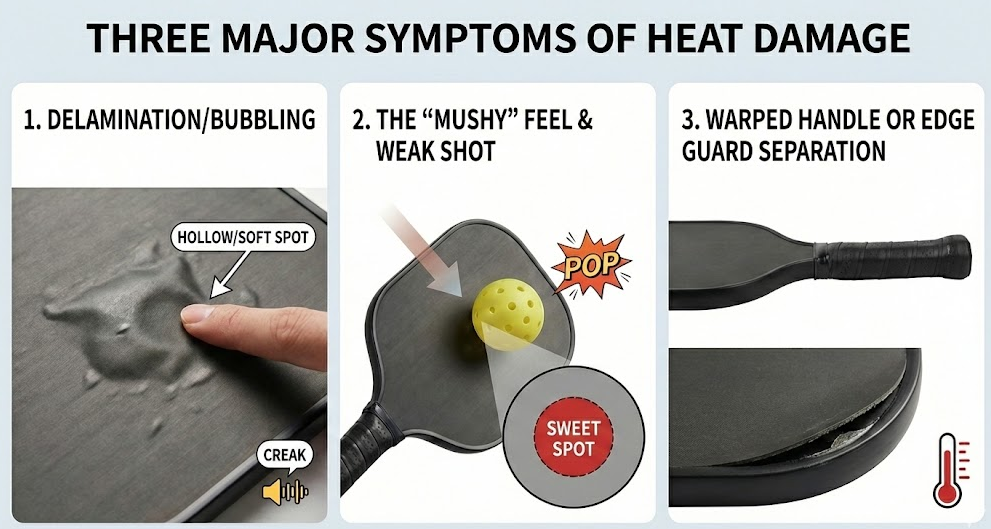
deformed; 3. The handle is deformed, or the edge guard separation is detached.
Under extreme high temperatures, some parts of the paddle may deform directly.
- Handle deformation: Although uncommon, the grip or handle structure of a paddle may bend or deform under prolonged exposure to extremely high temperatures.
- Edge protection strip detachment: The edge protection strip of a paddle is usually fixed with adhesive. High temperatures can soften it, causing the edge protection strip to loosen or detach, creating an entry point for moisture and other impurities to enter the paddle.
The “Car Oven” Effect: A Real Threat
You might think that leaving your paddle in your car for a short time won’t cause any major problems. However, the speed and extent to which the temperature inside a vehicle rises is far beyond your imagination.
|
Outside temperature (Fahrenheit/Celsius) |
The temperature inside the car after 10 minutes |
Car interior temperature after 30 minutes |
Car interior temperature after 60 minutes |
|
80°F (27°C) |
99°F (37°C) |
118°F (48°C) |
123°F (50°C) |
|
90°F (32°C) |
109°F (43°C) |
124°F (51°C) |
133°F (56°C) |
These figures are alarming: even when the outside temperature is only 27°C (80°F), the temperature inside your car can soar to over 50°C (123°F) in just one hour. Such high temperatures are enough to soften the paddle’s adhesive and cause the polymer core to swell, resulting in irreversible damage.
Even if you’re just going to the supermarket to buy water, don’t leave your paddle in your car in the sun.
“I often tell players that leaving a paddle in a car is like throwing a precision instrument into an oven; the consequences are predictable. The temperature in such an environment far exceeds the design limits of any paddle.”
In addition to high temperatures: Extreme cold weather warning
pickleball Although this article mainly focuses on high temperatures, as a pickleball equipment expert, I would also like to take this opportunity to remind everyone of the impact of extreme cold weather.
- Increased brittleness: Unlike high temperatures that soften polymers, extreme cold makes the polymer honeycomb core of the paddle brittle.
- Core breakage risk: In extremely cold conditions, if you hit the ball hard with a cold paddle, the honeycomb core may shatter due to the impact, causing damage to the paddle’s internal structure.
So please remember this “pet rule“:
“Treat your paddle like you would a pet.”
pickleball If you feel it’s too hot or too cold in your car for people or dogs, then it’s also not a good place to put your pickleball paddle.
Prevention is key: Simple storage tips to extend paddle life
Fortunately, preventing heat-related injuries is not complicated; it simply requires developing some good habits:
- indoors. Make it a habit to carry your paddle bag with you at all times: after playing pickleball, always take your bag indoors; never leave it in your car. This is the simplest and most effective way to protect yourself.
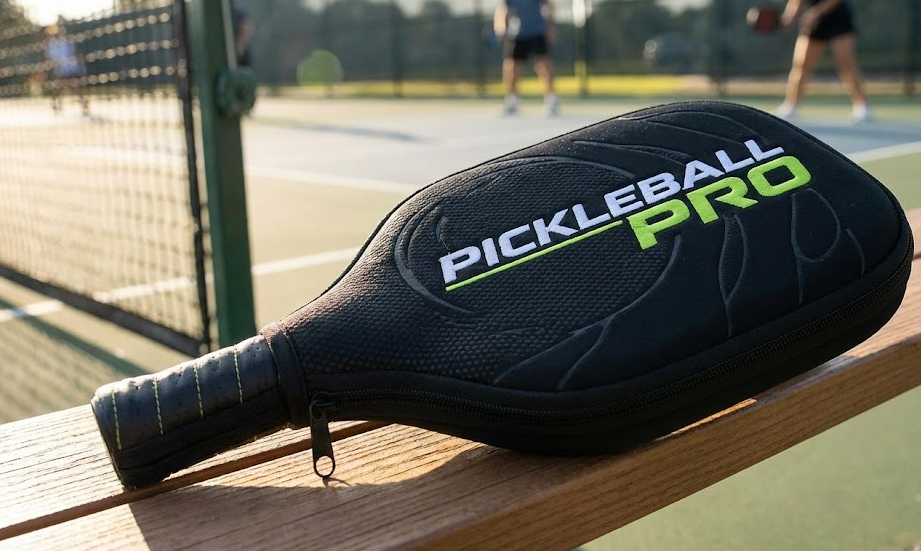
- Use a paddle cover: While a regular paddle cover cannot completely prevent heat conduction, it provides basic physical protection, reduces scratches, and cushions temperature fluctuations to some extent.
- pickleball Consider an insulated bag: If you frequently play in extreme weather or need to carry your paddle for extended periods, investing in a professional pickleball paddle bag with insulation is a wise choice. It will better help maintain your paddle at a relatively stable temperature.
- radiators, Choose a suitable storage location: At home, store the paddle in a cool, dry environment at room temperature, away from direct sunlight, radiators, or other heat sources.
Protect your investment
Whether your pickleball paddle is a $50 base model or a $250 high-end professional model, they are all equally fragile and cannot withstand high temperatures. Improper storage habits will not only shorten the life of your paddle but also affect your performance and enjoyment of the game. Don’t let a moment of laziness or negligence cost you your wallet.
If your paddle is bubbling, feels soft, or sounds like a piece of rotten wood, it has likely suffered irreversible high-temperature damage, and it is time to replace it.
Ready to find the perfect paddle for you? Check out our durable T700 carbon fiber series paddles—and this time, remember, don’t leave it in your car!
Quick Answer: Can Heat Damage a Pickleball Paddle?
Yes. Heat can soften glue, stress the edge guard, and make the core or face feel different, especially if the paddle is left in a hot car or direct sun for long periods. If you notice edge lifting, a warped face, a new dead spot, or a dull feel, check the paddle before playing again.
Related guides: repair a damaged paddle edge guard and when to replace a pickleball paddle.

About Jason Simmons
Jason S. Simmons has been obsessively dissecting racket sports equipment for over a decade. After transitioning from competitive tennis to Pickleball in 2020, Jason realized the market was flooded with confusing marketing jargon and overpriced gear.
His Mission: To help players—especially seniors and those recovering from Lateral Epicondylitis (Tennis Elbow)—find the perfect paddle setup that balances power, control, and health.
Why Trust Jason?
- Material Science Geek: He doesn't just play; he analyzes. From the weave patterns of Toray T700 Raw Carbon Fiber to the density of Polypropylene Honeycomb Cores, Jason understands the physics behind the "pop."
- Data-Driven Testing: Jason has play-tested over 50+ models, evaluating them on Swing Weight, Twist Weight, and Dwell Time rather than just subjective "feel."
- On the Court: Based in the US, Jason actively competes in regional 4.5+ level leagues. When he isn't drilling his third-shot drops, he is likely inspecting paddles for Core Crushing or Delamination issues.
Jason believes that "A dead paddle kills your game," and is dedicated to teaching players how to maintain their grit surface for peak performance.
View all posts by Jason Simmons