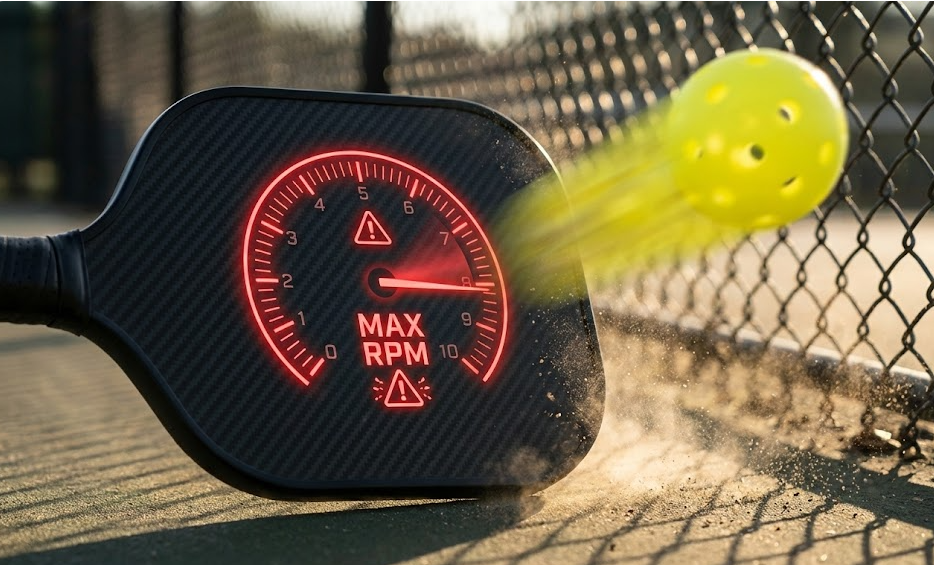
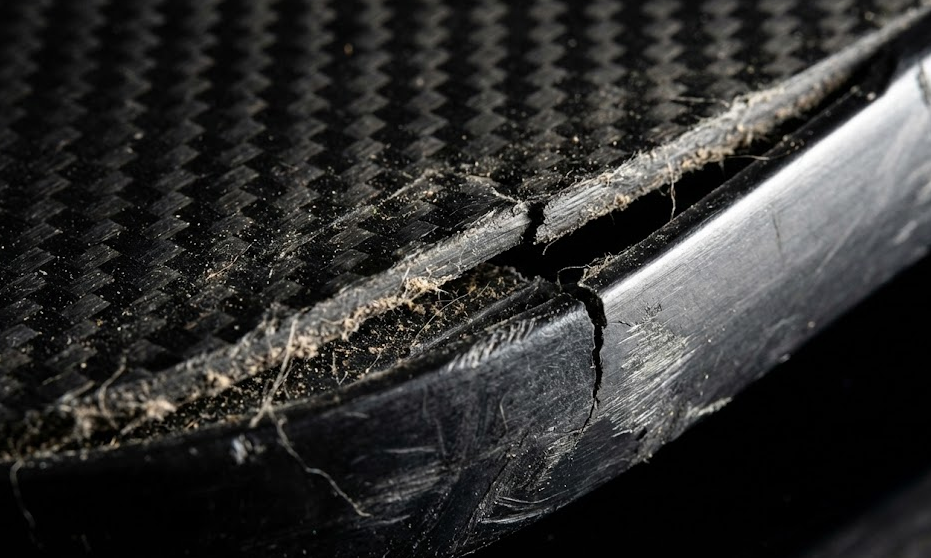
Is your Pickleball Paddle “bald”? Restore lost spin and friction in just 1 minute!
Have you ever had this experience? You just got a brand new T700 Raw Carbon Fiber Pickleball Paddle, and its rough surface felt like sandpaper, giving you confidence to create all sorts of tricky spin shots on the court. However, after just a few months, you find that the paddle surface has become as smooth as a mirror, the ball is no longer as obedient as before, and the spin shots have become weak and powerless.
Panic ensued: “Did I buy a fake?” “This paddle is nearing the end of its lifespan, should I replace it?”
Don’t jump to conclusions, and certainly don’t rush to put your precious paddle away. As an expert with years of experience in Pickleball equipment, I can tell you a secret: your paddle is likely just experiencing “clogged pores,” not actual “baldness.” The solution is within reach; you can even revive it in a minute. I remember being incredibly frustrated when I first encountered this “loss of spin,” thinking my high-end paddle was ruined so quickly, but it turned out to be a simple misunderstanding.
Science Revealed: Why Does Your Paddle Lose Friction?
To understand why a paddle “loses spin,” we first need to understand its surface structure and the physical properties of the Pickleball.
“The grater effect”: How Pickleballs clog carbon fiber textures
Carbon fiber paddles, in particular, have surfaces composed of countless tiny weaves. These grooves and protrusions, barely perceptible to the naked eye, are the secret base for “gripping” the Pickleball and generating friction.
However, the Pickleball itself is made of soft plastic. With each high-speed shot, the rough surface of the paddle acts like a delicate “grater,” scraping away extremely small amounts of plastic powder from the Pickleball. These almost invisible plastic dust particles accumulate over time, gradually filling the tiny grooves in the carbon fiber texture. When these grooves are filled, the paddle surface naturally becomes smooth, significantly reducing friction and spin.
So, your paddle isn’t actually “worn out”; it’s just “clogged in pores.” Just like our skin’s pores get clogged with oil, the paddle’s “pores” are also clogged with plastic dust.
Diagnose your paddle: Is it dirty or truly worn out?
Before taking any cleaning measures, it is crucial to quickly diagnose your paddle. Usually, you can identify the problem through simple visual and tactile tests.
Two simple steps to identify paddle problems
Visual inspection: Look for the “white film.” Carefully observe the center area of the paddle, also known as the “sweet spot.” Can you see a thin, whitish, or even slightly grayish film or mark? This film is often accumulated plastic powder. This phenomenon will be more obvious in bright light.
Tactile Scratch Test: Can you scrape off powder? Gently scratch the surface of the paddle with the tip of your fingernail. If you can feel some fine powdery material coming off as your fingernail scratches the surface, or if light-colored marks are left under your fingernail, then congratulations—your paddle is likely just dirty, not permanently worn. This is a typical sign of plastic powder clogging the texture.
If your paddle passes both of the above tests, the good news is that its spin can be fully restored!
Instant Recovery: The Magic of Pickleball Paddle Eraser
Now that we’ve identified the problem as “clogging,” the solution is quite simple and straightforward. What you need is a secret weapon specifically designed for Pickleball paddles—the Paddle Eraser.
The secret weapon of paddles: Crepe Rubber Paddle Eraser
This cleaning tool looks like a large eraser, but it’s not made of ordinary stationery erasers. Instead, it’s made of a special type of raw rubber (Crêpe Rubber). Its working principle isn’t grinding; instead, it uses the unique adhesive properties of the raw rubber, like a vacuum cleaner, to “stick” out plastic powder and dirt stuck in the carbon fiber texture, thus revealing the original rough texture underneath.
1-Minute Recovery Guide: Get Your Spin Back On Instantly
Restoring paddle spin using a rubber cleaner is extremely simple and takes only one minute:
- Make sure the paddle surface is dry. A damp surface will affect the stickiness of the eraser.
- Pick up the Paddle Eraser and gently but firmly rub the paddle face, especially areas that are visibly dirty or feel smooth, in circular motions. You don’t need to apply too much pressure; just let the eraser’s stickiness work.
- You will witness a miracle: the eraser will gradually turn black, and the surface will be covered with plastic powder that has been “stuck” out. At the same time, the carbon fiber texture at the bottom of the paddle will reappear, and the rough texture will return.
- Finally, gently wipe the paddle surface and remove any remaining debris with a clean, dry microfiber cloth. Your paddle will be brand new, with its spin instantly restored!
In my numerous tests, a high-quality Paddle Eraser can restore a paddle from a “disheartened” state to a “battle-ready” state in just a few dozen seconds. This immediate effect is impressive, as if it has pressed the “reset button” on the paddle.
Cost-effective choice: Small investment, big returns
A high-quality Pickleball paddle cleaner typically costs around $10, yet it can be used repeatedly for months or even a year. Compared to spending hundreds of dollars to replace a paddle, a cleaner is undoubtedly a very cost-effective investment. It effectively extends the time your paddle performs at its peak, allowing you to remain competitive on the court.
Key difference: Raw Carbon Fiber versus “sprayed frosted layer” (beware of inferior imitations)
In the Pickleball paddle market, not all paddles claiming to have a “rough texture” are trustworthy. Understanding the differences can help you avoid the pitfalls of inferior products and protect your investment.
Why Not All Textured Paddles Are Reliable
The Trap of “Spray-Coated Matte Layers”: Fleeting Friction. Some inexpensive paddles on the market use a “spray-coating” technique to mimic the rough feel of high-end carbon fiber paddles. They spray a layer of fine sand, a matte coating, or a special resin onto the paddle surface. While this “spray-coated matte layer” can provide some friction in the short term, its drawbacks are obvious: this surface will gradually wear off due to hitting, friction, and daily use. Once the matte layer is gone, the paddle is truly “bald,” losing all friction, and this loss is irreversible. At this point, no matter how good the cleaning agent, it won’t help. I’ve seen players complain that their newly purchased paddles quickly lose spin, only to discover upon closer inspection that it’s a problem with this spray-coated surface—that’s the real “end of life.”
The Durability of Raw Carbon Fiber (Our Advantage): True Recoverable Power. In stark contrast, the Raw Carbon Fiber paddles we recommend, and those mainstream in the high-end market (such as our T700 series), feature a surface texture that is inherent to the material itself. This texture is formed during the manufacturing process of the carbon fiber cloth; it is part of its material composition, not an added coating. This means that unless the carbon fiber cloth is physically worn through (which requires an extremely long time and extreme abrasion to occur), its inherent rough texture will remain forever. When it “loses spin” due to plastic powder blockage, the blockage can be removed with a raw rubber cleaner, revealing the original texture and restoring its spin potential. This is true durability and performance assurance, and the true value of investing in a high-end paddle.
Choosing a Raw Carbon Fiber paddle means you’re choosing a maintainable, recoverable, and durable piece of equipment, rather than a “disposable” surface friction paddle.
Caution: Never use these cleaning methods!
Choosing the right cleaning tools is crucial for restoring your paddle’s performance. At the same time, it’s even more important to understand which methods are absolutely forbidden to avoid causing irreversible damage to your valuable paddle.
Protect your investment: Avoid incorrect cleaning methods
As a Pickleball equipment expert, I must solemnly warn you:
- Keep away from water and soap: the risk of core dampness! You might think cleaning with water and mild soap is safe, but for most Pickleball paddles, especially those with a honeycomb core, this is extremely dangerous. Water can seep into the paddle through the edge guard, causing the honeycomb core (usually polymer or aluminum) to become damp. Once damp, it can lead to mold growth, or even worse, the honeycomb structure can detach and swell, severely affecting the paddle’s structural integrity, balance, and hitting performance. This damage is often irreparable.
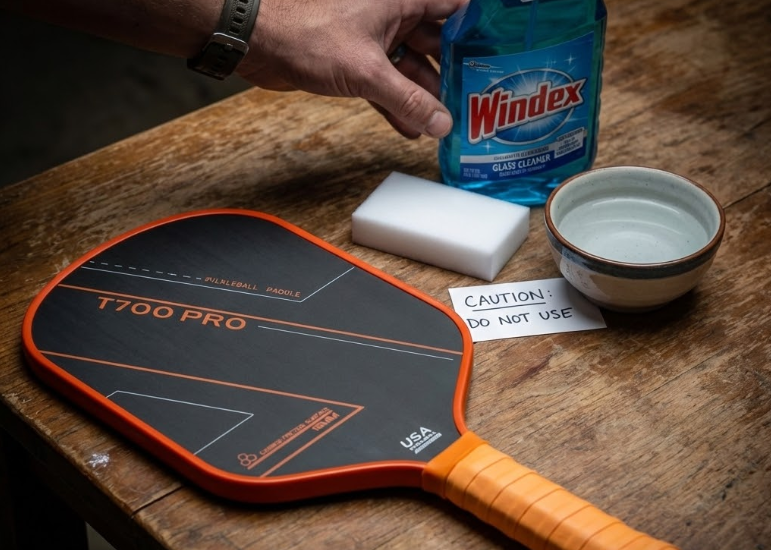
- Reject Household Cleaners: The Culprit Behind Resin Corrosion! Commercially available household cleaners, such as glass cleaners and kitchen cleaners, often contain corrosive chemicals. These chemicals can corrode the resin layer (the protective coating) on the surface of carbon fiber, damaging its physical structure and accelerating the loss of texture. Once the resin layer is damaged, it not only affects the paddle’s durability but also permanently alters its feel and spin potential.
Simple rule: For Raw Carbon Fiber paddles, use only a Paddle Eraser! The safest, most effective, and only recommended cleaning method for your Raw Carbon Fiber Pickleball paddle is to use a specialized raw rubber cleaning bar. It precisely removes blockages without damaging the paddle material itself.
Summary and Recommendations: Maintain peak performance and control the game.
The allure of Pickleball lies in the perfect combination of skill and equipment. Don’t panic when your paddle loses spin and affects your performance. It’s likely just that its brilliance is being obscured by plastic dust.
Develop the habit of keeping your paddle in “battle mode” at all times.
Regular Cleaning: A Simple Habit, Huge Rewards.
I strongly recommend developing a simple habit: after every few games, or when you feel your paddle’s friction has decreased, quickly clean the surface with a rubber cleaner. Just like polishing your shoes after exercise, it’s a simple maintenance habit that brings huge rewards. It ensures your paddle is always in peak condition, giving you confidence on the court and allowing you to control every shot.
Say goodbye to spin anxiety
Now you understand the science behind Pickleball paddles losing spin and how to effectively restore it. The loss of spin in your paddle is most likely a temporary “blockage,” not permanent damage. A Paddle Eraser is your most reliable partner, helping to extend the life of your paddle.
Experience truly sustained rotation
Ready to experience truly durable, regenerative spin from the T700 Raw Carbon? If you haven’t yet tried a genuine high-end carbon fiber paddle, or are looking for one so durable it’s practically “won’t break,” I invite you to explore our [T700 Raw Carbon Series]. Choose a paddle that will give you a significant boost on the court and feel the ultimate control and spin with every shot!

About Jason Simmons
Jason S. Simmons has been obsessively dissecting racket sports equipment for over a decade. After transitioning from competitive tennis to Pickleball in 2020, Jason realized the market was flooded with confusing marketing jargon and overpriced gear.
His Mission: To help players—especially seniors and those recovering from Lateral Epicondylitis (Tennis Elbow)—find the perfect paddle setup that balances power, control, and health.
Why Trust Jason?
- Material Science Geek: He doesn't just play; he analyzes. From the weave patterns of Toray T700 Raw Carbon Fiber to the density of Polypropylene Honeycomb Cores, Jason understands the physics behind the "pop."
- Data-Driven Testing: Jason has play-tested over 50+ models, evaluating them on Swing Weight, Twist Weight, and Dwell Time rather than just subjective "feel."
- On the Court: Based in the US, Jason actively competes in regional 4.5+ level leagues. When he isn't drilling his third-shot drops, he is likely inspecting paddles for Core Crushing or Delamination issues.
Jason believes that "A dead paddle kills your game," and is dedicated to teaching players how to maintain their grit surface for peak performance.
View all posts by Jason Simmons