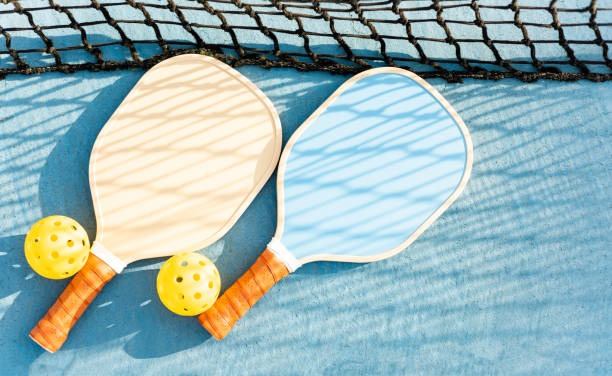
The myth of high spin on Pickleball Paddles: If you can’t control the ball, even the highest spin is meaningless.
As a seasoned pickleball equipment expert, I often see players fall into a misconception when choosing paddles: a blind worship of “high RPM” (revolutions per minute). If you watch various review videos, you’ll find that the current pickleball paddle market resembles a race car, with every brand claiming its paddle reaches an “amazing 2000+ RPM,” as if this is the sole criterion for judging a paddle’s quality.
But I must seriously remind you that this is like putting a beginner directly into driving an F1 car. If your paddle provides extremely high spin, but you can’t control the ball precisely, and the margin for error is extremely low, then these so-called “high spin” figures will only make you hit the ball onto the fence faster, not hit a winning shot. What you really need isn’t a paddle with the best specs on paper, but a partner that allows you to truly control the spin in actual gameplay.
The Science of Rotation: It’s More Than Just Sandpaper-like Roughness
To understand the spin of a pickleball paddle, we must delve into its core physics. Spin is not determined by a single factor but by a perfect combination of two key elements: friction and dwell time.
Friction: The “upper limit” of rotation
Friction primarily comes from the texture and material of the paddle’s surface. For example, a high-quality T700 raw carbon fiber surface, with its unique roughness (typically achieved through “peel ply” or “thermoforming” processes), provides superior ball grip. This surface, like the fingerprints on your palm, better “grips” the pickleball, thus generating powerful friction at the moment of impact. This determines the maximum spin potential your paddle can impart to the ball—the theoretical upper limit of RPM.
Dwell Time: The “Key” to Rotation
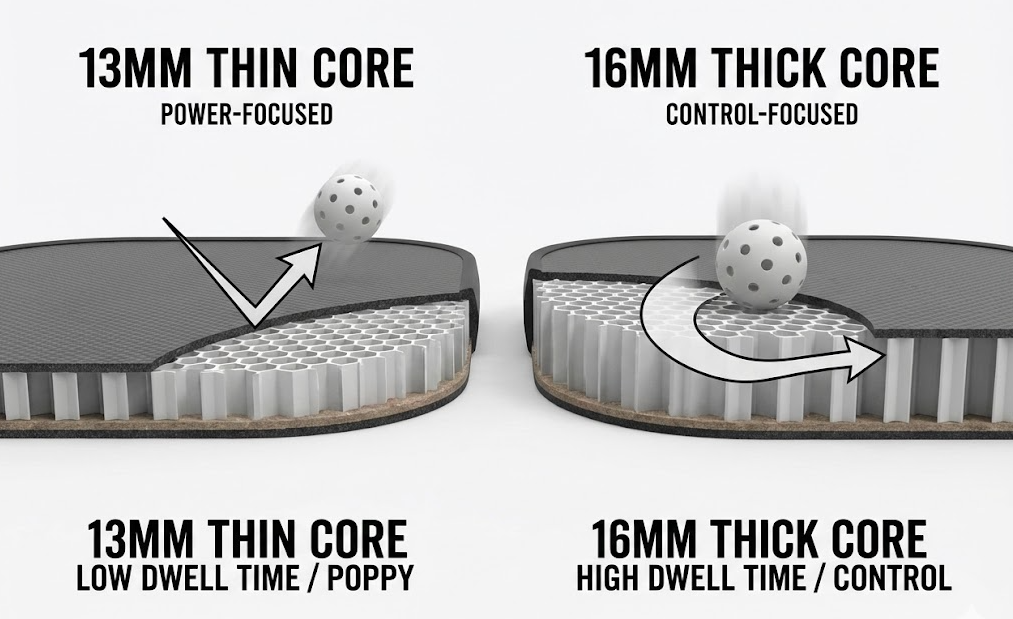
The dwell time (or “contact time”) of the ball on the paddle face is equally crucial. This is mainly determined by the thickness of the paddle core and its material properties. A thicker paddle core generally provides a longer dwell time, allowing the ball to “sink” into the paddle face at the moment of impact, giving you more time to “rub” against it, rather than bouncing away instantly.
Key point: If the ball bounces off the paddle face within 0.001 seconds, no matter how rough the paddle surface is, you simply don’t have enough time to apply effective spin. You need the ball to stay on the paddle face long enough to actually use friction to “roll” it up and generate the topspin or sidespin you want.
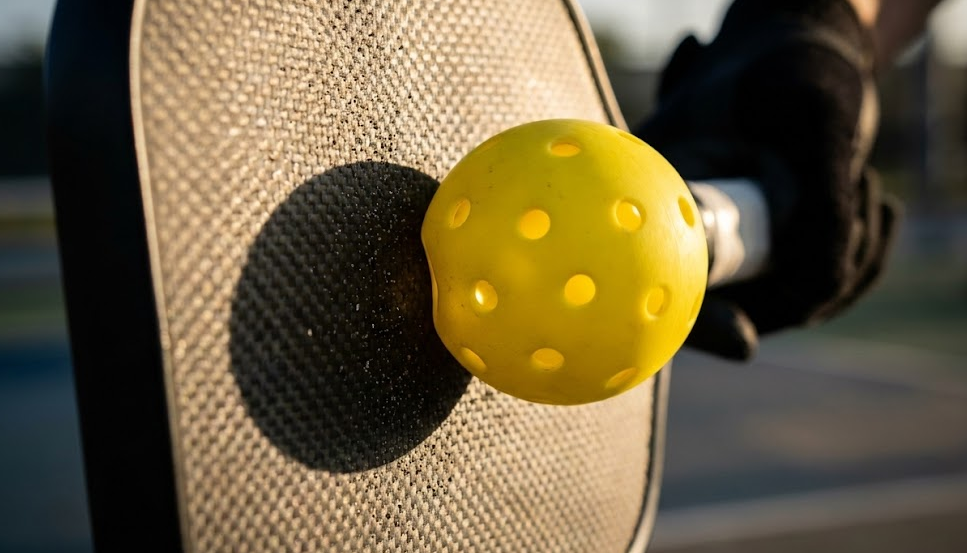
The trap of high spin and high elasticity: shots go out of bounds, endless trouble.
In my testing, I found that many paddles on the market that advertise “extremely high spin” often have a common feature: they are usually very thin (e.g., 13 mm or 14 mm) and have a stiff core material, resulting in a very high popping effect.
Difference between laboratory data and real-world performance
These paddles can indeed produce astonishing RPM (revolutions per minute) data when tested in a laboratory setting using standardized machine-based hitting techniques. This is because the machine’s movements are perfect, with precise contact points and power. However, the situation is quite different when these paddles are in the hands of a real player. In the heat of a match, your movements cannot always be flawless. A slight miscalculation in power or a slight deviation in the contact point can cause the thin, bouncy material of the paddle to cause the ball to leave the paddle face instantly, resulting in excessive ball speed and sending it flying directly out of bounds or sidelines.
The troubles of “bouncing balls”
Have you ever had this experience: you want to hit a beautiful flat topspin shot, but the ball unexpectedly bounces very high, giving your opponent an easy opportunity to smash it? This is a typical example of the “high spin + high elasticity” trap. The paddle’s elasticity is too strong, causing the ball to stay on the paddle face for too short a time. You simply cannot effectively “wrap” the ball and apply enough downward pressure and friction, ultimately resulting in a “high bounce.”
The concept of “Usable Spin”: its true value in practice.
So, what kind of spin should we be pursuing? I propose a concept called “Usable Spin.”
What is “Usable Spin”?
“Usable spin” refers to the spin you can consistently and reliably generate even under pressure during a match, when your movements are imperfect, your body is uncoordinated, or even when you’re on defense. It’s not a laboratory-generated limit, but rather the spin you can actually “use” on the court.
Why is 16 mm thickness + T700 surface my first choice?
Based on my years of testing and practical experience, I personally prefer a paddle with a 16 mm thick core and a T700 raw carbon fiber surface. While this type of paddle might not have the highest RPM in some extreme tests (for example, perhaps around 1800 RPM instead of 2000+ RPM), its dwell time is exceptional.
What does this mean? It means the ball stays on the paddle face longer, giving you more time to adjust the paddle angle and apply the desired spin. The result is consistent spin on every shot, instead of a few spectacular shots followed by nine frustrating errors. This consistency is what you truly need in a match.
|
Core Thickness |
Key Features |
Spin Potential |
Control |
Suitable for Ideal Players |
13 mm |
Extremely thin, highly elastic, and strong. |
High (but difficult to control) |
Low |
Offensive, power-based, professional players who require precise control |
14 mm |
Thinner, with a balance between elasticity and control, and a fast response. |
Higher |
Medium |
Offensive players who enjoy quick reactions |
16 mm |
Balanced, high dwell time, high fault tolerance |
High (Usable Spin) |
High | All-rounder: a player who focuses on control and stable spin. |
19 mm+ | Extremely thick, with superior control and shock absorption but relatively weak force. |
Medium |
Extremely high |
Defensive players who prioritize shock absorption and feel. |
Don’t pay the price for paper data: your feel is more important than RPM.
Digital games in brand marketing
I’ve noticed that many brands, in order to increase the RPM of their paddles from 1800 to 1900, might make minor tweaks to the materials or manufacturing process, then present this as a huge “upgrade,” instantly increasing the price by $50 or more. This is often driven by marketing rather than a genuine performance breakthrough.
Your feel is more important than RPM.
In my experience, as an average amateur player, it’s very difficult to distinguish the minuscule 5% difference between 1800 RPM and 1900 RPM. This numerical improvement has virtually no impact on your performance in actual matches.
My advice is as long as the paddle surface is made of genuine raw carbon fiber, the spin it provides is sufficient for most amateur players. Instead of blindly pursuing the ultimate on-paper stats, focus your energy on choosing a paddle that offers stability and excellent feel.
Conclusion and Recommendations
Stop having a spec sheet obsession. Remember, on a pickleball court, if you can’t control the ball, high spin is meaningless. A truly good paddle should help you translate your intentions into actual shots, rather than leading you astray in the pursuit of extreme statistics.
Looking for a paddle that truly lets you “control” spin? Say goodbye to flashy numbers and choose a design that offers superior dwell time and control. Check out our [16mm T700 Control Series]—designed for real-world spin, helping you improve your performance on the court, not just on paper.

About Jason Simmons
Jason S. Simmons has been obsessively dissecting racket sports equipment for over a decade. After transitioning from competitive tennis to Pickleball in 2020, Jason realized the market was flooded with confusing marketing jargon and overpriced gear.
His Mission: To help players—especially seniors and those recovering from Lateral Epicondylitis (Tennis Elbow)—find the perfect paddle setup that balances power, control, and health.
Why Trust Jason?
- Material Science Geek: He doesn't just play; he analyzes. From the weave patterns of Toray T700 Raw Carbon Fiber to the density of Polypropylene Honeycomb Cores, Jason understands the physics behind the "pop."
- Data-Driven Testing: Jason has play-tested over 50+ models, evaluating them on Swing Weight, Twist Weight, and Dwell Time rather than just subjective "feel."
- On the Court: Based in the US, Jason actively competes in regional 4.5+ level leagues. When he isn't drilling his third-shot drops, he is likely inspecting paddles for Core Crushing or Delamination issues.
Jason believes that "A dead paddle kills your game," and is dedicated to teaching players how to maintain their grit surface for peak performance.
View all posts by Jason Simmons