How to Clean a Pickleball Paddle: Restore Spinning, Remove Debris, and Extend Life (2026 Guide)
Hey Pickleball fans! Do you feel like your pickleball paddles have become a bit “sluggish” lately? Your once-sharp backspin (slice) has become unremarkable, and your once-proud topspin (topspin) no longer holds the ball?
Don’t rush to buy a new racket (unless you’ve already checked our 【2026 Best Pickleball Paddles Guide】 and decided to upgrade). As a seasoned Pickleball Equipment Expert, I’m here to tell you a truth that 90% of players overlook: your racket might not be broken; it’s just “dirty.”
. In this guide, we’ll delve into the correct way to clean your pickleball paddle. We’ll not only address ball residue removal but also teach you how to rejuvenate your raw carbon fiber surface and significantly extend the life of your equipment through proper pickleball paddle care.
Why is cleaning a pickleball paddle a matter of life and death?
racket; you might ask, “It’s just a racket; is it really necessary to be so particular?” The answer is: Absolutely.
1. Ball Residue (Spin Killer)
carbon fiber pickleball paddles—rely Most modern high-performance rackets—especially carbon fiber pickleball paddles—rely on the grit on their surface to generate friction. When you hit the ball, tiny fragments of the pickleball (plastic ball) detach and embed themselves in the grooves of these textures. Over time, these ball residues fill in the racket face, smoothing out the rough surface.
Consequences: Reduced friction -> loss of spin -> decreased ball control accuracy.
2. Feel and Feedback
Besides spin, accumulated dirt and sweat can also affect the crispness of your shot. Regular cleaning can help you rediscover that “pop” sound and clear feedback.

How to clean a Carbon Fiber Pickleball Paddle (Best Solution)
For the currently popular Raw Carbon Fiber (T700) material, ordinary wiping is far from enough. You need more professional tools.
Step 1: Use a pickleball paddle eraser.
The gold standard for cleaning carbon fiber racket surfaces.
What it is: A specially designed rubber block (Rubber Cleaning Block).
How to use: On a dry racket surface, rub vigorously up and down or in a circular motion.
Magic Effect: You’ll see the eraser turn gray, while the racket face returns to its original deep black. It physically “grabs” out plastic ball fragments embedded deep in the texture, instantly restoring spin.
Frequency: Recommended after every session.
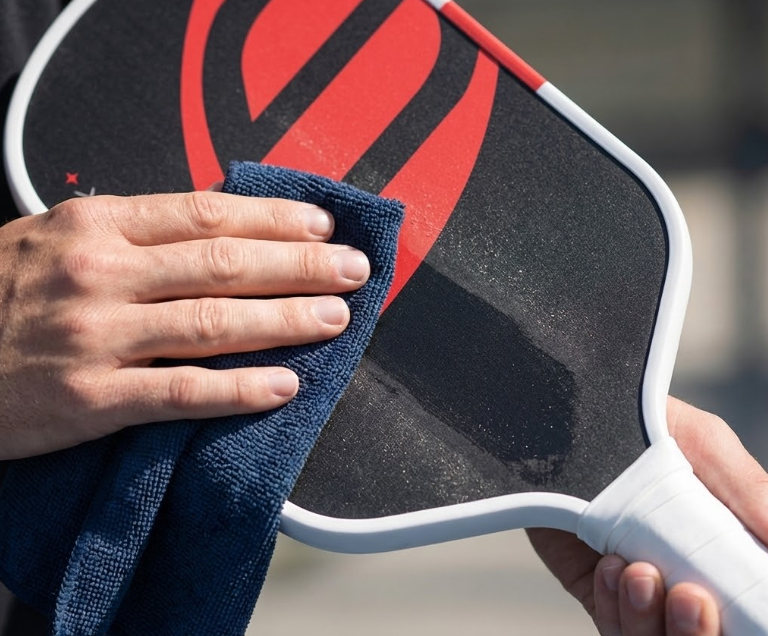
Step 2: Warm water and microfiber cloth (General Cleaning)
For Graphite or Fiberglass rackets (if you are unsure, read about the differences between carbon fiber and fiberglass), or for deep cleaning of carbon fiber rackets:
- microfiber cloth. Take a piece of microfiber cloth.
- Dampen it with a little warm water and wring it out until it is slightly damp.
- Gently wipe the surface to remove sweat and dirt.
- Key: Wipe dry immediately with a dry cloth.
honeycomb core Warning: Never soak your racket in water! Moisture seeping into the honeycomb core can cause irreversible damage.
Avoid these pitfalls: Never use these things!
Can I use a magic eraser?
BIG NO. While Magic Eraser is great for cleaning the home, it is essentially a micro-abrasive.
Risk: Using a magic eraser on a carbon fiber racket surface is equivalent to sanding with fine sandpaper. It will smooth out your grit, leading to permanent spin loss.
edge guard. Conclusion: Never touch the racket face unless you want to ruin it. If you have already damaged your paddle with a Magic Eraser, you might need to look at the best affordable paddles under $100 for a replacement.
Can I use wet wipes/glass cleaner?
Not recommended.
Wet Wipes: Many contain moisturizers or oils that leave a thin film on the racket surface, making the racket smoother.
Glass Cleaner (Windex): The chemical composition is too strong and may break down the resin coating on the surface.
Best solution: Just use water.
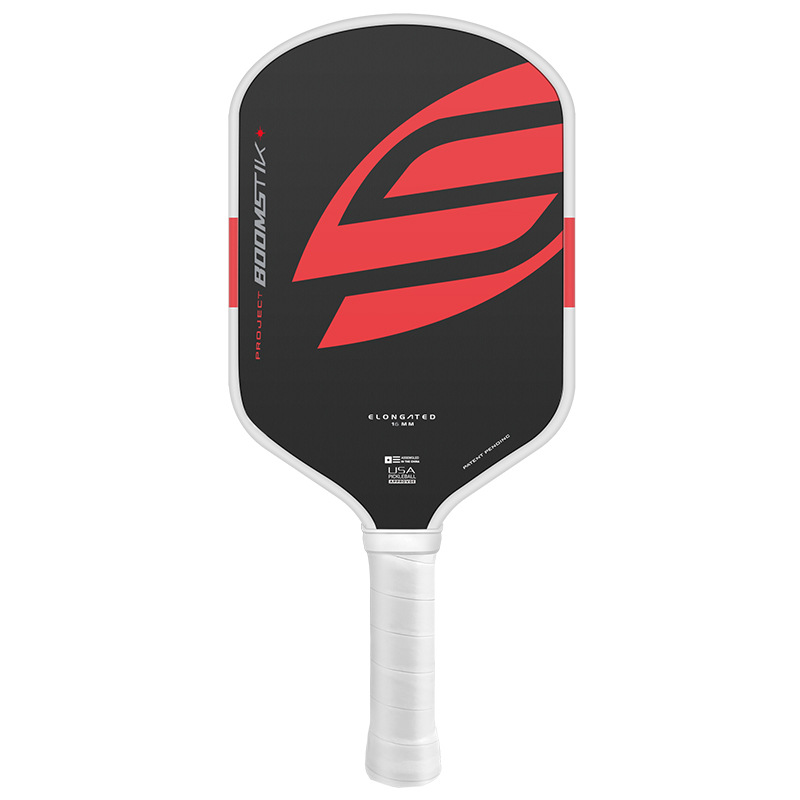
Handle and edge protection
Don’t forget your connection points.
Pickleball Paddle Grip
Sweat and oil can make the grip slippery.
a newMethod: Quickly wipe with a little mild soapy water, then let it air dry. If the grips are already worn, replacing them with a new overgrip is the cheapest upgrade option.
Edge Guard
a loose Regularly check for looseness. If you find a loose edge guard, you can learn more about fixing edge guard wear properly, or apply edge tape for added weight and protection.
When should I get a new racket?
. Even with the best care, pickleball paddles are consumables. Generally speaking, if you play 2-3 times a week, a paddle’s lifespan is about 1-3 years.
racket How to tell if a racquet is “dead”?
- Listen to the sound: the sound of the ball being hit becomes dull.
- Touch the surface: Even after cleaning, the central area still feels very smooth to the touch, with no friction.
- Observe the effect: Your strength is not as good as before, and the ball “drops” very quickly.
If your racket exhibits the above symptoms, it means that its core or surface has suffered permanent wear. At this point, even the best cleaning will be ineffective.
It’s time to upgrade! Check out our latest [Best Value T700 Carbon Fiber Paddles], featuring a more durable USAPA-approved surface that boosts your spin durability by 30%.
FAQ: Frequently Asked Questions
Q1: How often should I clean my pickleball paddle?
A: If it’s a carbon fiber racket, I recommend wiping it with a paddle eraser after each game. For a deep-water wipe, I suggest once a week.
Q2: Does water damage pickleball paddles?
A: Yes. While a small amount of rain is fine, prolonged dampness or water ingress can damage the internal honeycomb structure. Keep it dry!
Q3: Is a pickleball eraser necessary?
A: Absolutely essential for raw carbon fiber rackets. It’s the most effective tool for removing ball residue.

About Jason Simmons
Jason S. Simmons has been obsessively dissecting racket sports equipment for over a decade. After transitioning from competitive tennis to Pickleball in 2020, Jason realized the market was flooded with confusing marketing jargon and overpriced gear.
His Mission: To help players—especially seniors and those recovering from Lateral Epicondylitis (Tennis Elbow)—find the perfect paddle setup that balances power, control, and health.
Why Trust Jason?
- Material Science Geek: He doesn't just play; he analyzes. From the weave patterns of Toray T700 Raw Carbon Fiber to the density of Polypropylene Honeycomb Cores, Jason understands the physics behind the "pop."
- Data-Driven Testing: Jason has play-tested over 50+ models, evaluating them on Swing Weight, Twist Weight, and Dwell Time rather than just subjective "feel."
- On the Court: Based in the US, Jason actively competes in regional 4.5+ level leagues. When he isn't drilling his third-shot drops, he is likely inspecting paddles for Core Crushing or Delamination issues.
Jason believes that "A dead paddle kills your game," and is dedicated to teaching players how to maintain their grit surface for peak performance.
View all posts by Jason Simmons