How to deal with edge wear on pickleball paddles? Expert prevention and repair guide to extend Paddle life.
Quick Navigation
Do you know what a high-performance pickleball paddle means to a player? It’s not just an expensive investment but also an extension of your will on the court.
However, even the best pickleball paddles cannot escape the ravages of time and “accidents” on the field. Among these, edge wear is the number one “invisible killer” that plagues many players.
Many people think that edge wear is just a matter of “looks,” but from a fundamental perspective, the edge guard is actually the paddle’s “exoskeleton” and “weight ring.” Damage to it directly disrupts the paddle’s dynamic balance, causing a sharp drop in hitting performance and even posing safety hazards.
a full-chain solution from prevention to repair to ensure your “ally” always stays in peak condition.
I. Underlying Logic: Why is Edge Guard the “Lifeline” of a Paddle?
Before discussing wear and tear, we need to understand the true role of the edge guard in the construction of pickleball paddles. It’s not just a ring of plastic; it’s the cornerstone of maintaining the paddle’s physical properties.
1. Structural Integrity
- Most modern paddles use a “sandwich structure“: two layers of carbon fiber/glass fiber panels sandwiching a polymer honeycomb core in the middle.
- Logical Explanation: The honeycomb core is extremely resilient to pressure in the vertical direction but very vulnerable in the lateral direction. The edge guard acts like the embankment of a dam, sealing and protecting the fragile inner core. Once the embankment breaches, the core is exposed to moisture and dust, leading to material aging and delamination.
2. Dynamic Equilibrium (Swing Weight Physics)
- Logical analysis: The Edge Guard is located on the outermost ring of the paddle. According to the formula for moment of inertia ($I=mr^2$), the mass farther away from the grip has a greater impact on the swing weight.
- The integrity of the edges ensures the circumferential weighting of the paddle.
- Once the edges wear down and become uneven in mass, the paddle’s center of gravity and twist weight will change, causing the paddle face to feel “floaty” or unstable when you hit the ball.
II. Understanding Edge Wear: From Appearance to Internal Damage
Edge wear is not a single phenomenon; it is classified into three levels based on severity:
Level 1: Surface scratches and dents
- Phenomenon: Scratches or small pits appear on the surface of the guard strip.
- Impact: Primarily an aesthetic issue, but if left untreated, scratches can become stress concentration points, leading to crack propagation.
Level 2: Guard Separation
- Symptoms: Cracks appear in the edge guard, or gaps appear between it and the paddle face.
- The underlying consequence: At this point, the paddle’s airtightness is compromised. The protective strip no longer tightly “holds” the core, and the vibration during impact cannot be effectively suppressed, resulting in a worse feel (vibration increases).
Level 3: Core Exposure
- Phenomenon: The protective strip is missing, and the honeycomb structure or carbon fiber layer inside can be directly seen.
- Underlying consequences: Structural failure. Without protection, the core material will shatter with the slightest impact. At this point, the sweet spot of the paddle will shrink significantly or even disappear due to the lack of edge support.

III. The Culprit: Why Do Your Pickleball Paddles Get Wounded?
1. Missed shots and impact damage
This is the most direct reason. In intense matches, especially when digging or hitting low shots from the baseline, the edge of the paddle rubs against the rough surface (especially on outdoor hard courts) at high speed.
- Physical process: The instantaneous impact force exceeds the yield strength of the protective strip material, resulting in plastic deformation or fracture.
2. Chronic Wear
Even without severe collisions, minor frictions during daily use can accumulate over time.
- Scenario: When picking up a ball, the player habitually uses the paddle to “shovel” the ball or casually throws the paddle on the ground.
3. Material Fatigue
Edge guards are typically made of TPU (thermoplastic polyurethane). Over time, UV rays and oxidation can cause the material to become brittle, lose its elasticity, and become more prone to breaking upon impact.
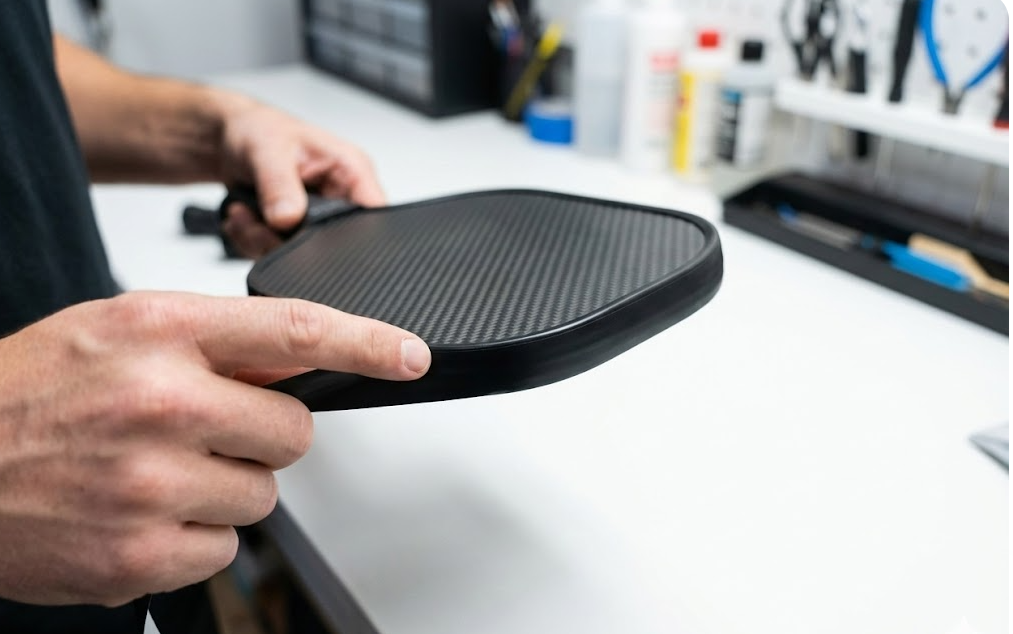
IV. Prevention is better than cure: Expert-level prevention strategies
The essence of “prevention” is risk management. By optimizing habits and physical protection, we can reduce wear and tear by 80%.
1. Technological prevention: Changing the power generation mechanism
- Footwork: Much edge wear stems from “reaching for the ball.” When your footwork is in place, you can calmly sidestep and hit the ball instead of straining your arm to “scoop” it up, thus reducing the probability of your paddle hitting the ground.
- Low ball handling logic: When dealing with a low ball, try to squat down with your knees bent, keeping the paddle head slightly up or parallel to the ground, rather than “shoveling” the ground vertically downwards.
2. Physical prevention: Edge tape
- This is the simplest and most cost-effective solution.
- Principle: A sacrificial layer is applied over the original Edge Guard. All friction is absorbed by the tape; when the tape wears out, it is removed and replaced with a new one, leaving the paddle itself completely undamaged.
- Purchase recommendation: Choose thicker electrical tape or dedicated pickleball edge tape.
3. Prevention at the purchasing level: materials and design
- Integrated design: Choose paddles with an edge guard and a thermoformed paddle face. This structure is stronger and less likely to come off than traditional glued joints.
- Swing weight matching: Choose a swing weight that suits your strength. If you feel the paddle is too heavy and you can’t control it, your swing trajectory will be distorted, and the probability of collisions will naturally increase exponentially.

V. Practical Repair: The “Surgical Operation” on Pickleball Paddles
Don’t panic when wear and tear has already occurred. For mild to moderate damage, we can extend the paddle’s lifespan through DIY repairs.
🛠️ Repair Solution A: Surface treatment for minor abrasion
1. Applicable to situations where there are only surface scratches and the protective strip is not broken.
- Cleaning: Thoroughly clean the worn areas with an alcohol swab to remove oil and dust.
- Polishing: Use 400-grit sandpaper to lightly polish the burrs until smooth. This prevents the burrs from scratching the skin when swinging the paddle and also reduces wind resistance.
🛠️ Repair Option B: Reinforce with edge tape (highly recommended)
1. Applicable situations: When the guard strip has minor cracks or to prevent wear and tear.
- Preparation: Cut the edge protection tape to the appropriate length (it is recommended to leave some slack).
- Adhesion: Start from the center of the paddle head and symmetrically adhere to both sides, ensuring the tape is taut and free of air bubbles.
- Reinforcement: Make a few small V-shaped cuts at the corners to prevent wrinkling.
🛠️ Repair Option C: Epoxy Resin Filling (Advanced Players)
1. Applicable situation: The guard strip has a small gap, but the core is not damaged.
- Mixing: Add a small amount of transparent AB epoxy resin.
- Filling: Use a toothpick to apply resin and carefully fill any cracks or gaps in the protective strip.
- Curing: Let stand for 24 hours to allow it to fully cure.
- Warning: Handle with extreme care. Do not allow resin to flow onto the carbon fiber striking surface, as this will result in a violation (altering the surface roughness).
VI. Decision-making moment: When should we make a decisive change?
Knowing when to repair is important, but knowing when to “let go” is even more crucial. Forcing your hands to use pickleball paddles when they suffer from the following irreversible structural damage can harm your feel for the ball and even lead to tennis elbow.
1. Core Crush/Delamination
- Phenomenon: When you press the surface of the paddle with your hand, there is a “crunching” sound, or the surface of the paddle has obvious soft spots.
- Logic: The adhesive between the core and the panel has failed, or the honeycomb structure has crumbled. The paddle has lost its energy transfer capability and has become an “energy-absorbing black hole.”
2. Severe Edge Guard detachment
- Problem: A large area of the protective strip has fallen off and cannot be glued back on.
- Logic: Without the surrounding weight and edge support, the sweet spot of the paddle will be completely ineffective, and the impact of hitting the ball will be directly transmitted to the arm.
3. Significant performance degradation
- Phenomenon: Even if the appearance is acceptable, there is a feeling of weakness in hitting the ball (dead feel), and the spin cannot be generated.
- Logic: Material fatigue. Like a car suspension that’s run 200,000 kilometers; it hasn’t broken, but it’s lost its elasticity.
VII. Buying Guide: How to Choose a Durable Paddle?
Since wear and tear cannot be completely avoided, we can be smarter in investing in our next paddle:
- Pay attention to materials: look for paddles that use TPU or high-strength PC protective strips, and avoid models that use cheap hard plastic.
- Focus on process: Thermoformed paddles have carbon fiber cloth wrapped around the edges, with the protective strips serving as an auxiliary feature. This structure is several times more durable than traditional “sandwich” glued paddles.
- Pay attention to balance: Pick up the paddle and try swinging it. If you feel it’s “top-heavy” and difficult to control, then there’s a high probability that the paddle will hit the ground in your hand.
Conclusion
In summary: Make your equipment match your skills.
Pickleball paddle is a must-learn skill for every player.
- Prevention is to reduce accidents;
- Repair is to extend lifespan;
- The change is to ensure competitive performance.
By maintaining your paddle scientifically, you can not only save money on replacing it but also ensure that your weapon won’t malfunction at the crucial moment in the game.
Ready to give your paddle a thorough check-up?
[ Click here to see our handpicked selection of “durable” thermoformed pickleball paddles ]

About Jason Simmons
Jason S. Simmons has been obsessively dissecting racket sports equipment for over a decade. After transitioning from competitive tennis to Pickleball in 2020, Jason realized the market was flooded with confusing marketing jargon and overpriced gear.
His Mission: To help players—especially seniors and those recovering from Lateral Epicondylitis (Tennis Elbow)—find the perfect paddle setup that balances power, control, and health.
Why Trust Jason?
- Material Science Geek: He doesn't just play; he analyzes. From the weave patterns of Toray T700 Raw Carbon Fiber to the density of Polypropylene Honeycomb Cores, Jason understands the physics behind the "pop."
- Data-Driven Testing: Jason has play-tested over 50+ models, evaluating them on Swing Weight, Twist Weight, and Dwell Time rather than just subjective "feel."
- On the Court: Based in the US, Jason actively competes in regional 4.5+ level leagues. When he isn't drilling his third-shot drops, he is likely inspecting paddles for Core Crushing or Delamination issues.
Jason believes that "A dead paddle kills your game," and is dedicated to teaching players how to maintain their grit surface for peak performance.
View all posts by Jason Simmons