How to properly clean your Pickleball Paddles? The ultimate guide for professional players.
Quick Navigation
Every pickleball enthusiast knows the importance of a Paddle to a player. It’s not just an extension of your arm on the court, but also a vehicle for your skills, strategies, and even your will to win. However, in conversations with countless players, I’ve found that many often overlook the most basic yet crucial aspect of Pickleball Paddle maintenance— cleaning.
This neglect often comes at a cost. Cleaning is not just about aesthetics; it directly affects your Paddle’s performance, the feel of your shot, and even the lifespan of this expensive piece of equipment.
Improper cleaning (or no cleaning at all) can damage the intricate texture of the Paddle surface, causing you to inexplicably lose spin and control when hitting the ball. Regular, proper cleaning, on the other hand, ensures that your “weapon” is always in peak condition.
In this ultimate guide, I’ll take you deep into the science of cleaning Paddles made of different materials, reveal the “no-go zones” that you absolutely must not touch, and teach you step-by-step how to maintain your equipment like a professional craftsman.
1. Why is “cleanliness” part of the game performance?
your Pickleball Paddles comes into close contact with the ball, sweat, dust, and other fine debris on the court. Over time, these imperceptible residues gradually cover the Paddle’s surface, especially the rough texture designed to provide spin and control.
Don’t underestimate these stains; their destructive power is astonishing.
- A precipitous drop in performance: The friction on the Paddle surface is crucial for generating spin. When the texture becomes clogged with dirt, the Paddle becomes smooth. This means your carefully designed slices may not catch the net, and topspin shots may not land on the baseline. At the same time, a dirty surface alters the micro-feedback of the Paddle when it contacts the ball, reducing your control.
- Shortened lifespan (the invisible killer): Salt from sweat, mineral particles from dust, and the effects of improperly used chemical cleaners can all slowly corrode the surface coating and even the core materials of a Paddle. They accelerate aging and can even cause irreversible structural damage.
- Health and Hygiene: Grips are a breeding ground for bacteria. The accumulation of sweat and bacteria over time not only makes the grip slippery and affects performance, but can also lead to skin hygiene problems.
Expert opinion: Keeping your Pickleball Paddles clean is essentially protecting your investment in the sport. A well-maintained Paddle can last you months or even years longer.
2. Understanding your Paddle surface: an essential step before cleaning.
Before picking up a rag, you must first understand what you are holding. Different surface materials have vastly different “tolerances” to cleaning agents and pressure.
Carbon fiber/graphite Pickleball Paddles
This is currently the mainstream material for high-end Paddles.
- Features: The surface typically has a very fine woven texture or a raw carbon finish, designed to provide ultimate control and spin. They are extremely effective at attracting dust and ball residue (that white powdery coating).
- Cleaning tips: Be gentle! The texture of carbon fiber is very delicate; any scratch from a hard object will cause irreversible wear.
Fiberglass/Composite Pickleball Paddle
- Features: The surface is generally relatively smooth, emphasizing power output (Pop). While it is more durable than carbon fiber, stubborn stains formed on smooth surfaces can sometimes be more difficult to remove.
- Cleaning tips: You can wipe with a little more force, but you should still avoid using sharp tools.
Polymer/Hybrid Material Pickleball Paddles
- Features: Balanced performance and diverse surface treatments.
- Cleaning tips: The core is usually honeycomb-shaped, so waterproofing is key. You must never let water seep into the edges.
In my extensive testing: I found that different materials react drastically to cleaning tools. For example, the fine texture of the T700 carbon fiber Paddle is extremely sensitive to stiff brushes; once damaged, that area becomes a “dead zone.” In contrast, the fiberglass Paddle can withstand gentle physical wiping.
3. Absolutely forbidden: These 4 mistakes will ruin your Pickleball Paddle.
Incorrect cleaning methods are more damaging than no cleaning at all. Here are some of the most common mistakes I’ve seen in these “tragedies”:
❌ 1. Use of irritating chemicals
Never use alcohol, acetone, bleach, or strong degreasers. These strong solvents will directly corrode the resin coating on the Paddle’s surface, damaging the texture and causing a permanent reduction in spin. They may even cause decals on the Paddle’s surface to peel off.
❌ 2. Use abrasive.
Stay away from scouring powders or kitchen cleaners containing abrasive particles. These act like sandpaper, physically smoothing out the texture of the Paddle’s surface. This is devastating for carbon fiber Paddles.
❌ 3. Excessive soaking or direct rinsing.
Although Pickleball Paddles appear sealed, there are always tiny gaps between the Edge Guard and the Paddle face. Prolonged soaking or direct rinsing with a tap/pressure water gun can cause moisture to seep into the internal polymer honeycomb core. Once water gets into the core, it can cause mildew and odor, or even material delamination and deformation, completely ruining the Paddle’s sweet spot.
❌ 4. Using rough tools
Steel wool and hard sponges are absolutely forbidden! They will instantly turn your “spinning weapon” into a smooth cutting board.
I once witnessed a fellow player, out of a love for cleanliness, use a pressure washer to wash his Paddle. The next day, the edge protector on the Paddle was loose, and the sound of hitting the ball became incredibly dull—water had gotten into the core, and hundreds of dollars had been wasted.
4. Step-by-step practical guide: How to clean like an expert?
Follow these professional steps to restore your Pickleball Paddles to its original condition and make it look brand new.
4.1. Daily cleaning (after each use)
This is the simplest, lowest-cost, yet most effective maintenance habit.
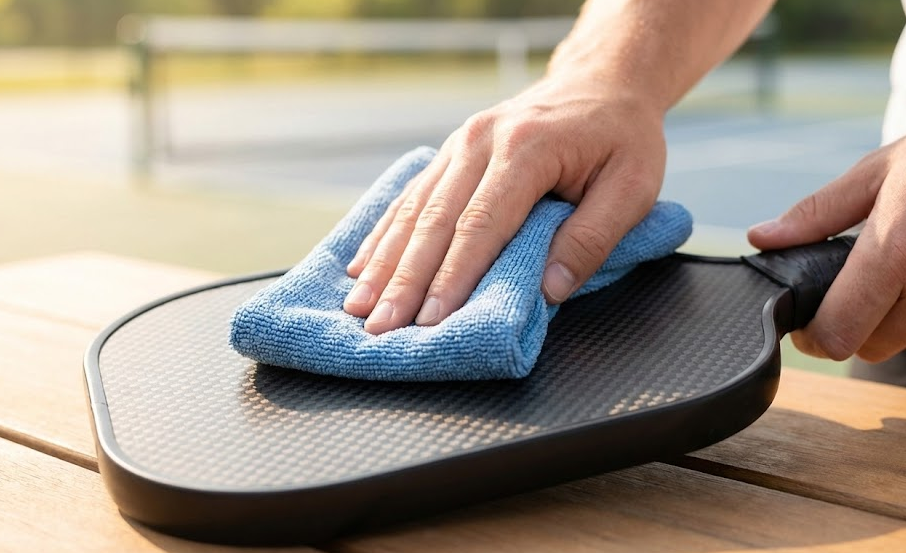
- Tools: A soft, clean microfiber cloth.
- step:
- After each game, don’t just throw your Paddle into your bag.
- Use a dry microfiber cloth to gently wipe the entire Paddle surface to remove dust, ball powder, and sweat.
- Make sure the Pickleball Paddle is dry before putting it in the Paddle cover.
4.2. Deep cleaning (removing stubborn dirt and ball marks)
When daily cleaning is insufficient to remove stubborn stains, or when you feel that the Paddle’s “spin” has decreased, it is recommended to perform a deep cleaning (recommended frequency: once a week).
Required materials:
- Mild soapy water: Mix a few drops of neutral dish soap or baby bath into a small bowl of water.
- Two clean microfiber cloths.
- A soft-bristled brush: an old toothbrush or nail brush will do (the bristles must be soft!).
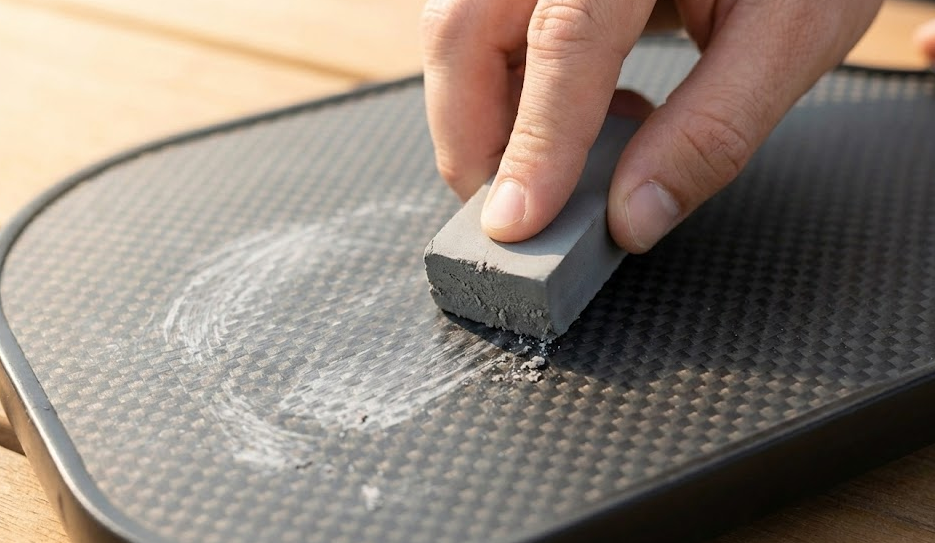
- Carbon Fiber Cleaning Block: I highly recommend this amazing tool, specially designed to remove ball marks.
Cleaning steps:
- Preliminary wiping: Use a slightly damp cloth to wipe away surface dust.
- For textures (key step):
- If you have a cleaning eraser: gently rub the ball marks on the dry Paddle surface, just like erasing pencil marks with an eraser, and you will see the white residue magically disappear.
- If not: Use a soft-bristled brush dipped in a small amount of soapy water to gently scrub along the grain of the grain. This will remove dirt embedded deep within the grain.
- Gentle cleaning: Gently wipe the entire surface with a cloth dampened with soapy water (wrung out until semi-damp, but not dripping wet!).
- Remove residue with water: Use a second cloth dampened with water to thoroughly wipe away all soap residue. Ensure the surface is no longer slippery.
- Thoroughly dry: Pat dry with a clean cloth, then place the Paddle in a cool, well-ventilated area to air dry naturally. Remember: Avoid direct sunlight and do not use hot air, as high temperatures can cause the materials to delaminate.
4.3. Handle Cleaning (Key to Hygiene)
- Tools: a damp cloth and a small amount of mild soapy water.
- Steps: Wipe the handle rubber with a damp cloth. For sweat-absorbing handles, you can gently press to absorb deep-seated dirt.
- Recommendation: Overgrip is a consumable. It’s best to replace it when it wears down, gets dirty, or loses its stickiness. New overgrip will instantly give you the best grip.
5. Maintenance and Storage: The Work Beyond Cleaning
Besides how to wash it, how to store it is equally important.
- Reject the “oven” effect: Never, ever leave your Pickleball Paddle in the trunk of your car for an extended period in the summer! Temperatures inside a car can reach over 60°C, which is enough to soften the adhesive inside the Paddle, causing core collapse or surface delamination. This is the number one cause of Paddle failure.
- Use a paddle cover: This isn’t just for looks. It protects the delicate edge guard from scratches by other items inside the bag and also keeps out dust.
- Proper placement: Hang or lay flat whenever possible. Do not place heavy objects on thePickleball Paddle for extended periods, and do not place it at an angle against a wall for long periods, as this may cause uneven stress and slight deformation.
Proper storage and regular cleaning can significantly extend the lifespan of Pickleball Paddles. I have a Paddle that I’ve used for two years, and thanks to proper care, its sweet spot and surface texture still maintain excellent competitive condition.
6. Expert Insights: When to Clean? When to Replace the Camera?
Understanding the lifecycle of a Paddle can help you make smarter decisions.
Your maintenance schedule
| Action | Frequency |
|---|---|
| Routine cleaning | 1 minute after each game. |
| Deep cleaning | once a week, or the night before a match (10 minutes). |
| Replace the handle rubber | depending on the frequency of playing, usually once every 1-3 weeks. |
This is a signal of “retirement”. No amount of cleaning can reverse physical aging. When the following conditions occur, it’s time to reward yourself with a new Pickleball Paddle:
- The surface is polished to a “smooth” finish: when you touch it with your finger, the original texture disappears, and no matter how much you wipe it, you can’t restore the original texture.
- Sweet spot “death”: The sound of the shot becomes dull (Dead Spot), and the ball doesn’t fly far even though it hits the middle.
- Structural damage: edge guard strips fall off, and visible cracks or dents appear on the Paddle surface.
- Abnormal noise: When shaking the Pickleball Paddle, it sounds like there is sand inside (the core is broken).
7. Conclusion
Price ranges don’t necessarily reflect the quality of Pickleball Paddles, but whether you have a $50 entry-level Pickleball Paddle or a $250 professional Paddle, proper cleaning and maintenance are essential.
By following this guide, you can not only maintain the aesthetics of your Paddle but also extend its lifespan, ensuring it always provides optimal spin, control, and power. A well-maintained Pickleball Paddles will give you more confidence on the court, allowing you to enjoy every precise shot and the joy of victory.
Ready to give your Pickleball Paddle a makeover? Get started now and give your “teammate” a deep spa treatment!
Is your Paddle beyond repair? Check out our latest high-performance Paddle series

About Jason Simmons
Jason S. Simmons has been obsessively dissecting racket sports equipment for over a decade. After transitioning from competitive tennis to Pickleball in 2020, Jason realized the market was flooded with confusing marketing jargon and overpriced gear.
His Mission: To help players—especially seniors and those recovering from Lateral Epicondylitis (Tennis Elbow)—find the perfect paddle setup that balances power, control, and health.
Why Trust Jason?
- Material Science Geek: He doesn't just play; he analyzes. From the weave patterns of Toray T700 Raw Carbon Fiber to the density of Polypropylene Honeycomb Cores, Jason understands the physics behind the "pop."
- Data-Driven Testing: Jason has play-tested over 50+ models, evaluating them on Swing Weight, Twist Weight, and Dwell Time rather than just subjective "feel."
- On the Court: Based in the US, Jason actively competes in regional 4.5+ level leagues. When he isn't drilling his third-shot drops, he is likely inspecting paddles for Core Crushing or Delamination issues.
Jason believes that "A dead paddle kills your game," and is dedicated to teaching players how to maintain their grit surface for peak performance.
View all posts by Jason Simmons