Pickleball Paddles Technology Breakdown: Which Cutting-Edge Technologies Truly Determine Your Ball Handling Skill?
Hey, old friends!
As someone who has been in this industry for many years and has an almost obsessive interest in equipment, I understand all too well the dilemmas people face when making purchases.
Various pickleball paddles on the market are simply dazzling, from “aerospace-grade carbon fiber” to “revolutionary shock-absorbing materials” and various incomprehensible patented technologies. These terms all sound impressive, but in the end, what we really care about is only one thing—that real “ball feel.”
Can it actually help me play better? Can it help me accurately send the ball to the position I want?
Today, I’ll strip away the dazzling marketing hype and take you on an in-depth analysis. We’ll discuss which pickleball paddle technologies truly enhance your feel for the ball and how to find the perfect racket for your playing style from among countless others.
Quick Navigation
I. Say Goodbye to Blind Selection: First, what is the “ball feel” of pickleball paddles?
Before delving into the technology, we must first reach a consensus: when experts talk about how “good” pickleball paddles “feel,” what exactly are they talking about?
“Ball feel” is much more than just the “thud” at the moment of impact. It’s a comprehensive physiological and psychological experience, primarily encompassing the following four dimensions:
- Control: The ability to hit the ball precisely where you intend it to land. Can you accurately hit the ball to the intended landing point?
- Touch accuracy: The clarity of feedback. Can you feel the ball hitting the racket face through the pickleball paddles and accurately judge how much force you applied?
- Power Transfer (Pop/Power): Penetration. Does your shot have enough speed to pressure your opponent without flying out of bounds?
- Vibration Dampening: Comfort. Does the racket transmit the impact vibration to your wrist, or does it effectively “eat” it up?
For intermediate and advanced players like us, the feel provided by pickleball paddles is the cornerstone for optimizing our playing style and improving our strategy. A good racket gives you confidence in crucial moments—whether it’s handling delicate drop shots at the net or powerful drives from the baseline.
II. Core Technologies Unveiled: How Do They Shape Your Shooting Experience?
Pickleball paddles differ primarily in their internal structure and surface materials. These are like the “DNA” of the racket, directly determining its character.
1. Core Material: The “Heart” of the Racket
The “core” of a racket is the fundamental chassis that determines its power, control, and shock absorption performance.
Polymer honeycomb core: This is currently the most common and popular core material on the market. Please remember this name.
Why does it improve the feel of the ball? Its unique feature is its “elasticity.” The honeycomb structure allows the ball to have a longer dwell time when it contacts the pickleball paddle’s face. This gives you even milliseconds of extra time to “wrap” the ball, thus greatly improving control. At the same time, this plastic structure effectively absorbs shock, providing a soft, substantial feel.
️ My practical experience: In my long-term testing, I found that even among brands using the same term, “polymer honeycomb core,” the tuning varies greatly. Some brands’ polymer cores are tuned very softly, making the ball feel “glued” to the racket face when hitting it, which greatly boosts my confidence when handling dinking shots at the net. On the other hand, some pickleball paddles are tuned more firmly, emphasizing rebound speed (pop), making them more suitable for fast-paced flat drives and rallies.
2. Surface Material: The Art of Balancing Control and Power
This is the part where the racket and the ball directly “fight,” which directly determines the spin, power, and control.
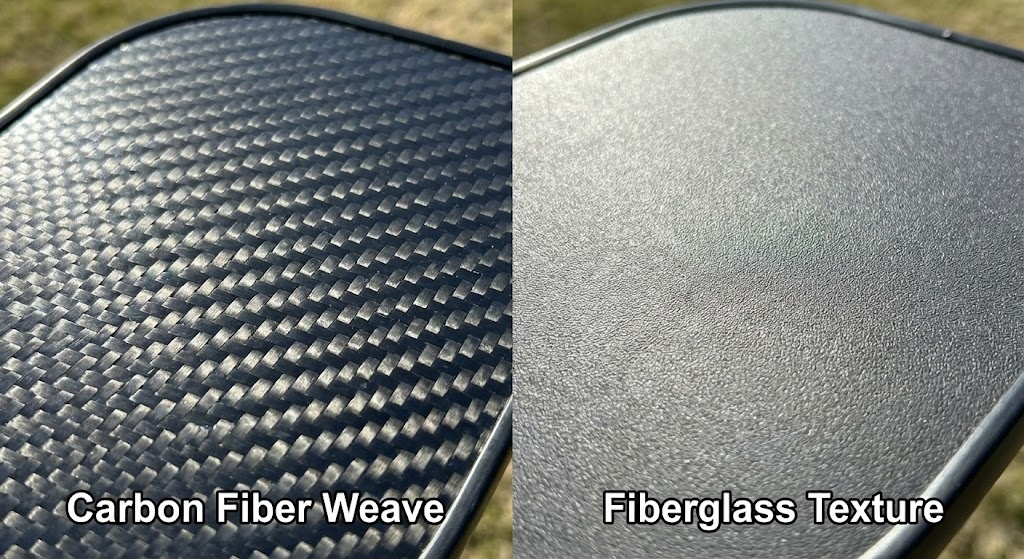
Carbon fiber paddles: If you are a player who values skill, placement, and accuracy, carbon fiber pickleball paddles are definitely the first choice.
- Feel characteristics: high rigidity and clear feedback. It’s as precise as a scalpel, allowing you to generate amazing spin. Advanced players especially love the delicate “grip” feel that carbon fiber provides.
Fiberglass Paddles: Fiberglass is generally more flexible and has a “spring effect.”
- Feel characteristics: High explosive power. When hit, the ball bounces off a trampoline, gaining extra speed (pop). If you are a beginner and find it difficult to generate power, or if you like to smash with force, fiberglass pickleball paddles can help you.
3. Racquet Core Thickness: The Secret to Sweet Spot and Power
Don’t underestimate these few millimeters of difference; they are a direct manifestation of the laws of physics.
- Thicker (16 mm and above): Typically has a larger sweet spot. This means that even if you don’t hit the exact center of the pickleball paddles, the racket provides relatively stable feedback. It’s more “inclusive,” absorbs shock better, and is ideal for players seeking consistency and defense.
- Thinner (13 mm and below): The shot is crisp, the power is transferred more directly, and the ball speed is faster, but it requires a higher degree of precision in the hitting point.
III. Winning Through Details: The “Hidden” Key Parameters That Cannot Be Ignored
Besides the core and surface, there are some seemingly minor parameters that often determine the “last mile” of the pickleball paddle’s feel.
1. Surface Texture: The Magic of Rotation
The roughness of the racket surface is not just for decoration; it is the key factor in determining whether you can generate strong spin.
Grit: Whether it’s the natural texture of raw carbon or the sandblasted coating, the increased friction means a stronger grip on the ball.
- Practical significance: Whether it’s serving, slicing, or topspin, the strong friction allows your pickleball paddles to produce more tricky arcs, causing the ball to drop rapidly after crossing the net.
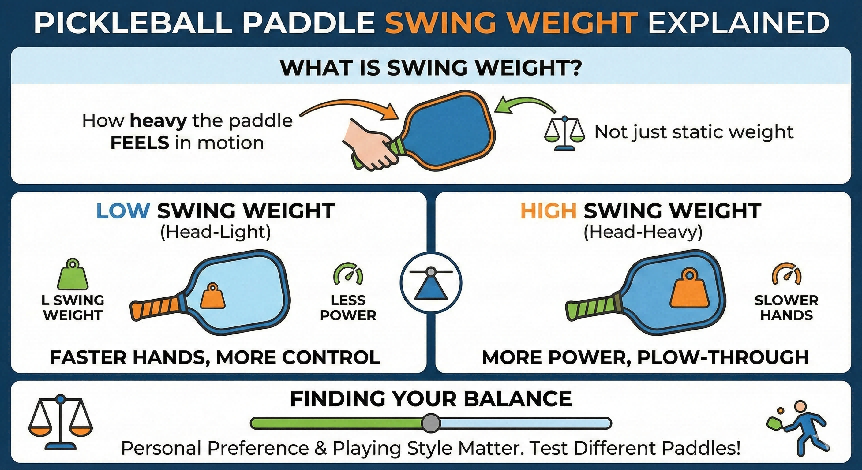
2. Swing Weight: The trade-off between strength and agility
Many people only look at static weight but ignore swing weight. This is a parameter that measures how heavy the racket feels during the swing.
- High swing weight: Like a hammer. It has great inertia, making baseline drives incredibly powerful, but it feels a bit slow when trying to match hand speed at the net.
- Low swing weight: like a dagger. Extremely fast reaction time, perfect for quick volleys and line changes at the net.
️ My practical experience: I recently conducted tests on fast net rallies (hand battles) and deliberately compared light-swing-heavy and heavy-swing-heavy pickleball paddles. The difference is huge: with the light-swing-heavy paddle, I can adjust the racket face angle more quickly to handle those tricky balls bouncing from around my feet. That sense of agility, that feeling of perfect coordination between mind and hand, is something the heavy paddle simply can’t provide.
3. Grip Size: The Foundation of Health
This is the parameter that is most easily overlooked but has the greatest impact on health.
- A grip that’s too big will feel like you’re holding a thick stick, hindering wrist flexibility.
- A grip that is too small will cause you to overuse your forearm muscles to grip the racket, leading to grip fatigue and even tennis elbow.
How to test yourself? When holding pickleball paddles, the tip of your ring finger should just touch the thenar eminence, or your index finger should just fit between your fingertip and palm.
IV. Matching Your Playing Style with Custom Pickleball Paddles
Now that you understand these technologies, the next step is to integrate them into your personal style.
The Precision Artist (Control Player)
- Your style: You pursue the ultimate landing point, like to use Dink balls to move your opponents around at the net, and win by strategy.
- Recommended configuration:
- Surface: Carbon fiber—for a superior tactile experience.
- thickness: 16 mm—Provides a large sweet spot and shock absorption.
- Heavy swing: Light swing, heavy strike—ensure quick reaction time at the net.
The Power Banger
- Your style: You like to hit powerful shots from the baseline, enjoy the thrill of winning with a single shot, and have a strong offensive drive.
- Recommended configuration:
- Surface: Fiberglass—used to generate explosive force during projectile launch.
- thickness: 13 mm/14 mm—more direct power transmission.
- Heavy swing: Higher swing weight—increases the inertia of the shot.
The All-Rounder
- Your style: You aim to find a balance between offense and defense, adapting to various situations.
- Recommended configuration:
- Look for pickleball paddles that combine a carbon fiber surface with a polymer core, or opt for a balanced racket with a medium thickness (14 mm-16 mm) and medium swing weight.
V. Say Goodbye to Price Myths: Choose the Right One, Not the Expensive One
Finally, I want to dispel a major misconception: do more expensive pickleball paddles necessarily have a better feel?
That’s not the case.
We often think of “you get what you pay for,” but in the world of pickleball, the premium often comes from brand advertising costs. Players should choose based on their personal playing style and specific needs for “ball feel,” rather than looking at the price tag.
I’ve tested some mid-range ($50-$100) pickleball paddles, and they’ve surprised me greatly. As long as they use the right materials (like T700 carbon fiber + polymer honeycomb core) and go through a thermoforming process, their feel and feedback are in no way inferior to high-end brands costing $200+. Some brands have achieved a perfect balance between control and power by optimizing core density and surface texture. This proves that value for money doesn’t mean low performance.
Conclusion: Technology empowers us to enjoy life.
Understanding the technology behind Pickleball Paddles isn’t about turning you into a physicist but about helping you make smarter choices and avoid wasting money.
From the core materials to the surface texture, from the swing weight to the grip size, every detail is designed to serve you.
Remember, the best racket isn’t the most expensive, but the one that best suits you.
Are you ready to find that racket that can “read” your mind?
list of high-performance, cost-effective pickleball paddles,carefully selected based on the above technological standards.

About Jason Simmons
Jason S. Simmons has been obsessively dissecting racket sports equipment for over a decade. After transitioning from competitive tennis to Pickleball in 2020, Jason realized the market was flooded with confusing marketing jargon and overpriced gear.
His Mission: To help players—especially seniors and those recovering from Lateral Epicondylitis (Tennis Elbow)—find the perfect paddle setup that balances power, control, and health.
Why Trust Jason?
- Material Science Geek: He doesn't just play; he analyzes. From the weave patterns of Toray T700 Raw Carbon Fiber to the density of Polypropylene Honeycomb Cores, Jason understands the physics behind the "pop."
- Data-Driven Testing: Jason has play-tested over 50+ models, evaluating them on Swing Weight, Twist Weight, and Dwell Time rather than just subjective "feel."
- On the Court: Based in the US, Jason actively competes in regional 4.5+ level leagues. When he isn't drilling his third-shot drops, he is likely inspecting paddles for Core Crushing or Delamination issues.
Jason believes that "A dead paddle kills your game," and is dedicated to teaching players how to maintain their grit surface for peak performance.
View all posts by Jason Simmons