Break free from your plateau: Is your Peak racket holding you back? 3 signs that it’s time for an upgrade.
Hey fellow Pickleball players! Have you ever had this experience: you’re sweating it out on the Pickleball court, feeling like you’ve practiced enough, your serve is stable, and your rallies are pretty good, but when you encounter those “experts,” you’re completely helpless against their spin shots, or you always get worn down by their relentless attacks at the net? You practice your topspin shots and work on unloading the power on your third shot, but you just feel like you’re missing that little something, and your consistency just won’t improve.
Congratulations, you may be in the midst of a “medium-level hell” that many Picklers experience!
Don’t just blame yourself for not practicing enough. If you’re still using that $30 kit you bought on a whim on Amazon, or that old paddle that’s been with you for two years and whose face is worn smooth, then you’re like trying to sprint in flip-flops—it’s not that you’re not trying hard enough, but that your “shoes” are limiting your speed.
As a seasoned Pickleball equipment expert, I (Jason) know this feeling all too well. I’ve found that many players stagnate at level 3.5, often not because they’re not trying hard enough, but because their paddles physically limit them. “Yes, Ben Johns can beat you with a wooden paddle. But you’re not Ben Johns. For us average players, equipment is far more important than we imagine.” Cheap paddles (smooth surfaces, thin cores) physically cannot generate the spin and resets required for level 4.0, becoming your “equipment ceiling.”
It’s time to check your equipment. Here are 3 obvious signs that your Pickleball paddle might be holding you back, and it’s time to consider an upgrade!
Is your paddle holding you back? 3 signs that it’s time to upgrade.
Sign #1: You can’t generate topspin (even with proper technique, the ball doesn’t spin).
The phenomenon: The coach taught you the standard low-to-high brushing motion, and you tried your best to imitate the swing trajectory of professional players, but the ball still flew flat or went directly into the net, lacking that “curve” of rapid descent after clearing the net. You felt like you were using all your strength, but the ball wouldn’t obey your commands.
Reason: Your paddle surface is too smooth. This could be because your paddle wasn’t originally designed with a rough surface (like many beginner paddles), or the “spray-on grit” on the paddle surface has been worn down over time. Without enough friction, the paddle can’t “bite” the ball, and naturally, it can’t convert your swing into effective spin.
4.0 Requirement: To become a 4.0 level player, controlling the ball’s trajectory (Dip) is one of the core skills. Topspin allows the ball to drop rapidly after crossing the net, increasing the depth and threat of your shot, forcing your opponent to retreat or hit the ball from a lower position, thus creating attacking opportunities for you.
The Upgrade: You need a paddle with a rough surface made of T700 Raw Carbon Fiber. This material naturally provides excellent friction, allowing it to grip the ball and precisely convert your swing into powerful topspin.
“In my tests, switching from a smooth paddle face to a T700 Raw Carbon Fiber paddle face made me noticeably feel the difference in the ‘grip’ force between the ball and the paddle face when hitting the ball, making it effortless to generate topspin. This is not just a technical issue, but also a physical limitation.”
Sign #2: Your resets always bounce high (you can’t control soft shots at the net).
The phenomenon: When engaging in close combat at the kitchen line, your opponent hits a powerful shot. You try to reset (block) it with your paddle face, but the ball always bounces high and is either smashed by your opponent or goes out of bounds. You feel like your paddle is a trampoline, unable to absorb the impact.
Reason: Your paddle might be too “bouncy.” This is common in fiberglass paddles, paddles with thinner cores, or paddles with stiffer cores (“dead core”). These paddles are characterized by high power but poor shock absorption. They bounce the ball back like a trampoline instead of absorbing energy, making it difficult to accurately control the ball’s landing point and height.
4.0 Requirement: Soft Game is the key to advancing from 3.5 to 4.0. Precise resets and ball control are crucial, allowing you to control the game through rhythm changes in intense matches and turn your opponent’s powerful shots into scoring opportunities.
The Upgrade: You need a paddle with a 16mm or thicker Polymer Core. This thickness of polymer core effectively absorbs impact, providing a softer, more “wrap-around” feel to the ball. It turns your opponent’s “bullets” into “cotton,” making it easier to gently place the ball at the net and limit your opponent’s attack.
“I used to use a paddle with a very thin core, and I always felt powerless when hitting resets at the net, and the ball would easily fly high. After switching to a paddle with a 16mm thick core, the feeling of ‘the ball being wrapped up’ greatly boosted my confidence in soft ball techniques, and it felt like the paddle had become an extension of my hand.”
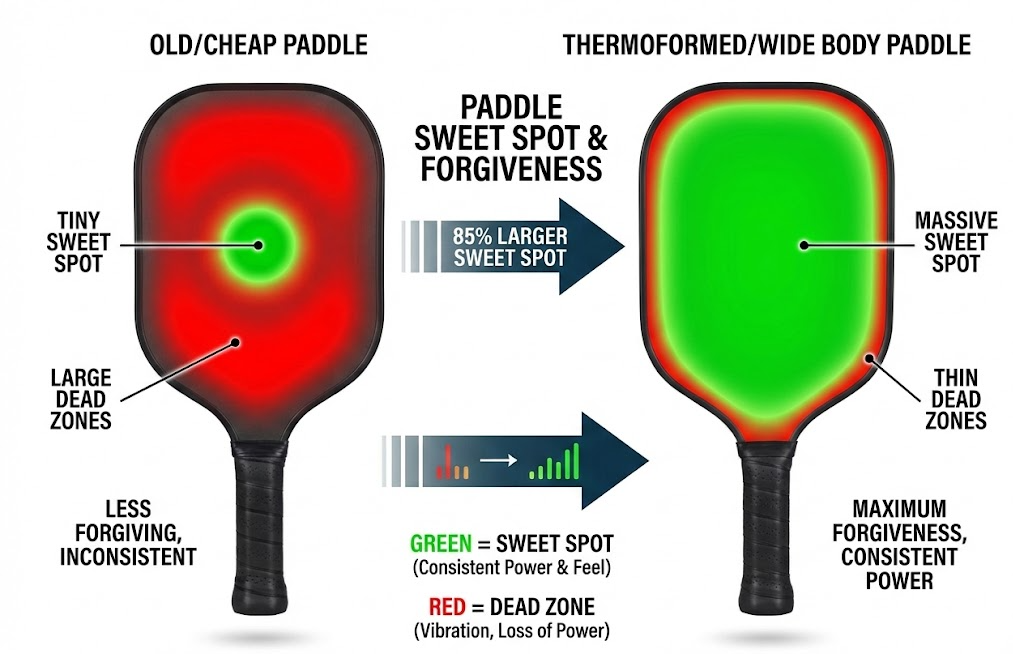
Sign #3: You feel the sweet spot is too small (you make a mistake if it’s slightly off-center).
The phenomenon: During a match, if you slightly miss the center of the paddle face, the ball either goes into the net or flies erratically, making your shots feel very inconsistent. To accommodate the paddle, you have to play cautiously, afraid to exert force, lest you make a mistake if you deviate from the center.
Cause: Cheap or old paddles typically have a small sweet spot and poor consistency. This can be related to the paddle’s structure, material distribution, or manufacturing process. When the point of impact deviates from the sweet spot, the paddle’s feedback is very poor, resulting in a significant reduction in ball speed, direction, and spin.
4.0 Requirement: Consistency is fundamental to improving your win rate. In intense matches, you need a larger, more forgiving sweet spot to maintain accuracy and consistency in your shots, allowing you to hit the ball confidently in all situations.
The Upgrade: You need a paddle with either a Thermoformed or Wide Body design. Thermoformed technology provides a more even feedback across the entire paddle face, offering a larger sweet spot; while a wide body design physically increases the paddle face area, thus expanding the effective hitting zone. Both significantly improve the paddle’s forgiveness, allowing you to maintain shot quality even if the hitting point isn’t perfectly centered.
Jason’s Viewpoint: “In my experience, a wide and forgiving sweet spot significantly improves shot consistency, especially during intense rallies, maintaining shot quality even if the hitting point isn’t perfectly centered. This allows you to focus more on strategy rather than worrying about mis-hitting.”
In-depth understanding: How equipment parameters affect your performance
Upgrading your paddle isn’t just about changing brands; it’s about understanding how different parameters affect your performance on the court.
A. Material composition:
Carbon fiber paddles offer superior control and feel, making them suitable for advanced players or those who prioritize skill and precision.
Fiberglass paddles are generally more suitable for power-based playing styles and are often used by beginners or players who prefer an aggressive style.
Polymer Core: Offers a softer feel and greater flexibility, making it suitable for mid-range paddles that prioritize control.
B. Core Thickness: From 13mm to 16mm or even 19mm
Thin core (below 13mm): usually provides a stronger sense of power and a “hard” feel, but relatively poor control and shock absorption.
Thick core (16mm and above): Provides excellent control, shock absorption and soft feel, and usually has a larger sweet spot, making it more suitable for players who pursue stability and soft ball technique.
C. Swing Weight: The balance between strength and flexibility
Heavier swing weight: provides more power when hitting the ball, but the swing speed is relatively slower, requiring a higher level of reaction time.
Lighter Swing Weight: Facilitates faster reaction and better control, suitable for players who prefer quick wrist movements or focus on defensive counter-attacks.
D. Grip Size: Fits the hand shape and enhances control.
The grip size must match the player’s hand shape. A grip that is too large will affect wrist flexibility and ball control, while a grip that is too small may cause the grip to be too tight, increasing wrist pressure and even affecting the power of the shot.
E. Surface Texture: Improves rotational capabilities
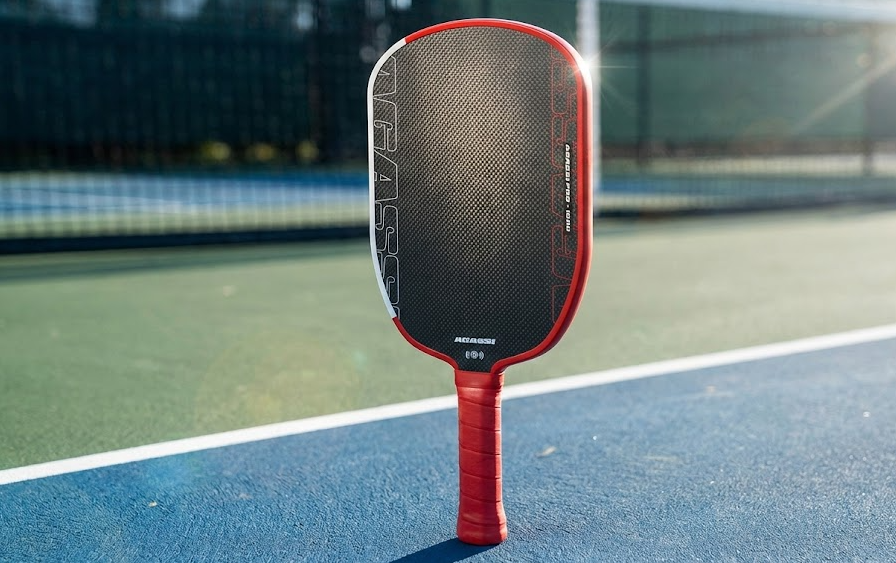
The texture of the paddle surface, such as a matte or rough coating, is key to enhancing the paddle’s spin. For example, the roughness of the T700 Raw Carbon Fiber significantly increases ball friction, making it easier to generate topspin and sidespin.
The “sunk cost” fallacy: It’s time to let go.
You might think, “My paddle is still usable, it’s not broken.” or “This paddle is my first paddle, I have an emotional attachment to it!”
This mentality is normal, but it may be hindering your progress. This is precisely the “sunk cost fallacy” at work—we are often unwilling to give up an option that is no longer suitable for us because of the costs we have already invested (whether financial or emotional).
“Often, it’s not that we lack the ability to improve, but rather that we’re bound by our past investments. Spending $89 on a new paddle that unlocks your potential is far more worthwhile than spending $500 on private lessons to adapt to a bad paddle that physically limits you. Upgrading your equipment is an investment in the future, not a waste of the past.”
Your old paddle isn’t broken, but it’s holding you back. It’s time to put it down and embrace a tool that can take you to the next level.
Your “Graduation Day”: Choose Your Path to Advancement
You’ve graduated from beginner level, and your gear should “graduate” too. The leap from 3.5 to 4.0 isn’t just about skill improvement; it’s a leap forward in the integration of equipment and technique.
Choosing a paddle that suits your current skill level won’t automatically make you better, but it will allow you to develop advanced techniques. It’s a “pay-to-unlock” rather than a “pay-to-win” process.
|
Features/Requirements |
Recommended paddle type |
Suitable player type |
|
Strong rotation, precise control |
T700 Raw Carbon Fiber |
Seeking topspin, delicate ball control, and an increased offensive threat |
|
Excellent stress relief and soft feel |
16mm+ Polymer Core |
Skilled at soft shots/resets at the net, consistent defense, and looking to reduce errors. |
|
Extra-large sweet spot, high tolerance for error |
Thermoformed / Wide Body |
Pursuing consistency in shots, reducing errors, and improving stability |
|
Balance of strength and control |
Medium swing weight, mixed material paddle face |
All-rounder, finding a balance in feel, adaptable to various playing styles |
Ready to break through the 3.5 level barrier? Switch to this paddle designed specifically for advanced players and unlock your full potential. You’ll discover that your technical bottleneck might just be your equipment bottleneck!
Say goodbye to frequent “pop-ups” and start dominating the court!

About Jason Simmons
Jason S. Simmons has been obsessively dissecting racket sports equipment for over a decade. After transitioning from competitive tennis to Pickleball in 2020, Jason realized the market was flooded with confusing marketing jargon and overpriced gear.
His Mission: To help players—especially seniors and those recovering from Lateral Epicondylitis (Tennis Elbow)—find the perfect paddle setup that balances power, control, and health.
Why Trust Jason?
- Material Science Geek: He doesn't just play; he analyzes. From the weave patterns of Toray T700 Raw Carbon Fiber to the density of Polypropylene Honeycomb Cores, Jason understands the physics behind the "pop."
- Data-Driven Testing: Jason has play-tested over 50+ models, evaluating them on Swing Weight, Twist Weight, and Dwell Time rather than just subjective "feel."
- On the Court: Based in the US, Jason actively competes in regional 4.5+ level leagues. When he isn't drilling his third-shot drops, he is likely inspecting paddles for Core Crushing or Delamination issues.
Jason believes that "A dead paddle kills your game," and is dedicated to teaching players how to maintain their grit surface for peak performance.
View all posts by Jason Simmons