Pickleball Paddle “elasticity” trap: Why does excessive pursuit of power lead to repeated “giving away the ball”?
As a pickleball equipment expert, I’ve seen too many players drawn to one word when choosing a paddle—”power.” When I see them pick up a fiberglass paddle, and the ball flies off with a light touch, their eyes gleaming with “Wow, this paddle is so powerful!”, I know they might be walking into a “bouncy” trap. While this instantaneous thrill is certainly tempting, my years of testing experience have shown that once you actually step into the kitchen line, this seemingly “free speed” can very well become your biggest enemy.
Have you ever wondered why you always hit the ball high (pop up) or get smashed by your opponent at the net? You might attribute it to poor technique, but often the problem isn’t with you but rather that you’ve chosen the wrong paddle. Today, let’s delve into the secrets of “elasticity,” “power,” and “control” in pickleball paddles to help you say goodbye to the embarrassment of “giving away points.”
What is “Pop”? A deep dive into the rebound coefficient.
To understand why high-elasticity paddles are a trap for most people, we must first distinguish between the concepts of “pop” and “power.”
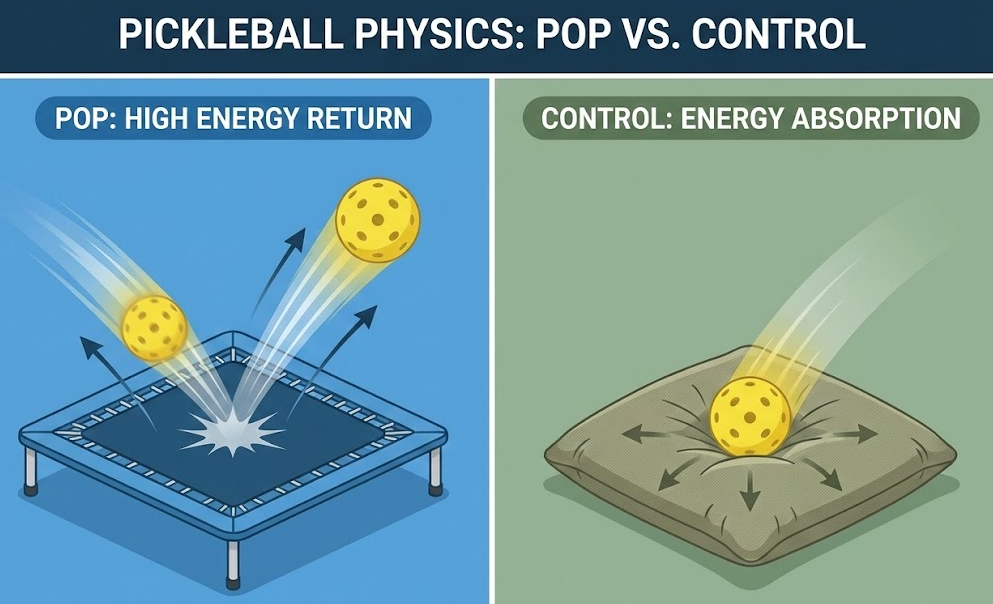
“Pop” refers to the speed at which the ball leaves the paddle face, much like a “trampoline effect.” When the paddle surface is hard or thin, the contact time between the ball and the paddle face is short, and energy is released rapidly, causing the ball to “boom” out instantly.
High Pop Characteristics:
- Imagine a trampoline.
- The ball has a short contact time with the paddle face.
- Results in high ball speed and a powerful rebound.
- Usually associated with a fiberglass paddle face or a thin core of around 13 mm.
“Power”: This refers to the player transferring their power to the ball through the swing, giving the ball penetrating force. A good power paddle should allow you to feel the solid sensation of the ball being “hit” when you hit it, rather than just being “bounced away.”
Low Pop/Control Characteristics:
- Imagine a sandbag.
- Longer contact time between the ball and the paddle face.
- Allows the face to better absorb and contain the ball’s energy, providing better feel and control.
- Typically characteristic of carbon fiber paddle faces or thick cores around 16 mm.
- Polymer honeycomb cores especially offer this containment, enhancing “feel” without sacrificing control.
Why is high elasticity a bad thing for 90% of players?
In my testing and teaching experience, I’ve found that most non-professional players, especially those looking to improve their dink technique, are troubled by high-elasticity paddles.
The Kitchen Nightmare: Dinking’s Fatal Flaw
One of the core strategies in pickleball is dinking. In the kitchen area, you need to gently place the ball into your opponent’s kitchen area without committing a foul, forcing them to move or hit a high ball. This is a delicate skill that requires extreme control and feel.
Pop-up Trap
If your paddle has too much bounce, even if you just want to gently place a dink shot, the paddle face will cause the ball to bounce high due to its high rebound characteristics. This is what we often call a “pop-up.”
The result is disastrous: your opponent doesn’t need any advanced technique; they can simply see your high-flying shot, move forward easily, smash it, and score directly. You might think your technique is lacking, but in my experience, many times, the point you lose isn’t because of poor technique but because your paddle is “too enthusiastic,” lacking the necessary margin for error.
Advantages of control: Dominating the entire situation and turning danger into safety.
So what do we really need? The answer is control. A good control paddle gives you more initiative and a greater margin for error in a match.
Reset Ability: Resolve a crisis
In pickleball, you can’t always be on the offensive. When your opponent launches a fierce attack and smashes the ball to your feet, you need a paddle that can “drain” the force. This type of paddle allows the ball to stay on the paddle face a little longer, “absorbing” some of the ball’s energy, and then gently deflecting the ball back into your opponent’s court, “resetting” the disadvantageous situation.
For example, a 16 mm thick T700 raw carbon fiber paddle, with its polymer core and rough carbon fiber surface, provides excellent shock absorption and friction, allowing you to play with ease even on defense. I’ve personally tested it, and when facing high-speed balls, the control provided by this thick core allows me to more confidently drop the ball short, rather than passively bouncing it high.
Precise Placement: Tactical Master
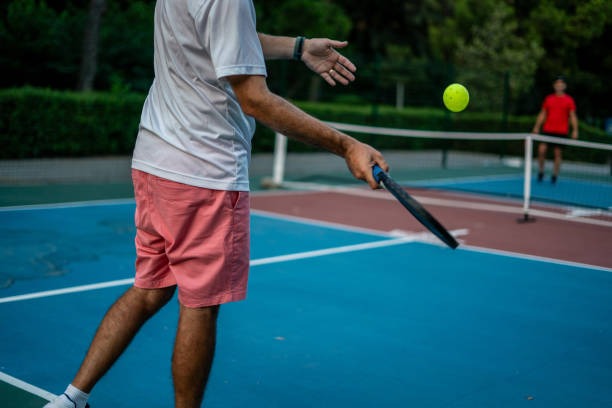
A low-bounce paddle gives you precise control over shot placement. This means you can apply more power to your shots and aim for angles without worrying about the ball going out of bounds. You can execute your tactics with greater confidence, placing the ball in your opponent’s weak areas to create scoring opportunities.
Rule: You bring the power; let the paddle bring the control.
Your body and swing determine how much power you can generate, and the paddle’s mission is to help you use that power precisely and send the ball consistently where you want it to go.
The Golden Rules of Material Selection
Based on my expertise and extensive testing data, here are the golden rules regarding paddle materials:
Material Breakdown:
- Carbon fiber paddles: offer superior control and feel, making them suitable for advanced players or those who prioritize skill and precision. Their surface textures (such as matte or rough coatings) help enhance the paddle’s spin.
- Fiberglass paddles typically offer greater power but less control and a relatively smaller sweet spot. They are often used by beginners or players with an aggressive playing style, but as mentioned earlier, they pose a challenge for net shots that require precise control.
- Polymer honeycomb core: Generally provides a softer feel and better embrace, helping to improve “elasticity” without sacrificing control, making it suitable for mid-range paddles that emphasize control.
Core Thickness and Feel:
- Thicker cores (such as 16 mm): usually have a larger sweet spot, providing better shock absorption and control, suitable for beginners and players who value stability.
- Thinner cores (e.g., 13 mm): faster rebound and stronger feel, but more difficult to control and require a more precise hitting point.
Other Key Factors:
- Swing weight is key to determining the feel of a paddle. A heavier swing weight provides more power, while a lighter swing weight helps with faster reaction and better control.
- Grip Size: It must match the player’s hand size. A grip that is too large will affect control, while a grip that is too small may cause wrist pressure.
- Edge Guard: Key to paddle durability, especially in outdoor matches.
Who is best suited for a high-elasticity paddle?
So, are high-elasticity paddles completely useless? Of course not. It’s just that their suitability for a very limited group of people is extremely limited.
Ideal Candidates for High-Elasticity Paddles:
- Professional players: Only when your touch is incredibly refined and your control over the paddle’s energy reaches a level of perfection can you perfectly harness the explosive power of a high-elasticity paddle and transform it into a deadly offensive weapon. They can maximize the advantages of a high-elasticity paddle through precise force control.
- Players with insufficient power: A very small number of older players or players with specific physical conditions who are very weak and need to use the paddle to hit the ball may benefit from a high-elasticity paddle. However, even for these players, the sacrifice in control that comes with it needs to be weighed.
For most of us ordinary players, what we really need is a margin for error, consistency, and the sense of control to “hold the ball” in crucial moments, rather than uncontrollable explosive power. Blindly pursuing “bouncy” will only make your game unpredictable.
Conclusion and Recommendations: Regain Control of Your Game
If you are struggling with dunking at the net, it’s time to re-evaluate your paddle. Perhaps that trampoline-like fiberglass paddle, or its overly thin core, is unwittingly hindering your technical progress. Price range doesn’t necessarily reflect quality; players should choose paddles based on their individual playing style, not just price.
My advice is to experience that ultimate feeling of control, like the ball is “sucked onto the paddle face.” When the paddle can better “grab” the ball instead of “bounce” it away, you’ll find your dinks become lower and more precise, your defense becomes more solid, and your offense becomes more confident.
Ready to say goodbye to frequent “giving away points” and improve your net play? Upgrade your gear and check out our [16mm Raw Carbon Control Series], renowned for its stability and precision. These paddles are designed for players who crave true control of the game, not just superficial power.
Explore our top picks based on your playing style and find the perfect paddle for you!

About Jason Simmons
Jason S. Simmons has been obsessively dissecting racket sports equipment for over a decade. After transitioning from competitive tennis to Pickleball in 2020, Jason realized the market was flooded with confusing marketing jargon and overpriced gear.
His Mission: To help players—especially seniors and those recovering from Lateral Epicondylitis (Tennis Elbow)—find the perfect paddle setup that balances power, control, and health.
Why Trust Jason?
- Material Science Geek: He doesn't just play; he analyzes. From the weave patterns of Toray T700 Raw Carbon Fiber to the density of Polypropylene Honeycomb Cores, Jason understands the physics behind the "pop."
- Data-Driven Testing: Jason has play-tested over 50+ models, evaluating them on Swing Weight, Twist Weight, and Dwell Time rather than just subjective "feel."
- On the Court: Based in the US, Jason actively competes in regional 4.5+ level leagues. When he isn't drilling his third-shot drops, he is likely inspecting paddles for Core Crushing or Delamination issues.
Jason believes that "A dead paddle kills your game," and is dedicated to teaching players how to maintain their grit surface for peak performance.
View all posts by Jason Simmons